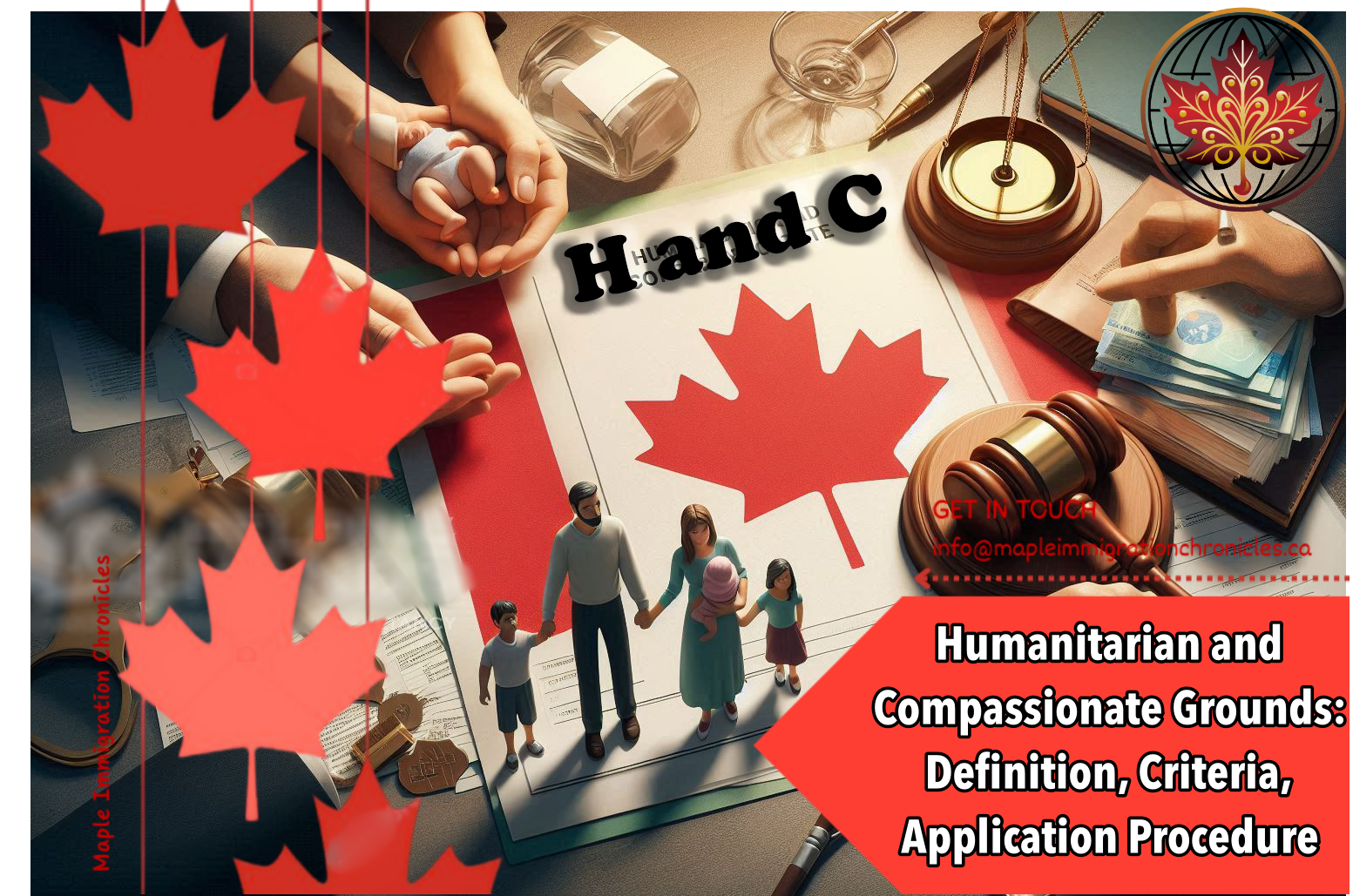
Humanitarian and Compassionate Grounds (H&C) represent an exceptional mechanism provided under Canadian immigration law, which allows individuals who do not meet the formal criteria for obtaining permanent resident status to submit an application for PR based on extraordinary humanitarian or compelling circumstances. This request is reviewed under section 25 of the Immigration and Refugee Protection Act (IRPA).
This material outlines the legal nature of this mechanism, the key factors influencing the case assessment, the step-by-step procedure for submitting an application, and critical considerations applicants must keep in mind.
1. What is H&C and when does it apply?
H&C is not an immigration program in the conventional sense but a special procedure that enables foreign nationals to obtain permanent residency even if they do not meet the standard criteria (education, work experience, language, authorization to work, etc.). The applicant must convincingly demonstrate that a refusal would result in undue hardship, unfairness, or go against the best interests of a child.
2. Example of a typical H&C case
In a case where a mother of three children lived in Canada for more than 10 years without status, the key factor became the evaluation of the Best Interests of the Children. The children were born and raised in Canada, fully integrated into society. Their deportation with their mother to a country they had never been to and with which they had no connection would be considered a serious violation of their rights. Even in the absence of danger in the country of origin, the officer ruled in favor of the applicant, considering the humanitarian circumstances and the welfare of the children.
3. Main positive and negative factors
Positive factors supporting application approval:
- Residing in Canada with children, especially if they are integrated into the school system and society.
- Serious medical conditions that cannot be effectively treated in the country of origin.
- Absence of relatives or support in the country of origin, especially if the territory is occupied or dangerous.
- Inability to provide for oneself and family due to objective reasons.
- Unique life circumstances that significantly differ from common situations faced by others.
Negative factors:
- Recent arrival in Canada (less than a year).
- Young age of the applicant (under 30) or advanced age (over 55) without additional complicating factors.
- Availability of realistic pathways to apply for PR through other immigration programs.
- Absence of evidence of hardship or integration efforts.
4. Categories of typical H&C cases
Immigration consultants conditionally divide H&C cases into three groups:
- Truly unique and exceptional cases — high chance of approval (up to 90%).
- Cases with strong but general arguments — moderate success probability (approximately 50–75%).
- Cases lacking convincing grounds and based solely on the desire to bypass regular immigration channels — low chance of success (up to 15%).
5. Steps to submit an H&C application
Step 1. Preparation
It is necessary to assess whether the H&C procedure is appropriate in your situation and consult with a specialist.
Step 2. Document package preparation
- IMM 0008 (Application for Permanent Residence)
- IMM 5283 (Humanitarian and Compassionate Considerations)
- Identification documents (passport, birth certificates, marriage documents)
- Evidence of exceptional circumstances (medical records, support letters)
- Financial documents (bank statements, proof of income)
- Proof of integration (certificates, community or volunteer participation)
Step 3. Cover letter
The application must be thoroughly prepared and legally justified. It is important to clearly explain your circumstances, difficulties, and the consequences of potential removal.
Step 4. Fee payment
The processing fee must be paid. In case of financial hardship, a fee waiver request may be submitted.
Step 5. Submit the application
The completed package must be mailed to the appropriate IRCC office. It is important to follow current instructions regarding forms and addresses.
Step 6. Wait for a decision
Processing can take up to 24 months. The applicant has the right to remain in Canada until a final decision is made.
Step 7. Respond to IRCC requests
IRCC may request additional documents. Delays in response can negatively affect the application outcome.
6. Key considerations
- Presence of children and their well-being — one of the strongest supporting factors.
- Integration into Canadian society — community involvement, education, volunteer work.
- Physical or psychological health — documented health issues and lack of treatment in the home country.
- Proof of impossibility to apply via other immigration programs — especially when legal or humanitarian obstacles exist.
Conclusion
Submitting an application on Humanitarian and Compassionate grounds is a complex, lengthy process that requires thorough preparation. Success largely depends on the quality of evidence, strength of arguments, and the applicant’s ability to demonstrate the uniqueness and validity of their situation. Each case is assessed individually, and the decision is made based on the discretionary powers of the immigration officer.
In case of doubts about eligibility, it is strongly recommended to seek professional legal advice.