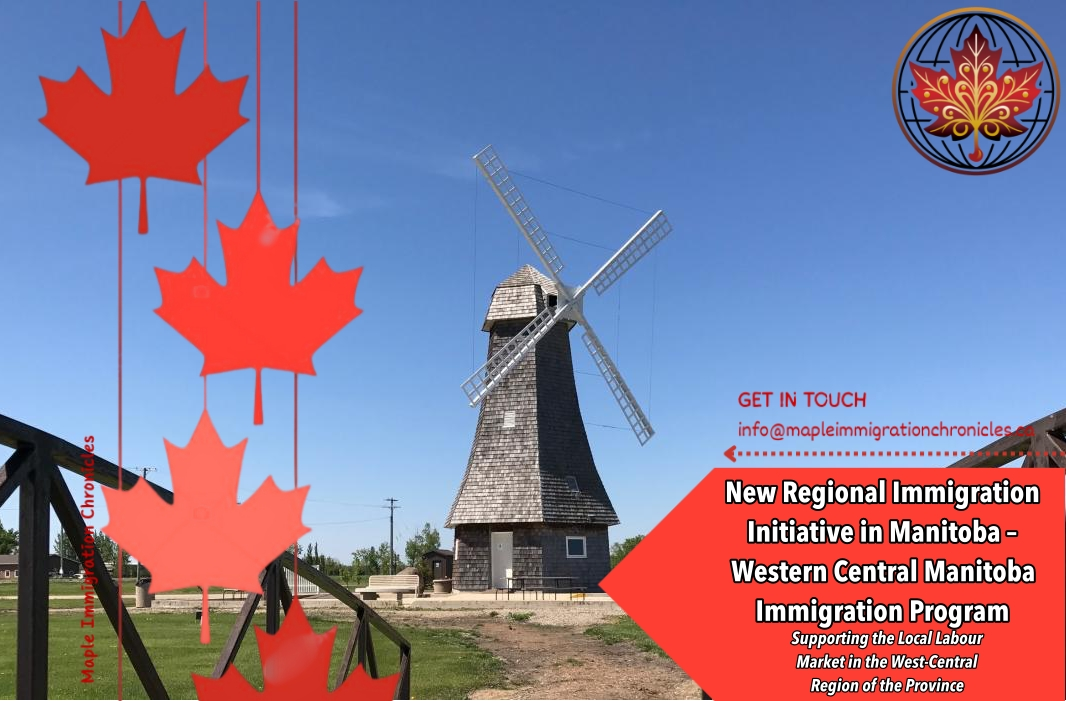
In response to a persistent labour shortage in rural communities, the Government of Manitoba has launched a three-year pilot program — the West-Central Immigration Initiative. The program aims to provide local employers with access to new immigration mechanisms to attract skilled foreign workers. The primary goal is to stimulate economic development, support community viability, and strengthen population growth in the west-central part of the province.
This initiative is part of the province’s broader strategy to support regional immigration by addressing employment, mobility, and infrastructure capacity in small population centres.
Targeted Communities
The program covers seven rural municipalities and one Indigenous community, namely:
- Municipality of Russell-Binscarth
- RM of Yellowhead
- Municipality of Roblin
- RM of Ellice-Archie
- RM of Riding Mountain West
- Rossburn Municipality
- Prairie View Municipality
- Gambler First Nation
These communities are located in Manitoba’s west-central region, an area with potential for growth in agriculture, manufacturing, and service industries, but limited access to workforce.
Rationale for the Program
A survey of 85 local employers indicated that over the next three years, there will be a need for between 240 and 300 workers. This demand arises from business expansion, the creation of new jobs, and the need to fill existing vacancies. The situation is further complicated by the fact that the local labour market cannot fully meet this internal demand due to the limited availability of suitable candidates.
Context of Provincial Immigration Policy
Manitoba’s Minister of Immigration, Malaya Marcelino, noted that an increasing number of provincial nominees (under MPNP) are choosing rural areas as their place of residence. In 2012, only 16.2% of nominees settled in non-urban regions, whereas in 2023, this figure rose to 25%.
This trend highlights the effectiveness of Manitoba’s decentralization strategy, supported by previous successful initiatives in Winkler-Stanley, Morden, and Parkland, where businesses saw measurable benefits from newcomer arrivals.
Challenges and the Justification for Regional Approach
Currently, immigration to Canada faces systemic difficulties, including:
- Increased federal restrictions and quotas
- Higher financial sustainability requirements for applicants
- Longer application processing times
- More complex procedural and screening stages
In this context, participation in regional immigration programs, such as the West-Central Manitoba initiative, becomes a viable alternative for candidates seeking stable employment, simplified processes, and residence in a less competitive environment.
Conclusion
The launch of the West-Central Immigration Initiative is a strategic step by the Government of Manitoba to sustainably address labour shortages in rural regions. The combination of employer demand, community readiness, and provincial policy coordination forms a strong foundation for integrating newcomers into Manitoba’s economy.
Given the province’s prior success with similar programs, this initiative is well-positioned to evolve into a stable and long-term immigration channel beyond 2027.
Additional Resources:
- Official page: Western Central Manitoba Immigration Program
- Labour Market Report: List of in-demand occupations in Manitoba’s west-central region
Wishing you success in immigration planning and execution!