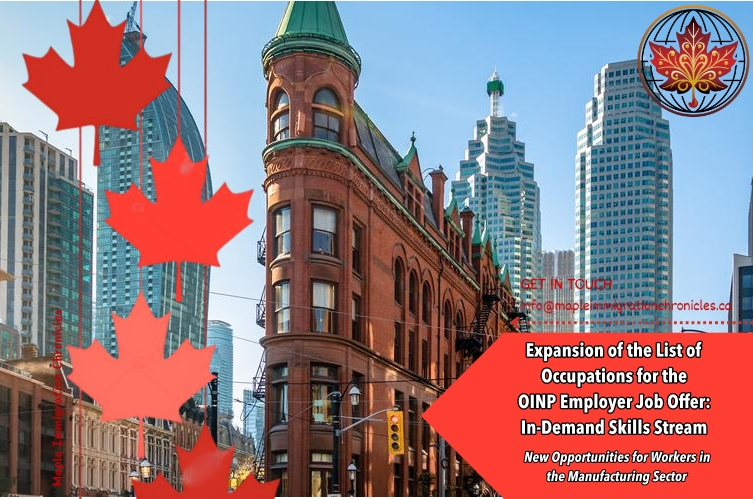
The Government of Ontario continues to adapt its immigration policy to the current needs of the labor market by making targeted changes to provincial immigration programs. One of the most recent steps was the update of the list of occupations under the OINP Employer Job Offer: In-Demand Skills stream, which allows for the nomination of candidates with experience in high-demand fields for permanent residency.
This stream focuses on attracting foreign workers to occupations where there is a chronic shortage of labor, especially in industries that ensure continuity of production and infrastructure development. In June 2025, Ontario added new National Occupation Classification (NOC 2021) codes to the list, expanding the range of occupations that can be supported under this immigration program.
The offered position may be located in any municipality in Ontario (both inside and outside the Greater Toronto Area) and must belong to one of the following occupations classified under NOC TEER category 4 or 5:
| NOC Code | Occupation Title (translated) |
| 44101 | Home support workers, caregivers and related occupations |
| 65202 | Meat cutters and fishmongers — retail and wholesale |
| 75110 | Construction trades helpers and labourers |
| 75119 | Other trades helpers and labourers |
| 84120 | Specialized livestock workers and farm machinery operators |
| 85100 | Livestock labourers |
| 85101 | Harvesting labourers |
| 85103 | Nursery and greenhouse labourers |
| 94141 | Industrial butchers and meat cutters, poultry preparers and related workers |
The offered position must be located outside the Greater Toronto Area (City of Toronto, and the regions of Durham, Halton, York, and Peel) and must be in one of the following occupations classified under NOC TEER category 4 or 5:
| NOC Code | Occupation Title (translated) |
| 14400 | Shippers and receivers |
| 14402 | Production logistics workers |
| 65320 | Dry cleaning, laundry and related occupations |
| 74200 | Railway yard and track maintenance workers |
| 74203 | Automotive and heavy truck and equipment parts installers and servicers |
| 74204 | Utility maintenance workers |
| 74205 | Public works maintenance equipment operators and related workers |
| 75101 | Material handlers |
| 75211 | Railway and motor transport labourers |
| 75212 | Public works and maintenance labourers |
| 85102 | Aquaculture and marine harvest labourers |
| 94100 | Machine operators, mineral and metal processing |
| 94101 | Foundry workers |
| 94102 | Glass forming and finishing machine operators and glass cutters |
| 94103 | Concrete, clay and stone forming machine operators |
| 94104 | Inspectors and testers, mineral and metal processing |
| 94105 | Metalworking and forging machine operators |
| 94106 | Machining tool operators |
| 94107 | Machine operators of other metal products |
| 94110 | Chemical plant machine operators |
| 94111 | Plastics processing machine operators |
| 94112 | Rubber processing machine operators and related workers |
| 94120 | Sawmill machine operators |
| 94121 | Pulp mill, papermaking and finishing machine operators |
| 94123 | Lumber graders and other wood processing inspectors and graders |
| 94124 | Woodworking machine operators |
| 94132 | Industrial sewing machine operators |
| 94140 | Process control and machine operators, food and beverage processing |
| 94142 | Fish and seafood plant workers |
| 94143 | Testers and graders, food and beverage processing |
| 94200 | Motor vehicle assemblers, inspectors and testers |
| 94201 | Electronics assemblers, fabricators, inspectors and testers |
| 94202 | Assemblers and inspectors, electrical appliance, apparatus and equipment manufacturing |
| 94203 | Assemblers, fabricators and inspectors, industrial electrical motors and transformers |
| 94204 | Mechanical assemblers and inspectors |
| 94205 | Machine operators and inspectors, electrical apparatus manufacturing |
| 94211 | Assemblers and inspectors of other wood products |
| 94212 | Plastic products assemblers, finishers and inspectors |
| 94213 | Industrial painters, coaters and metal finishing process operators |
| 94219 | Other products assemblers, finishers and inspectors |
| 95100 | Labourers in mineral and metal processing |
| 95101 | Labourers in metal fabrication |
| 95102 | Labourers in chemical products processing and utilities |
| 95103 | Labourers in wood, pulp and paper processing |
| 95104 | Labourers in rubber and plastic products manufacturing |
| 95106 | Labourers in food and beverage processing |
| 95107 | Labourers in fish and seafood processing |
All listed occupations fall under TEER 4 and 5, which do not require a university degree but do require technical training and hands-on experience. The program targets candidates who already have a valid job offer from an Ontario employer for an eligible occupation and who meet the basic requirements of provincial immigration.
Purpose of the Update
The expansion of the eligible occupation list has strategic importance for maintaining the productivity of Ontario’s key economic sectors. In particular, it aims to:
- Address labour shortages in essential production and service chains;
- Support the development of the regional economy, especially in areas outside the Greater Toronto Area (GTA), where the need for technical workers is most acute;
- Attract foreign specialists with practical experience who are ready to integrate into the province’s economy through lawful employment.
These changes also consider demographic and infrastructure challenges — growing demand for housing, transportation, food security — and highlight the important role of manufacturing occupations in ensuring the resilience and self-sufficiency of Ontario’s regions.
Conclusion
The updated list of in-demand occupations under the OINP In-Demand Skills Stream is another step toward increasing the flexibility of Ontario’s provincial immigration system. The addition of new NOC codes reflects the government’s commitment to aligning immigration tools with the actual needs of employers and the overall economy.
This opens real opportunities for qualified foreign workers to legalize their stay in Canada and secure stable employment in strategic sectors. These measures are expected to support Ontario’s sustainable economic development, improve regional workforce distribution, and increase investment in areas with high demand for industrial labour.