
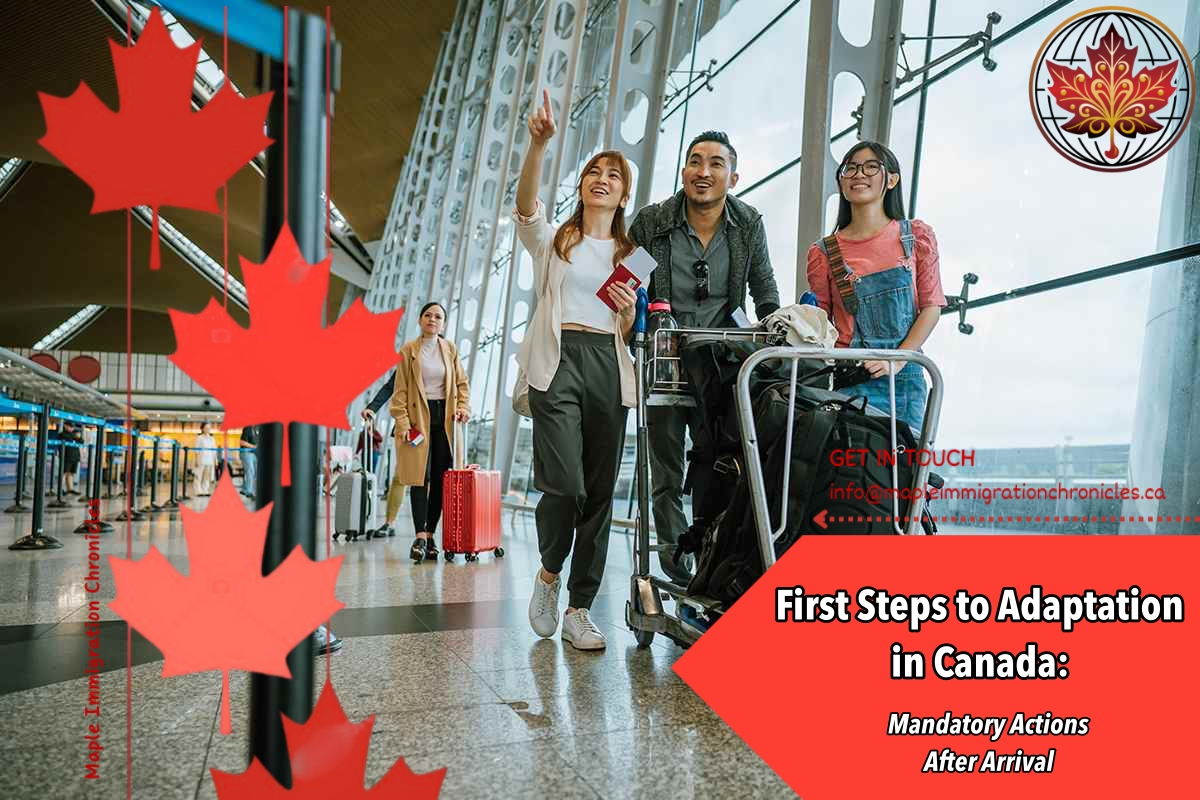
Adapting to a new country requires a clear understanding of essential procedures that must be completed immediately after entering Canada. For newcomers and temporary residents, following these organizational steps is crucial for legal employment, access to public services, health care, and stable living arrangements.
Below is a list of key actions to take in the first days and weeks after arrival, with practical recommendations for their completion.
Status Documents: PR Card or Temporary Residence Permit
- Permanent Residents (PR):
After crossing the border, your PR card will be automatically produced and sent by mail to the provided address. The average delivery timeframe is 45 to 60 days. It is important to verify your contact information to avoid delays or loss of documents. - Temporary Residents (Work/Study Permit):
Work or study permits for temporary residents (under the relevant visa) are issued immediately upon arrival in Canada. Keep copies of the permit for future use.
Obtaining SIN (Social Insurance Number)
Your SIN is a unique social insurance number required for:
- Employment.
- Access to government services, including taxation and social benefits.
You can apply for a SIN in person at the nearest Service Canada office. You will need to present documents confirming your status (passport, visa, PR card, or work/study permit).
Health Insurance
The health care system in Canada is administered at the provincial level, so registration procedures vary depending on the province or territory.
- Register for health care coverage as soon as possible after arrival.
- Some provinces have a waiting period of up to 3 months, during which public health insurance does not apply.
It is strongly recommended to purchase temporary private health insurance for this period to ensure access to medical services if needed.
Opening a Bank Account
A bank account is necessary for:
- Receiving salary payments.
- Conducting financial transactions.
- Accessing other services (such as establishing a credit history).
Most Canadian banks offer special programs for newcomers, including:
- Account opening without proof of income.
- Preferential terms for banking services during the first few months.
- Access to debit and credit cards.
Compare offers from major banks, such as RBC, TD, Scotiabank, BMO, and CIBC.
Finding Accommodation
- Initially, it is advisable to book temporary accommodation via hotels, apartments, or short-term rental platforms (such as Airbnb).
- Upon arrival, begin searching for long-term housing, taking into account:
- Safety of the neighborhood.
- Access to public transportation.
- Rental costs and utilities.
- Proximity to schools or your workplace.
Note: A credit history is often required for long-term rental agreements. If you do not have one yet, additional guarantees or a larger security deposit may be needed.
Language Courses and Integration Programs
Most newcomers are eligible for free language courses through LINC (Language Instruction for Newcomers to Canada).
This is an excellent opportunity to:
- Improve your English or French language skills.
- Understand Canadian cultural norms and social systems.
- Enhance your competitiveness in the job market.
Additionally, free social integration programs, workshops, and legal consultations are available.
Community Resources and Organizations for Immigrants
Numerous community centers and immigrant support organizations offer assistance with:
- Job search and resume writing.
- Enrollment in educational institutions.
- Understanding your rights and obligations as a newcomer.
- Adaptation and community involvement.
You are encouraged to seek assistance — most services are government-funded and free for newcomers.
Education: Enrolling Children in School
- School attendance is mandatory for children aged 5 or 6 and older, depending on the province.
- Upon arrival, contact your local school board to register your child for school.
- The education system varies by province, so familiarize yourself with the school program and enrollment requirements in your area.
Mobile and Internet Connectivity
To integrate fully into daily life, you need to:
- Connect to a mobile phone provider from major companies (such as Rogers, Bell, Telus, Fido, Freedom Mobile).
- Choose a home Internet provider, considering:
- Network coverage in your area.
- Internet speed and data limits.
- Connection and monthly service costs.
It is advisable to compare rates from different companies to find the most favorable option.
Conclusions
Completing these essential steps forms the foundation for successful adaptation in Canada. Having proper documentation, access to financial services, health insurance, housing, and language support enables newcomers to integrate faster, avoid everyday challenges, and confidently build a new life in Canada.