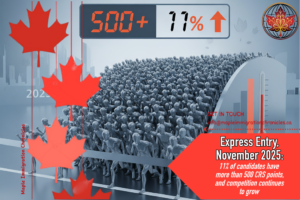

The Canadian Express Entry system, introduced back in 2015 as an innovative tool for selecting economic immigrants, in 2025 functions under conditions of unprecedented pressure. The latest general draws demonstrate record-high cut-off scores, exceeding 525–530 CRS. This means that even candidates with excellent profiles, including Canadian experience, a high level of education and language proficiency, have found themselves in a situation where obtaining an Invitation to Apply (ITA) is unpredictable.
An important precondition for this was the combination of several systemic factors: political restrictions, IRCC priorities, unevenness in the number of invitations, seasonal inflow of new profiles, and a shift of balance in favor of category-based draws. Understanding these reasons is the key to developing the correct strategy by each candidate.
Factors that determine the cut-off level
Number of invitations in a draw
In the Express Entry system, the key parameter that directly determines the level of competition and CRS thresholds is the number of Invitations to Apply (ITA) for permanent residence issued in each draw.
Regulatory logic of the system:
- Immigration, Refugees and Citizenship Canada (IRCC) annually sets the overall ITA quota within the Immigration Levels Plan.
- This quota is further distributed among individual draws held throughout the year.
In previous years, the number of ITAs per draw ranged from 3,000 to 7,000, which ensured a relatively predictable cut-off level. In 2025 the situation changed: despite high demand and growth in the number of profiles in the pool, the number of ITAs is in many cases lower than expected, creating additional competition.
Legal and administrative logic is simple:
- A larger number of ITAs in a given draw → a wider range of candidates receive invitations → cut-off decreases.
- A smaller number of ITAs → competition intensifies, only the strongest profiles are invited → CRS rises.
Of particular importance is the impact of category-based draws. Since 2023 IRCC has allocated a significant part of the ITA quota specifically to target categories — francophone candidates and specialists in designated professions (healthcare, IT, construction, transport, etc.). This means that general draws receive reduced quotas, which automatically raises the CRS cut-off in such draws.
Thus, the number of ITAs in each draw is not merely a technical parameter. It is a regulatory instrument through which IRCC manages the structure of flows:
- directs part of immigration spaces to priority categories;
- restrains growth of the overall number of applicants;
- but at the same time creates a situation where even candidates with more than 500 CRS points are forced to wait due to limited quotas in general draws.
Number of new profiles
Each year the Express Entry system is replenished with an approximately stable number of new applicants, but this process has clearly expressed seasonal peaks that significantly affect pool dynamics.
The most noticeable waves of inflow of new profiles fall on two key periods:
- May–June each year.
At this time thousands of international students graduate from Canadian colleges and universities. They immediately become eligible to create a profile in Express Entry (both under the Federal Skilled Worker and, prospectively, under the Canadian Experience Class). Even without a year of Canadian work experience, they can already obtain a sufficient number of points for education, language proficiency, and age. This leads to a noticeable “explosion” of new registrations in the pool. - One year after graduation — the second wave.
The same graduates who used the Post-Graduation Work Permit (PGWP) after a year gain Canadian work experience. This gives them additional points under the Canadian Experience Class (CEC). As a result, the same profiles already in the system receive a significant CRS increase and move into higher score ranges, intensifying competition with candidates applying under FSW or other economic programs.
Although this factor is considered less influential than frequency of draws or number of ITAs, its importance lies in creating local “waves of competition.” The segment most affected is 450–500 CRS, as it is precisely in this range that graduates who have just added Canadian experience points or created new profiles after study are concentrated.
From a legal-analytical perspective, this process underscores structural inequality between candidates with internal Canadian experience and those applying from abroad. The former receive an advantage due to extra points under CEC, while the latter are forced to compete in the mid-high segment, where competition intensifies during seasonal peaks.
Thus, the number of new profiles is not merely a statistical indicator. It is a dynamic factor that determines the level of competition in the 450–500 CRS range and often decides whether a candidate will receive an invitation in upcoming general draws or be “pushed down” in chances under pressure of new waves of applicants.
Frequency of draws
Before the COVID-19 pandemic the Express Entry system functioned in a predictable rhythm: draws were held every two weeks, on average 23–25 times a year. This regularity created relative stability: candidates could forecast approximate timing of the next draw and calculate their chances in accordance with the current distribution of profiles in the pool.
After the pandemic the situation changed fundamentally. Draws became irregular: instead of a uniform schedule, long breaks of 4–6 weeks or more appeared. This led to a cumulative effect:
- every day the system is replenished with a significant number of new profiles, including high-scoring candidates with Canadian experience, high education and strong language scores;
- during the break the pool gradually becomes saturated with profiles over 500 CRS waiting for the next draw;
- when the draw is finally held, competition is significantly sharper, and the cut-off automatically rises.
Thus, irregularity of draws became a structural reason why even candidates with scores over 500 CRS cannot be confident of quick ITA. From a legal-analytical point of view this shows imbalance between political management of quotas and real accumulation processes in the pool.
Moreover, absence of a stable schedule negatively affects predictability of the system, which is one of the foundations of proper administrative process. Candidates are forced into uncertainty, complicating planning both for themselves and for employers and provincial programs, which often synchronize their nominations with federal draws.
Types of draws
Since June 2023 the Express Entry system underwent structural transformation that radically changed the balance between groups of candidates. If earlier the main mechanism remained general draws, today the structure includes three separate formats, each with its own logic and consequences:
- General draws.
This is the classic format covering all candidates in the pool regardless of profession or language. The highest competition occurs here, as the number of applicants in the 480–600 range constantly grows. Any reduction in ITAs here automatically raises the CRS cut-off. - Category-based draws.
Since 2023 IRCC has prioritized specific groups:
- francophone candidates (to support francophone communities outside Quebec);
- professional categories deemed strategic:
• Healthcare,
• STEM,
• Skilled Trades,
• Transport,
• Agriculture and Agri-Food,
• Education.
Each such draw uses part of the ITA quota, thereby reducing places available for general draws. As a result, competition among candidates who do not meet the target criteria increases geometrically.
- CEC and PNP rounds.
These remain narrow-specialized:
- Canadian Experience Class focuses on those with one year of Canadian experience;
- Provincial Nominee Program is the mechanism for implementing provincial quotas, guaranteeing ITA for nominated candidates but also diverting resources from general draws.
Legal and practical consequence: every category-based or specialized draw cuts off part of the annual ITA quota, reducing resources for general draws. This means that:
- competition among high-scoring candidates without target features becomes harsher;
- even profiles with 500+ points are not guaranteed invitations, as most quota goes to strategic priorities;
- the system transforms from “universal” into a segmented model where chances directly depend on alignment with political and economic priorities.
Current structure of the pool (5 August 2025)
Total registered profiles: 256,585.
CRS range | Number of profiles | Dynamics (20 July – 5 August 2025) |
601+ | 1,225 | +5% |
501–600 | 24,165 | +9% |
471–500 | 45,830 | –6% |
451–470 | 62,100 | stable |
401–450 | 75,400 | +2% |
≤400 | 47,865 | +1% |
Analytical conclusion: the pool structure confirms growth of the “upper segment” (501–600 CRS). This creates a situation where even high profiles with 500–510 points risk not receiving ITA. The 471–500 segment, once considered promising, is shrinking, showing displacement of these candidates by stronger competitors.
July 2025 draws
In July, 7,558 ITAs were issued, only slightly more than in June (+153).
Draw type | Cut-off (CRS) | Number of ITAs | Analysis |
General | 529 | 2,750 | confirms high competition |
Healthcare | 445 | 2,400 | most accessible cut-off |
STEM | 489 | 1,200 | lower threshold but narrow access |
CEC | 510 | 1,208 | balance between domestic experience and high CRS |
Conclusion: the lowest cut-off was in healthcare (445). This shows that category-based draws create real opportunities for specialists, while general rounds remain maximally difficult.
Priority of francophone immigration
IRCC has set a strategic goal to increase share of francophone permanent residents outside Quebec.
Year | Target indicator |
2025 | 8.5% |
2026 | 9.5% |
2027 | 10% |
Legal significance: francophone candidates effectively receive privileged status. Separate category-based draws with lower cut-offs are held for them. This means that even mid-range profiles (460–470 CRS) can obtain ITA if they confirm French CLB 7+.
Reasons for consistently high cut-offs
Analysis shows that rising scores are caused by:
- growth of candidates in 501–600;
- redistribution of quotas to category-based draws;
- accumulation of profiles during pauses;
- constant inflow of strong profiles (STEM, CEC, francophone);
- unstable schedule of draws.
Why even 500+ points do not guarantee ITA
Traditionally profiles above 500 CRS were considered almost guaranteed. In 2025 structure changed, and even this score no longer ensures success.
Factor | Analytical explanation |
Large 501–600 segment | Over 24,165 candidates; competition occurs even within the top. |
Reduced general quotas | Many ITAs redirected to category-based draws. |
Inflow of new competitors | PGWP graduates and CEC gain extra points. |
Irregular draws | Delays cause accumulation, pushing cut-offs up. |
Conclusion: even 500–515 CRS does not guarantee ITA. Candidates must seek PNP (+600), improve languages (CLB 9/CLB 7 FR), or target category-based draws.
Recommendations for candidates
- Improve language results: CLB 9+ gives major boost; French CLB 7+ opens special rounds.
- Provincial nomination: +600 almost guarantees ITA.
- Target professions: even minimal experience in healthcare, STEM, or transport may be decisive.
- Update profile: add certificates, experience, tests immediately.
- Monitor changes: in 2026 three new categories expected, which may alter distribution of chances.
Conclusion
As of August 2025 Express Entry operates in an environment of intensified competition. General draws remain extremely difficult, with cut-offs above 525 CRS. At the same time category-based draws create alternative channels for francophone candidates and specialists in priority sectors.
Key for candidates: success depends on flexible strategy, active improvement of profile, pursuit of provincial nomination, and participation in targeted draws. Only a comprehensive approach provides real chances for ITA in the near term.