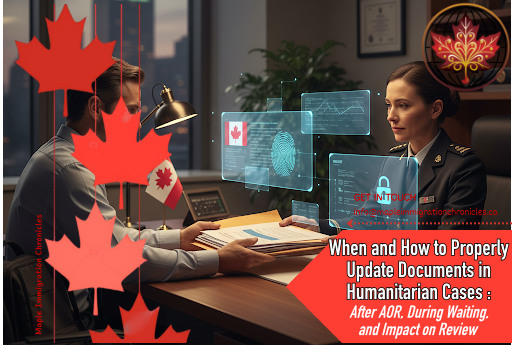
In Humanitarian and Compassionate (H&C) cases, receiving the Acknowledgement of Receipt (AOR) means that your application has been accepted for review, however, further waiting may last for years. During this period the question arises: is it necessary to add something to the file, when exactly to do it, and how does it affect the review of the case?
Updating documents is an important tool, because the long waiting time can be used to strengthen humanitarian factors: to show integration, adaptation, vulnerability, stability, and seriousness of your intentions.
When it is Worth Updating Documents
The general recommendation is — once a year after submission or after receiving AOR to submit a structured large update. Also, it is mandatory to inform IRCC in the case of significant changes.
Optimal cases for updating:
- a year or more has passed since submission;
- changes in family status (marriage, divorce, birth of a child);
- serious medical circumstances (new diagnosis, surgery, long-term treatment);
- confirmation of stable employment and tax payment in Canada;
- children’s successes in school, participation in clubs, sports or cultural programs;
- letters of support from community, employers, churches, educational institutions.
Less significant updates, which are not a priority:
- extension of work permit or visa (IRCC sees this in the GCMS system);
- short-term certificates without significant impact;
- small monthly references without systematization.
Which Documents Really Strengthen the Case
Category | Examples of what is worth submitting | What does not have critical significance |
Family circumstances | birth certificates of children, address changes, marriage or divorce certificates | repeated sending of copies of passports or work permit |
Medical documents | certificates about new diagnoses, chronic illnesses, long-term treatment | general preventive certificates |
Education and children | report cards, references about clubs, adaptation programs | one-time certificates without significant context |
Finances and work | CRA NOA, references about stable work and income | separate pay stubs |
Social connections | letters of support from organizations, employers, schools, churches | dozens of identical letters from acquaintances |
Community activity | references about volunteering, participation in projects, sports achievements | photos without official confirmations |
How to Properly Submit Updates
- Collect documents in a structured package. Do not send small materials weekly. It is better to prepare one large update once a year, which will include a planned list of changes (family, health, work, school, integration).
- Add a cover letter. In it systematize the information: what happened since submission, which new evidence you add, how it affects humanitarian factors.
- Use IRCC Webform. This is the main way to add documents to your file. In exceptional cases you can use postal sending.
- Keep copies. All sent documents and letters should be stored in paper or electronic form.
- Be organized. Keep a list of all submitted documents, set reminders about possible requests (for example, police certificate).
- Regularly check mail. Including the spam folder, so as not to miss requests from IRCC.
Does Updating Affect the Queue of Review?
- No, your case does not return to the beginning. The submission date (AOR) remains unchanged.
- The update is simply added to the file. It becomes part of the package of documents and is considered by the officer when making a decision.
- Exception: if you submit a new application, then a new file with a new date is created.
- Possible difficulties: too frequent small updates can complicate the officer’s work, but it does not change the queue.
Conclusions
Updating documents after AOR is a mandatory part of a competent strategy of conducting a humanitarian case. The best is to send one large systematized update once a year or in the case of serious changes. This allows to show IRCC the relevance of your circumstances, strengthen arguments, and use the long waiting time to your advantage.
It is important to focus on substantial evidence: family, health, work, education, integration. Excessive sending of secondary documents not only does not help, but also complicates the officer’s work.
The material is of informational character and is not legal advice. For professional help, it is worth contacting a licensed consultant or lawyer.