In recent weeks, Ukrainian media and social networks abound with headlines:
“Ukrainians in Canada are being forced to prove that they are not draft dodgers,”
“Time to pack for home,”
“Canada is preparing deportations of Ukrainian men.”
Such information triggers a wave of panic among applicants who are in the process of obtaining permanent residence.
In the public space, fragments of IRCC letters are being circulated, torn out of context, without an explanation of the legal nature of these documents.
As a result, an impression is formed of a “new campaign” or “strict control” over Ukrainians — although in reality, the situation is completely different.
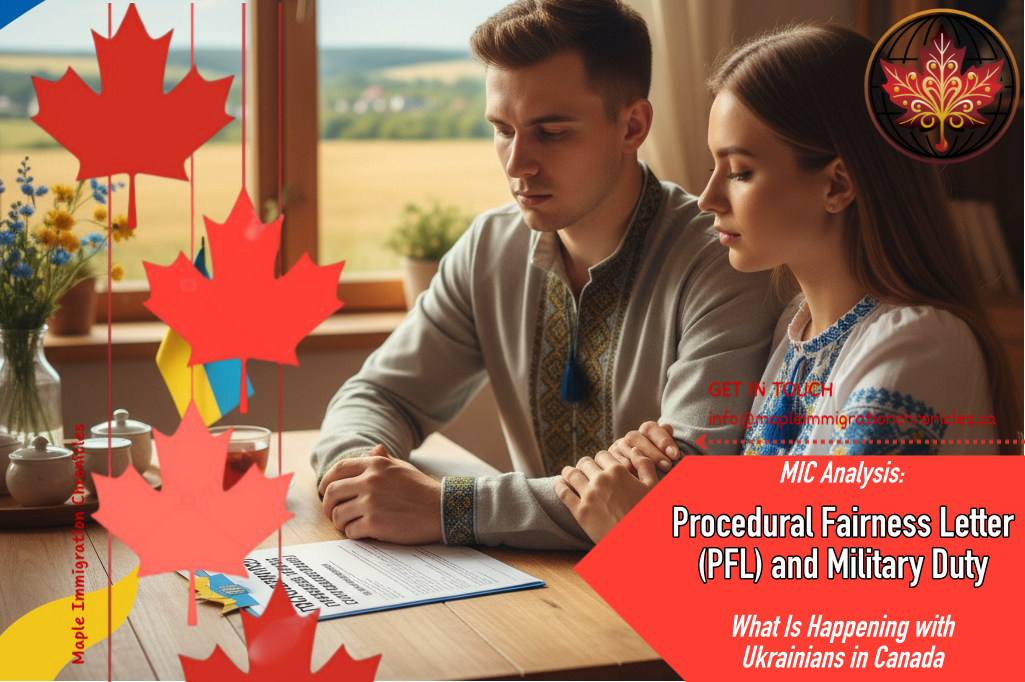
However, the truth is different: it is not about mass deportations, but about a Procedural Fairness Letter (PFL) — a usual IRCC practice that is used before a decision is made in a case.
This is not a new law, not a special campaign against Ukrainians, and not a verdict.
This is a mechanism of procedural fairness, intended to give a person the right to explain the officer’s doubts.
In other words, if an officer of Immigration, Refugees and Citizenship Canada (IRCC) has a question or suspicion that a certain part of your history appears incomplete, contradictory, or potentially illegal, they do not refuse automatically, but send a PFL to give an opportunity to defend oneself.
This is part of the constitutional principle of natural justice — “the right to be heard.”
What Is a PFL and Why It Is Sent
A PFL is an official letter from IRCC in which the officer describes concerns regarding the case and provides the applicant an opportunity to give explanations.
This is a stage before the decision is made, when IRCC gives a chance to prevent a refusal.
- It is not a deportation order.
- It is not an automatic refusal.
- It is the right to be heard — an opportunity to avoid an error already at the stage of administrative review.
IRCC uses such letters in cases where the materials lack evidence or there are gaps in chronology.
This may relate to any topic — inconsistencies in dates, absence of a certificate, discrepancies in work or education, or suspicion of false information.
But regarding Ukrainians, the main question today is often related precisely to military duty: the officer wants to know whether the applicant violated the legislation of his country.
Such logic follows from paragraphs 16(1) and 40(1)(a) of the IRPA, which oblige the applicant to provide truthful, complete information and not conceal facts that may be material for making a decision.
Why Requests to Ukrainians Are Appearing Now
The reason is that in application forms (in particular, Schedule A – IMM5669), men indicate that they resided in Ukraine after reaching 25 years of age. The officer knows that:
- In Ukraine there is compulsory military conscription;
- It was canceled in 2012, but reinstated in 2014;
- After 2022, all men aged 18 to 60 had to register for military service.
Therefore, if a person indicates that they resided in Ukraine during this period but the documents contain no record of a medical examination, deferment, or exemption, the officer cannot simply “skip” this gap.
IRCC is obliged to ensure that you did not violate the law of your state, because this may be a ground for inadmissibility under section A36(2)(c) IRPA.
Therefore, the question “Why did you not serve?” — is not a condemnation, but a request for clarification.
What Real Cases Look Like
At present, in the public space, there are only a few examples of such PFLs. It is known that:
- One applicant received a letter after he had already provided a registration certificate and a form with the note “did not serve.” This did not convince the officer, and he requested additional documents.
- In another case, a colleague of the applicant received a PFL, but the response was competent and the case was successfully defended.
- There are examples when screenshots of similar letters quickly disappeared from public space — possibly due to excessive media hype and an incorrect interpretation of the news.
For experienced lawyers and consultants, such requests are a normal part of work, although a rare one. Similar letters are sent not only to Ukrainians — this is a common procedure regarding applicants from countries with military obligations (for example, Israel, Korea, Iran, Turkey).
Legal Basis and Logic of the PFL
The situation that caused the greatest resonance boils down to several specific facts, confirmed by screenshots of letters that were circulated on social networks:
1️⃣ The applicant — a man of conscription age — resided in Ukraine, and therefore, by law, was subject to conscription.
2️⃣ IRCC sent him an official request to provide documents confirming that he was exempted from military service.
3️⃣ In response, the applicant submitted a registration certificate and a form where, in the field about performing military service, it was indicated only “did not serve.”
4️⃣ The IRCC officer indicated that by law the applicant had to undergo a medical commission and provide either a document of exemption or a record of performing service.
5️⃣ The applicant was given a short period to provide the relevant evidence and explanations.
These requirements form the basis of a Procedural Fairness Letter.
The applicant’s task is not only to submit documents, but also to clearly explain the circumstances.
What Questions Arise in the Context of the Response
To answer such a PFL competently, it is necessary to consider a number of key points:
- What exactly does the applicant’s registration certificate contain? Are there marks about a medical commission, deferment, or exemption?
- Did the applicant receive a summons to undergo the commission?
- If he received one — what was the result of the medical examination?
- If he did not receive — why?
- Did the applicant leave Ukraine legally, without obstacles at the border?
These questions are of fundamental importance, since from their answers it depends whether a person will be considered “clean before the law.”
According to the principle “innocent until proven guilty,” the burden of proof lies with the officer, but the applicant must provide sufficient explanations to remove doubts.
Purpose of PFL and Section A36(2)(c) IRPA
The main purpose of a PFL is to verify whether the applicant violated the legislation of his country.
If he avoided service illegally, this may become a basis for recognizing him as inadmissible under section A36(2)(c) IRPA — when a person commits an act that is an offense both in Canada and in the country of origin.
- If the applicant did not receive summonses, did not undergo the commission, and left the country through an official checkpoint — he acted within the law, and there should be no claims against him.
- If he deliberately ignored calls or used forged documents, then the officer has grounds to consider this a serious violation.
Inconsistencies in the Letter’s Wording
In published PFLs there is an important inconsistency. IRCC often writes:
“As you were residing in your home country when you were of compulsory military age, you are required to provide a certified copy of proof of military exemption or a certified copy of military service records.”
That is, only two options are proposed — either exemption or military records.
However, in real life there is a third: a person may lawfully reside in Ukraine at conscription age and have neither a document of exemption nor military records, simply because he never received summonses.
This is an entirely legal situation that needs to be explained in detail to the officer.
What an Ideal Response Might Be
A properly structured response may look like this:
“Indeed, by age I could have been conscripted and sent to a medical commission. However, I did not receive summonses, did not undergo the commission, and when leaving Ukraine there were no questions to me. I have provided all the documents I possess. There were no violations of the law on my part.”
At the same time, it should be understood that:
- It is not certain that such a situation will be true in every case;
- Even if it is true, there is no guarantee the officer will automatically accept the explanations without additional proof.
Each case requires individual analysis, and there is no universal solution.
IRCC officers assess not only the content but also the credibility of sources, consistency of facts, and completeness of explanations.
Why Professional Assistance Matters
The response to a PFL is a critical document.
If it is written superficially, later the court will not allow adding new materials. The court checks only whether the officer made an error based on the data available at the time.
Therefore, the correct strategy is to engage professionals with experience in similar cases.
A lawyer or licensed RCIC consultant can help:
- Interpret the content of the PFL and understand what exactly the officer implies;
- Structure the response properly;
- Avoid emotional or ambiguous wording;
- Provide relevant evidence acceptable in the administrative process.
How to Prepare a Response Properly
The response to a PFL is not a formality, but a crucial stage.
In case of appeal, no new evidence can be added — the court will assess only what was provided to the officer.
Correct strategy includes:
- Analyze the letter point by point. List every concern raised.
- Gather evidence. Registration certificate, military office documents, deferment or medical papers, official letters, timeline.
- Explain context. Why some records are missing, what laws were in force, how departure occurred.
- Respect deadlines. PFLs often allow only seven days — but extensions can be requested with justification.
- Use professional representation. The response must be well-structured, logical, numbered, and legally sound.
Common Myths and Reality
Myth | Reality |
“This is the beginning of deportations of Ukrainians.” | There is no evidence of mass returns — these are individual cases. |
“PFL = refusal.” | No. It is a chance to clarify and provide evidence. |
“If you received a PFL — everything is lost.” | False. There are documented examples of successful outcomes. |
“You can respond on your own.” | Highly risky. Courts won’t accept new evidence later — mistakes here are final. |
Conclusions
A PFL from IRCC is not a punitive tool, but a means to verify facts and allow a person to clarify concerns.
These letters do not signal a policy shift against Ukrainians — and certainly do not mean mass deportations.
The right reaction:
- Stay calm and approach media reports critically.
- Prepare your response professionally and with evidence.
- Seek expert assistance if uncertainties arise.
A PFL is a challenge — but also an opportunity to demonstrate honesty and integrity.
A well-prepared, documented response can save your application and keep your path to permanent residence in Canada.