As of 9 November 2025, the Express Entry pool has remained very saturated and at the same time has become more competitive in the upper score ranges.
The total number of profiles in the pool has decreased by more than 2,500 in a little more than two weeks, but the number of candidates with high CRS scores (above 500, and especially with a provincial nomination) has increased significantly.
In parallel with this, in 2025 IRCC continues to actively use category-based draws – primarily for French-speaking candidates, Canadian Experience Class (CEC) participants, as well as in priority categories (health and social services, education, trades). Below is a detailed analysis of the structure of the pool and the draws.
Current distribution of candidates in the Express Entry pool (CRS and changes over 2 weeks)
Table 1 shows the distribution of CRS scores in the Express Entry pool as of 9 November 2025, as well as the change in the number of profiles in each range compared to 26 October 2025.
Table 1. Distribution of CRS scores in the Express Entry pool and change in the number of profiles
CRS score range | Number of candidates | Change in number of profiles |
0–300 | 8 018 | −9 |
301–350 | 19 104 | −306 |
351–400 | 52 360 | −108 |
401–410 | 14 049 | +180 |
411–420 | 13 714 | −1 106 |
421–430 | 12 876 | −2 122 |
431–440 | 14 320 | −456 |
441–450 | 13 980 | −109 |
451–460 | 14 752 | −89 |
461–470 | 15 830 | +38 |
471–480 | 15 042 | +315 |
481–490 | 12 315 | +223 |
491–500 | 12 236 | +185 |
501–600 | 26 414 | +417 |
601–1 200 | 696 | +390 |
Total | 245 706 | −2 547 |
Key trends
- Almost all ranges from 0 to 460 CRS points showed a decrease in the number of profiles (that is, some candidates either received invitations, or profiles were deleted/their validity expired).
- The largest drop is observed in the ranges 411–420 and 421–430: together the decrease amounts to 3 228 profiles.
- The largest increase in the number of candidates is in the range 501–600 (+417 profiles), while the range 601–1 200 grew by almost 400 profiles. This indicates a noticeable increase in the number of candidates with a high score – primarily due to provincial nominations (PNP).
- Overall, the pool has shrunk by more than 2,500 profiles, but the share of “strong” candidates in the upper CRS ranges has increased.
Percentage distribution of candidates and percentiles: what your CRS score means
The following table shows what share of the total pool each CRS range constitutes, as well as the percentile range – that is, what percentage of candidates have a score less than or equal to the upper bound of this range.
Table 2. Share of candidates in the Express Entry pool by CRS ranges (as of 9.11.2025)
CRS range | Number of candidates | Percentage of the pool | Percentile range* |
0–300 | 8 018 | 3,26 % | 0,00 % – 3,26 % |
301–350 | 19 104 | 7,78 % | 3,26 % – 11,04 % |
351–400 | 52 360 | 21,31 % | 11,04 % – 32,35 % |
401–410 | 14 049 | 5,72 % | 32,35 % – 38,07 % |
411–420 | 13 714 | 5,58 % | 38,07 % – 43,65 % |
421–430 | 12 876 | 5,24 % | 43,65 % – 48,89 % |
431–440 | 14 320 | 5,83 % | 48,89 % – 54,72 % |
441–450 | 13 980 | 5,69 % | 54,72 % – 60,41 % |
451–460 | 14 752 | 6,00 % | 60,41 % – 66,41 % |
461–470 | 15 830 | 6,44 % | 66,41 % – 72,85 % |
471–480 | 15 042 | 6,12 % | 72,85 % – 78,97 % |
481–490 | 12 315 | 5,01 % | 78,97 % – 83,99 % |
491–500 | 12 236 | 4,98 % | 83,99 % – 88,97 % |
501–600 | 26 414 | 10,75 % | 88,97 % – 99,72 % |
601–1 200 | 696 | 0,28 % | 99,72 % – 100,00 % |
* Methodology: percentiles reflect the share of candidates with a score less than or equal to the upper bound of the corresponding range. In the table the values are shown as ranges, that is, candidates within, for example, 471–480 points occupy a position approximately between 72,85 % and 78,97 % of all profiles in the pool.
Important conclusion
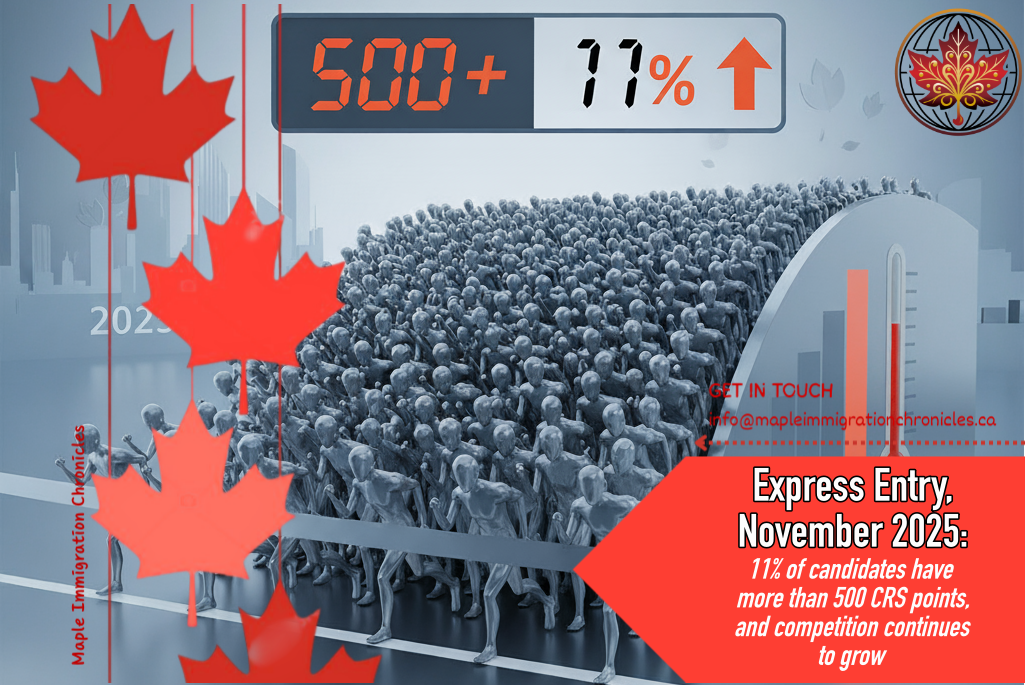
About 11 % of candidates (10,75 % in the range 501–600 + 0,28 % in the range 601–1 200) have a CRS above 500 points. This means that competition in the “top” part of the pool has increased significantly, and for many candidates the key becomes:
- either increasing CRS (experience, language, education, job offer),
- or obtaining a provincial nomination (PNP), which adds 600 points to the profile.
Official IRCC distribution: aggregated ranges and their breakdown
Text 3 reproduces the typical IRCC format, where some rows are “bold” aggregated ranges, and the rows following them break these ranges down.
Table 3. Overall distribution of candidates in the Express Entry pool (IRCC format)
CRS range | Number of candidates |
601–1 200 | 696 |
501–600 | 26 414 |
451–500 | 70 175 |
491–500 | 12 236 |
481–490 | 12 315 |
471–480 | 15 042 |
461–470 | 15 830 |
451–460 | 14 752 |
401–450 | 68 939 |
441–450 | 13 980 |
431–440 | 14 320 |
421–430 | 12 876 |
411–420 | 13 714 |
401–410 | 14 049 |
351–400 | 52 360 |
301–350 | 19 104 |
0–300 | 8 018 |
The numbers for the aggregated ranges (for example, 451–500 or 401–450) equal the sum of the corresponding subranges below, which makes it possible to see the structure of the pool both “from above” (general blocks) and “from below” (broken down into 10-point segments).
Express Entry draws over the last 30 days (11 October – 11 November 2025)
Over the last 30 days (from 11 October to 11 November 2025) IRCC has conducted six draws in the Express Entry system and issued 10 861 invitations (ITA) in four types of draws.
Table 4. Express Entry draws over the last 30 days
Draw date | Draw type | Number of ITA | CRS cut-off |
14 October 2025 | Provincial Nominee Program (PNP) | 345 | 778 |
15 October 2025 | Health and social services | 2 500 | 472 |
27 October 2025 | Provincial Nominee Program (PNP) | 302 | 761 |
28 October 2025 | Canadian Experience Class (CEC) | 1 000 | 533 |
29 October 2025 | Francophone category (French language) | 6 000 | 416 |
10 November 2025 | Provincial Nominee Program (PNP) | 714 | 738 |
It is particularly important that the largest number of ITA were issued in the Francophone draw on 29 October 2025 (6 000 invitations, cut-off score 416). This fully corresponds to Canada’s priority to increase the share of French-speaking immigrants outside Quebec.
Previous 30 days: comparison of draw intensity
In the previous 30-day period (from 11 September to 11 October 2025) IRCC also conducted six draws, however the total number of ITA was 1 092 lower – that is, 9 769 invitations.
Table 5. Express Entry draws over the previous 30 days
Draw date | Draw type | Number of ITA | CRS cut-off |
15 September 2025 | Provincial Nominee Program (PNP) | 228 | 746 |
17 September 2025 | Education | 2 500 | 462 |
18 September 2025 | Trades | 1 250 | 505 |
29 September 2025 | Provincial Nominee Program (PNP) | 291 | 855 |
1 October 2025 | Canadian Experience Class (CEC) | 1 000 | 534 |
6 October 2025 | Francophone category (French language) | 4 500 | 432 |
Comparison of the two periods shows:
- IRCC is increasing the total number of ITA.
- Francophone and CEC draws consistently remain the main sources of invitations.
- PNP draws show very high cut-off scores (often 730+), which underlines the value of a provincial nomination as a tool for candidates with a lower “federal” CRS.
CEC draw of 12 November 2025: second CEC draw in two weeks
On 12 November 2025 IRCC conducted another draw for Canadian Experience Class candidates, issuing 1 000 ITA.
Conditions of participation:
- minimum CRS score – 533;
- the Express Entry profile had to be created before 3:39 (UTC) on 17 October 2025.
This draw:
- became the fifth CEC draw in a row where:
- the cut-off score was 533 or 534,
- the number of ITA was 1 000,
- broke the previous “rhythm” when CEC draws were held approximately once every 4 weeks: the previous CEC draw took place on 28 October 2025, that is, only a little more than two weeks before this one.
Full list of Express Entry draws in 2025 (as of 12 November)
Below is a consolidated table of all Express Entry draws in 2025 up to and including 12 November.
Table 6. Express Entry draws in 2025
Date | Draw type | Number of ITA | CRS cut-off |
12 November | Canadian Experience Class | 1 000 | 533 |
10 November | Provincial Nominee Program (PNP) | 714 | 738 |
29 October | Francophone category (French language) | 6 000 | 416 |
28 October | Canadian Experience Class | 1 000 | 533 |
27 October | Provincial Nominee Program (PNP) | 302 | 761 |
15 October | Health and social services | 2 500 | 472 |
14 October | Provincial Nominee Program (PNP) | 345 | 778 |
6 October | Francophone category | 4 500 | 432 |
1 October | Canadian Experience Class | 1 000 | 534 |
29 September | Provincial Nominee Program (PNP) | 291 | 855 |
18 September | Trades | 1 250 | 505 |
17 September | Education | 2 500 | 462 |
15 September | Provincial Nominee Program (PNP) | 228 | 746 |
4 September | Francophone category | 4 500 | 446 |
3 September | Canadian Experience Class | 1 000 | 534 |
2 September | Provincial Nominee Program (PNP) | 249 | 772 |
19 August | Health and social services | 2 500 | 470 |
18 August | Provincial Nominee Program (PNP) | 192 | 800 |
8 August | Francophone category | 2 500 | 481 |
7 August | Canadian Experience Class | 1 000 | 534 |
6 August | Provincial Nominee Program (PNP) | 225 | 739 |
22 July | Health and social services | 4 000 | 475 |
21 July | Provincial Nominee Program (PNP) | 202 | 788 |
8 July | Canadian Experience Class | 3 000 | 518 |
7 July | Provincial Nominee Program (PNP) | 356 | 750 |
26 June | Canadian Experience Class | 3 000 | 521 |
23 June | Provincial Nominee Program (PNP) | 503 | 742 |
12 June | Canadian Experience Class | 3 000 | 529 |
10 June | Provincial Nominee Program (PNP) | 125 | 784 |
4 June | Health and social services | 500 | 504 |
2 June | Provincial Nominee Program (PNP) | 277 | 726 |
13 May | Canadian Experience Class | 500 | 547 |
12 May | Provincial Nominee Program (PNP) | 511 | 706 |
2 May | Health and social services | 500 | 510 |
1 May | Education | 1 000 | 479 |
28 April | Provincial Nominee Program (PNP) | 421 | 727 |
14 April | Provincial Nominee Program (PNP) | 825 | 764 |
21 March | Francophone category | 7 500 | 379 |
17 March | Provincial Nominee Program (PNP) | 536 | 736 |
6 March | Francophone category | 4 500 | 410 |
3 March | Provincial Nominee Program (PNP) | 725 | 667 |
19 February | Francophone category | 6 500 | 428 |
17 February | Provincial Nominee Program (PNP) | 646 | 750 |
5 February | Canadian Experience Class | 4 000 | 521 |
4 February | Provincial Nominee Program (PNP) | 455 | 802 |
23 January | Canadian Experience Class | 4 000 | 527 |
8 January | Canadian Experience Class | 1 350 | 542 |
7 January | Provincial Nominee Program (PNP) | 471 | 793 |
How many draws were conducted over the year and which streams are priority
Based on the aggregated statistics for 2025:
Table 7. Number of draws in 2025 by type
Draw type | Number of draws |
Provincial Nominee Program (PNP) | 21 |
Canadian Experience Class (CEC) | 12 |
Francophone category (French language) | 7 |
Health and social services | 5 |
Education | 2 |
Trades | 1 |
As of the date of publication of the text, IRCC has issued 82 223 ITA in 2025 through the Express Entry system.
The distribution of ITA by streams is given below.
Table 8. Number of ITA in 2025 by streams
Draw type | Number of ITA issued |
Francophone category (French) | 36 000 |
Canadian Experience Class | 23 850 |
Health and social services | 9 792 |
Provincial Nominee Program | 7 963 |
Education | 3 500 |
Trades | 1 250 |
What this means for Express Entry candidates
On the basis of the data presented, several practical conclusions can be drawn:
- Competition in the upper part of the pool has increased significantly.
About 11 % of candidates have more than 500 CRS points, and the ranges 501–600 and 601–1 200 show an increase in the number of profiles. - PNP is becoming a key tool for increasing chances.
The range 601–1 200 points consists mainly of candidates with a provincial nomination. PNP draws have very high cut-off scores (often 730+), but in return they practically guarantee an invitation due to the additional 600 points. - CEC candidates have a stable but high threshold.
All recent CEC draws since August 2025: - issued 1 000 ITA each;
- had a cut-off score of 533 or 534;
- were conducted regularly, and the last draw on 12 November took place already two weeks after the previous one.
- Francophone draws are the main “generator” of invitations.
Francophone category-based draws have given 36 000 ITA since the beginning of the year and often have a lower CRS cut-off than general or even some category-based draws. For candidates with French, this is one of the most effective ways to increase chances. - Category-based draws by occupations (Healthcare, Education, Trades) open additional opportunities for those who have relevant experience and meet the NOC and work-experience requirements.
For potential applicants this means that an immigration strategy through Express Entry in 2025 must be as multi-vector as possible:
- not to limit oneself only to a “dry” CRS score,
- actively consider provincial programs (PNP),
- where possible, strengthen the Francophone component,
- and also monitor category-based draws in one’s field (healthcare, education, trades).
What percentile means in the context of Express Entry
A percentile is an indicator that shows what percentage of candidates in the pool have a score less than or equal to a certain CRS value.
Very simply:
- the 50th percentile means that half of the candidates have a score lower than or equal to this value, and the other half higher;
- the 80th percentile means that 80 % of candidates have a score lower than or equal to this value, and only 20 % higher.
In the table we looked at, for each score range (for example, 471–480) a percentile range is given (for example, 72,85 % – 78,97 %). This means that:
- candidates at the lower bound of the range (471) will be closer to 72,85 %;
- candidates at the upper bound (480) – closer to 78,97 %;
- all those between 471 and 480 “lie” somewhere between these two values.
So, percentiles show not just how many points you have now, but where you are relative to everyone else in the Express Entry pool.
How to read the CRS distribution table: logic by example
Let us recall a fragment of the logic from the table:
- range 471–480: 6,12 % of candidates, percentile range 72,85 % – 78,97 %;
- range 481–490: 5,01 % of candidates, percentile range 78,97 % – 83,99 %;
- range 491–500: 4,98 % of candidates, percentile range 83,99 % – 88,97 %;
- range 501–600: 10,75 % of candidates, percentile range 88,97 % – 99,72 %.
How to interpret this step by step
- All candidates from 0 to 471 CRS points are approximately up to 72,85 % of the pool.
- If you fall into the range 471–480, you already “move up” into the 73–79 percentile zone. This means that only 21–27 % of candidates in the pool have a higher score than you.
- If you move from the range 471–480 to 481–490, you move into the zone of approximately 79–84 percentiles, that is, only 16–21 % of the pool have a CRS higher than yours.
- If your CRS crosses the 500 threshold, you become part of the upper approximately 11 % (501–600, and then 601–1 200), that is, you are already “operating” in the 89–100 percentile zone. This means that 9 out of 10 candidates in the pool have a lower score than you.
Thus, the percentile range allows you to formulate for yourself (and for a client) a simple sentence:
“With this score you are above N % of all candidates in the Express Entry pool.”
Specific examples of interpreting CRS scores
Below are several hypothetical examples to show the logic.
Example 1. CRS = 430
The range 421–430 has a percentile range of 43,65 % – 48,89 %.
If a candidate has 430 CRS points, one can roughly say:
- approximately 45–49 % of candidates have a score lower than or equal to 430;
- accordingly, 51–55 % have a higher score.
That is, a candidate with 430 points is approximately in the middle of the pool: they are not at the bottom, but also far from the upper part.
For practical interpretation: this is usually a non-competitive score without category-based or general draws with low cut-offs, and the candidate should:
- either significantly increase CRS (language tests, experience, education, job offer),
- or actively work towards a PNP nomination, where a further +600 points make the profile practically “guaranteed to be invited”.
Example 2. CRS = 465
CRS 465 falls into the range 461–470, percentile range 66,41 % – 72,85 %.
Approximate interpretation:
- the candidate has a higher score than about two thirds (66–73 %) of the pool;
- about 27–34 % of candidates have a higher score than 465.
This is already above average, however in 2025, against the background of high cut-offs in CEC, PNP and category-based draws, 465 points still look riskily low for “passive waiting” for an invitation in a general or CEC draw. It is worth either:
- upgrading the score,
- or focusing on PNP or other channels (for example, Francophone programs, if it is realistic to improve French).
Example 3. CRS = 478
CRS 478 belongs to the range 471–480 (72,85 % – 78,97 %).
Approximately:
- the candidate has a higher score than about 75–79 % of the pool;
- accordingly, only 21–25 % of candidates in the pool have a CRS higher than 478.
This is quite a strong position, especially if at some point IRCC returns to larger all-program or CEC draws with lower cut-offs. However, in 2025, when:
- CEC draws often have a cut-off of 533–534;
- some category-based draws also stay at the level of 470+;
a candidate with 478 points is in a “grey-green zone”: clearly better than the majority, but still not guaranteed to pass without additional factors.
Example 4. CRS = 492
CRS 492 falls into the range 491–500 (83,99 % – 88,97 %).
Interpretation:
- the candidate has a higher score than 84–89 % of the pool;
- accordingly, only about 11–16 % of candidates have a higher score than 492.
In fact this is the upper part of the pool, but below the “elite” 500+. In normal years with large all-program draws such scores would often be competitive. In the conditions of 2025, much depends on:
- the frequency of all-program or large CEC draws;
- the policy focus on category-based and PNP draws.
Such a candidate has sense to:
- remain in the pool and monitor the dynamics of cut-offs;
- at the same time work on French, PNP, or even form a strategy through a job offer.
Example 5. CRS = 507
CRS 507 is already in the range 501–600 (88,97 % – 99,72 %).
It can be formulated as follows:
- the candidate has a higher score than approximately 89–99 % of candidates in the pool;
- they are in the top 1–11 % by CRS in the entire system.
This is a very strong position. However, in 2025 it is worth remembering:
- the extremely high cut-offs in many PNP draws (high 700+ due to +600 points for a nomination),
- that the cut-off in CEC remains at 533–534.
That is, even with 507 points a candidate may not get into CEC draws with a threshold of 533–534, but remains very competitive in case of a return to more “soft” general draws or changes in policy.
Example 6. CRS = 533
CRS 533 is a classic example for 2025, because:
- exactly 533–534 is the typical passing level for recent CEC draws;
- 533 is in the range 501–600, that is, the candidate is in the top approximately 10–11 % of all profiles.
Formulation:
“With a score of 533 you are in the top approximately 10 % of all candidates in the Express Entry pool. In 2025 this is also confirmed by IRCC practice: CEC draws with a cut-off of 533–534 regularly issue invitations to candidates with such scores.”
That is, 533 in 2025 is a managerial, not just competitive position: under conditions of regular CEC draws with such thresholds, a candidate actually ends up in the “invitation zone” if they meet all other requirements.