
Analytics, hypotheses, and forecasts
Many of us are now closely following Express Entry and eagerly awaiting new draws. Especially those with Canadian work experience or who are expecting a CEC draw — which has not occurred since the beginning of the year. Meanwhile, IRCC has already conducted three large rounds for Francophone candidates, which raises new questions — likely not by coincidence.
The role of Express Entry in the overall plan
- The share of Express Entry in total immigration quotas is increasing from 22.8% (2024) to ~31.5% (2025)
- The total number of arrivals under federal economic programs — ~124,600 (vs. 110,770 in 2024)
🔹 This is happening against the backdrop of a 20% reduction in overall immigration levels, giving the federal government more control over immigration streams and reducing the number of admissions through provincial and regional programs.
🔹 Therefore, Express Entry will play a significantly greater role in Canada’s immigration system in 2025.
Express Entry 2025: Focus on category-based selection
In 2025, IRCC will focus on draws based on occupational categories that match the needs of Canada’s labor market.
This is implemented through the Federal Economic Priorities quota in the annual immigration plan.
Priority streams:
- Healthcare and social services
- Education
- Science, Technology, Engineering and Mathematics (STEM)
- Skilled trades
- Agriculture and agri-food
- High level of French-language proficiency
In 2024, there were few draws for healthcare and trades, but in 2025 an increase is expected.
Francophone candidates remain in focus
- Target for 2025 — 8.5% of all new PRs
- In 2026 — 9.5%
Canada continues to support the growth of the share of Francophone immigrants outside of Quebec through Express Entry.
Two hypotheses regarding Francophone draws
- CEC draws were deliberately postponed
The Francophone rounds in January–March may have served as a “technical pause,” to avoid mixing CEC draws with old profiles that still included 50–200 points for job offers. This delay gave IRCC time to wait for the pool to be cleaned. - Francophone draws are part of a consistent strategy
IRCC is likely testing a model of “mass category closures”:
First — three large Francophone draws (over 12,000 ITAs in total),
Then — possibly one more (2,000–4,000),
Afterwards — focus on another category (e.g., IT or Health), using a similar approach.
Critical changes: Removal of job offer points
According to official IRCC stats (as of March 19, 2025):
- 37,170 candidates had points for Arranged Employment:
- 36,150 had 50 points
- 1,020 had 200 points
After March 2025:
🔻 These points were removed
🔻 Around 80–90% of candidates lost 50 points, significantly lowering their CRS ranking
Estimated impact:
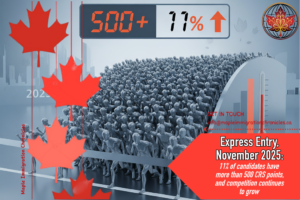
- CRS 501+: decreased from 26,215 to ~15,000
- CRS 451–500: increased from 70,055 to ~85,000
- CRS under 450: grew by about 5,000
➡️ This greatly increased competition in the 450–500 range, especially for those who previously stayed “above water” thanks to job offers.
Pool structure by program
(based on MEC source):
- FSW — around 50% of the pool
- CEC — nearly 45%
- FST — only 2%
📈 CEC continues to grow rapidly: just a few years ago it was a minor category, but now it’s central.
What does this mean for candidates?
🎯 New conditions → new strategy:
- Combine work experience: 1 year in Canada + 1 year abroad = more CRS points than 2 years in Canada only
- Develop your French — one of the most effective ways to boost CRS
- Watch for category-based draws and IRCC’s changing priorities
💡 Most important — ethical approach
In hard times, clients may feel pressure or lose motivation. That’s when professionals must offer a realistic, honest, and well-grounded strategy.
What affects the timing of the next Express Entry draw?
The Express Entry schedule is not fixed — several key factors influence it:
- Immigration policy and annual quotas
Government decisions on overall PR numbers and program distribution directly affect draw frequency, type, and size. - Economic needs and labor market demand
If Canada needs workers in a particular sector, IRCC may adjust the speed and focus of its draws. - Administrative and historical patterns
Although draws usually occur every 2 weeks, this may shift due to technical delays, policy updates, or re-prioritization.
📌 Conclusion:
Draw timing is flexible.
Previous trends may offer clues, but only IRCC sets the exact date.
CRS score projections for 2025
Assumption:
- 2 draws per month
- 3,000–4,000 ITAs each
What does this mean for candidates?
- CEC candidates have a strong advantage — make full use of PGWP, Canadian experience, and language scores
- The category-based approach opens new windows — especially for narrow specialties and Francophones
- The pool is shifting toward a more balanced distribution, with less artificial influence from job offers
Conclusion
Express Entry 2025 is a time of strategic transformation.
🎯 Now is the best time to re-evaluate your immigration strategy with IRCC’s new priorities in mind.
Key actions for candidates:
- Update your profile without job offer points
- Improve your language, education, and experience
- Combine Canadian and foreign experience (CEC + FSW)
- Monitor category-based draws and adapt where possible
➡️ It’s a complex, but predictable year. That means — time to act strategically.