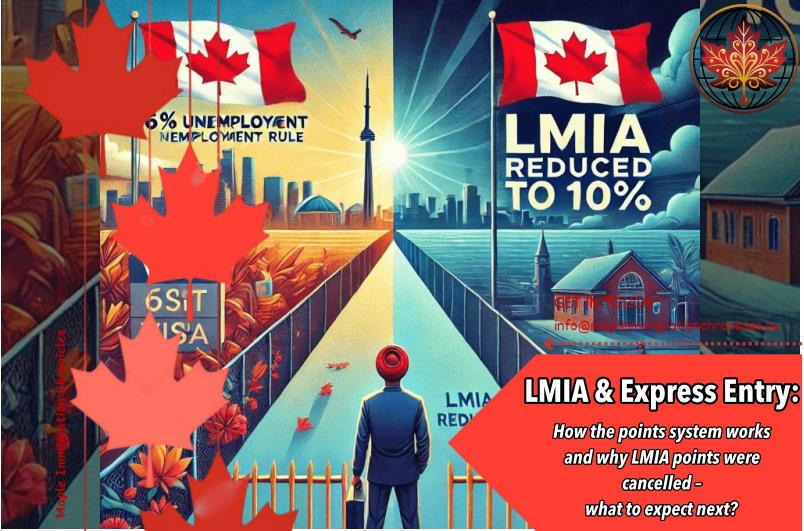
On March 25, 2025, IRCC officially stopped awarding additional points for a job offer based on LMIA in the Express Entry system.
This raised many questions:
- Why were these points removed?
- Should we expect compensation in another form?
- What should candidates do next?
- And how could this change affect Express Entry?
In this post, we’ll explore:
- how the Express Entry system works,
- the role LMIA points played,
- why their removal seems fully logical,
- and what strategies work now.
LMIA points were removed – why weren’t they added somewhere else?
After the removal of points for an LMIA-based Job Offer, many started asking:
- “Why weren’t these points compensated?”
- “Why not give them for something else?”
Let’s break down how the Express Entry system works — and why it all makes sense.
How the Express Entry system works
Maximum points — 1200
The system is divided into 4 categories: A, B, C, and D.
Category A: Core factors (max. 460 or 500 points)
- Age — 100 or 110
- Education — 140 or 150
- Official languages — 128 and 136 (first); 22 and 24 (second)
- Canadian work experience — 70 or 80
This is the foundation of your profile. Nothing has changed here.
Category B: Spouse factors (max. 40 points)
- Spouse’s language — up to 20
- Spouse’s education — up to 10
- Spouse’s Canadian work experience — up to 10
A + B = max. 500 points
Even a perfect candidate can’t get more.
Example: A 29-year-old candidate with a PhD, CLB 10 in English, CLB 9 in French, and 5 years of experience — will get all 500 points. Unrealistic? Yes. But theoretically possible.
Category C: Skill Transferability (max. 100 points)
Assesses how easily your skills can be adapted to the Canadian labor market.
- Education + high language — up to 50
- Education + Canadian experience — up to 50
- Foreign experience + high language — up to 50
- Foreign experience + Canadian experience — up to 50
- Red Seal — 50 points (e.g., licensed electrician)
But even with all combinations — only 100 points will be counted!
A + B + C = max. 600 points
Category D: Additional points (max. 600)
These are bonuses outside the core, but provide a significant advantage:
- Relative with PR or citizenship — 15
- Canadian education:
- 1–2 years — 15
- 3+ years / Master’s / PhD — 30
- French CLB 7 — 25
- French CLB 7 + English CLB 5 or higher — 50
- Job Offer (previously) — 50 or 200 (NOC 00)
- Provincial Nomination — 600
Just like in category C, even if you have:
- Provincial Nomination (600)
- French + English (50)
- Canadian Master’s degree (30)
- Relative in Canada (15)
Only a maximum of 600 will be counted.
So why was LMIA cancelled?
When Express Entry launched in 2015, a Job Offer gave 600 points — the same as A + B + C combined.
This made sense because:
- Most applications came from abroad
- Only a few had an LMIA
- Applying for a work permit from within Canada was impossible
But the situation changed:
- More applicants were already in Canada
- Applying from inside the country became allowed
- Abuse started
As a result — LMIA points were removed.
But other bonuses remain!
Why weren’t those points given for something else?
Because this was not a core part of the system — it was only an additional bonus.
There is no obligation to compensate it.
IRCC didn’t “take away” points — it simply removed an add-on that had lost its fairness and effectiveness.
What does this mean for you?
Don’t look for “where those points went.” Focus on what actually works:
- Improve your English / French
- Get education in Canada
- Accumulate relevant work experience
- Try to get a provincial nomination
- Apply through Express Entry category-based draws
How will the LMIA points cancellation affect Express Entry?
This is not just a technical tweak — it’s a change that will reshape the entire dynamic of Express Entry.
What may change?
1. More chances for those who truly match Canada’s priorities
Previously, LMIA could “push” a weak profile to the top, even without strong language, education, or experience.
Now the system better rewards strong candidates — with good language skills, Canadian education, experience, or who fall into priority categories (STEM, health, trades).
2. Category-based draws will take the lead
Without LMIA points, most “average” profiles won’t pass general (all-program) draws.
Now the main hope lies in category-based draws, which offer opportunities to specialists in specific sectors.
3. Less “artificial pressure” on CRS cutoff scores
LMIA points artificially raised CRS scores in general rounds.
Now, without them, the scores could become more stable and fair for those without LMIA but with strong profiles.
4. Less abuse and “gray market” employment
Previously, some candidates sought “formal” Job Offers just for the points — spawning an entire industry of questionable services.
Now that incentive is gone → fewer abuses, more transparency.
5. Provincial programs (PNP) will become even more important
The 600 points for nomination remain. Provinces now more actively invite the workers they really need — through their own streams or Notifications of Interest.
Conclusion
Cancelling LMIA points is part of transforming Express Entry into a more targeted system that reflects Canada’s real needs.
Instead of “looking for LMIA,” focus on building your profile:
- Improve your language
- Gain experience and education
- Follow category-based and provincial draws
The system hasn’t become worse — it has become more precise.
Work with your strengths — and your chances will grow!