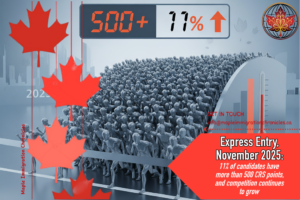

For many prospective immigrants to Canada, the conventional Express Entry system can seem unattainable—especially for those without a high Comprehensive Ranking System (CRS) score, provincial nomination, or French-language proficiency. However, a promising alternative exists through category-based draws, which focus on specific occupations identified by Immigration, Refugees and Citizenship Canada (IRCC) as essential to Canada’s labour market.
These occupation-targeted draws feature significantly lower CRS thresholds than general draws, allowing qualified individuals to obtain an invitation to apply (ITA) for permanent residence by gaining six months of relevant Canadian work experience in eligible fields. This approach offers a more realistic route to PR, particularly for candidates with limited points but strong work ethic and adaptability.
What Are Category-Based Draws and Who Benefits?
Since 2023, IRCC has conducted draws based on sectors such as Healthcare, Trades, STEM, Education, and Agriculture & Agri-Food. Unlike general Express Entry rounds, category-based draws focus on candidates who meet occupational criteria—regardless of their total CRS score. To be eligible, applicants must:
- Meet general Express Entry criteria (FSW, CEC, or FST);
- Accumulate six months of continuous full-time (or equivalent part-time) Canadian work experience in a single eligible occupation within the last three years;
- Comply with specific requirements outlined for the draw.
For those who fall short in CRS, this creates an opportunity to pivot strategically by gaining qualifying experience in one of these in-demand occupations.
The Most Accessible Occupations
The following analysis outlines occupations that offer the most accessible pathways to gaining the six months of qualifying Canadian work experience required for category-based Express Entry draws. It includes the estimated time typically needed to complete education or training prior to entering the workforce in each role.
Additionally, it provides information on the most recent CRS cut-off scores for each category-based draw, national median hourly wages, and whether the occupation qualifies for a spousal open work permit (SOWP) under current eligibility criteria.
| Occupation | Time to Qualify to Begin Working | CRS Cut-off Score (Most Recent EE Draw) | Category | Median Hourly Pay | SOWP-Eligible? |
| Elementary and secondary school teacher assistants (43100) | 10 months to 2 years | 479 (May 1, 2025) | Education | $24.36 | Yes |
| Insurance agents and brokers (63100) | A few weeks to a few months | 491 (April 11, 2024) | STEM | $29.77 | No |
| Medical laboratory assistants and related technical occupations (33101) | 1–2 years | 510 (May 2, 2025) | Healthcare and social services | $26.35 | Yes |
| Nurse aides and patient service associates (33102) | N/A – Can begin work immediately | N/A | Healthcare and social services | $23.00 | Yes |
| Pharmacy technical assistants and pharmacy assistants (33103) | N/A – Can begin work immediately | N/A | Healthcare and social services | $20.00 | Yes |
| Cooks (63200) | N/A – Can begin work immediately | 433 (October 23, 2024) | Trades | $17.00 | No |
| Concrete finishers (73100) | N/A – Can begin work immediately | N/A | Trades | $32.76 | Yes |
| Floor covering installers (73113) | N/A – Can begin work immediately | N/A | Trades | $26.92 | Yes |
| Roofers and shinglers (73110) | N/A – Can begin work immediately | N/A | Trades | $30.00 | Yes |
| Painters and decorators (except interior decorators) | N/A – Can begin work immediately | N/A | Trades | $26.00 | Yes |
| Butchers – retail and wholesale (63201) | N/A – Can begin work immediately | 437 (February 16, 2024) | Agriculture and agri-food | $19.50 | No |
Accessible Occupations: Low Barriers, High Opportunity
While some in-demand occupations require extensive training or licensing, others are relatively easy to access and offer quick entry into the Canadian workforce. For example:
- Teacher assistants can begin working after completing a 10–24 month college diploma, supporting students and educators in public schools.
- Insurance brokers may require only a few weeks of training and a licensing exam, depending on the province and type of insurance.
- Medical lab assistants, pharmacy assistants, and nurse aides often enter the workforce after short college programs or employer-based training.
- Cooks, painters, roofers, and flooring installers can start work immediately and build experience while training on the job or through apprenticeships.
- Butchers and agri-food workers are in demand and often qualify with basic training and food safety certification.
While certification may enhance employability and long-term earnings, it is not mandatory in many jurisdictions, making these occupations highly accessible for newcomers.
Case Study: Brian’s Path to PR
Brian, a 26-year-old with a post-graduation work permit, had a CRS score of 470 and met the Canadian Experience Class criteria. Despite this, he did not receive an invitation in any of the 2025 draws. To improve his profile, he enrolled in a college education program and worked full-time as a teacher assistant for six months. His CRS increased to 505, and he became eligible for the Education category draw, which had a cut-off of 479.
This example highlights how intentional, short-term decisions can create long-term immigration opportunities.
Key Considerations for Applicants
- Training Requirements: Many TEER 3 occupations require a college diploma, less than two years of apprenticeship, or several months of on-the-job training. These lower entry barriers allow candidates to qualify quickly.
- SOWP Eligibility: Some occupations—particularly in healthcare and education—allow spouses of workers to obtain an open work permit, facilitating family integration and financial stability.
- Labour Demand: Occupations targeted by IRCC align with persistent labour shortages, increasing the likelihood of employment and long-term career development.
- Flexibility and Progression: Entry-level work can serve as a bridge, allowing candidates to gain Canadian experience, upgrade their credentials, and transition to higher-skilled roles.
Conclusion
Canada’s category-based Express Entry draws open a practical pathway to permanent residence for those willing to invest in targeted occupational experience. By choosing accessible jobs with strong market demand and minimal entry requirements, candidates can overcome CRS barriers and qualify for immigration on the strength of their work contributions.
This approach is particularly valuable for newcomers without prior Canadian work experience or for those seeking to switch careers. With strategic planning and awareness of IRCC updates, applicants can align their efforts with immigration priorities—and secure their future in Canada.