Advantages | Eligibility Requirements | Documents | Step-by-Step Application Process
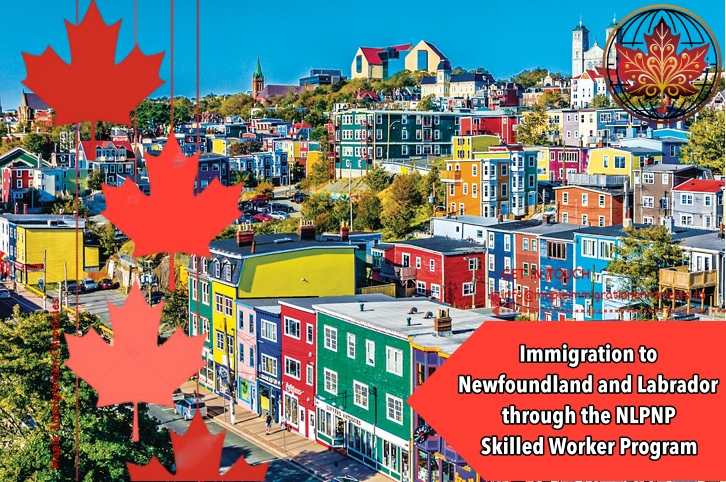
The province of Newfoundland and Labrador is the easternmost point of Canada and is characterized by a unique combination of natural beauty, small community size, economic affordability, and an acute need for foreign specialists. Against the backdrop of an aging population and youth migration to Canada’s central provinces, the local government has launched a practical and efficient immigration program — the Skilled Worker Stream under the Newfoundland and Labrador Provincial Nominee Program (NLPNP).
This program provides for the nomination of qualified foreign workers who already have a job offer from an employer in Newfoundland. Upon receiving such a nomination, the applicant may submit documents for permanent residence to IRCC — Immigration, Refugees and Citizenship Canada.
2. Strategic Advantages of Newfoundland and Labrador
2.1 Geographic and Socioeconomic Characteristics
The province is located on the Atlantic Ocean coast, with key cities being St. John’s, Corner Brook, and Gander. The area is mostly rural with low population density. This ensures lower housing costs, less strain on infrastructure, and a favorable environment for the adaptation of families with children.
2.2 Strong Support from the Provincial Government
The immigration policy of Newfoundland is developed with consideration of the workforce needs of specific sectors. The province regularly updates its in-demand occupation lists, supports employers in the recruitment process, offers free language courses for newcomers, adaptation programs, and even funding for certain certifications for immigrants in healthcare and construction sectors.
2.3 “Pathways Job Matching” Provincial Strategy
This is a unique initiative of the Newfoundland government that enables the search and automatic matching of foreign candidates with real job vacancies in the province. The system allows both employers and immigrants to optimize the pre-selection process before applying to NLPNP.
The program not only allows one to obtain status but also ensures economic integration, as workers arrive with a guaranteed job.
2.5 Less Strict Requirements
The NLPNP Skilled Worker does not require a high language or educational threshold. There is no requirement for Express Entry, CRS points, or educational credential assessment (ECA), unless requested by the employer.
2.6 Accessible and Less Competitive Market
A smaller number of applicants and a less saturated environment compared to Ontario or British Columbia provide an opportunity to find a job faster and to be nominated without a multi-level selection process.
2.7 Housing and Cost of Living
Compared to major cities like Toronto or Vancouver, average expenses for rent, food, transportation, and utilities in Newfoundland are 30–40% lower. This is critically important during the early stages of settlement.
3. Main Requirements of the NLPNP Skilled Worker Program
3.1 Valid Job Offer
The Job Offer must be:
• Issued by an employer registered in Newfoundland;
• For full-time employment (usually 30 to 40 hours/week);
• Without an end date (i.e., not seasonal or temporary work);
• Paid in accordance with the Canadian Labour Code and provincial minimum wage regulations.
Important: The province may reject the application if the offer does not reflect real employment conditions.
3.2 Work Experience
In most cases, at least 1–2 years of experience in the relevant profession is required. Special emphasis is placed on experience confirmed by:
• Previous employment contracts;
• Employer letters describing duties;
• Reference letters with contact details of former supervisors.
3.3 Language Proficiency
The minimum requirement is CLB 4. However, for occupations in healthcare or services, CLB 5–7 is often requested. For applicants applying from outside Canada, the language certificate must be no older than 2 years.
3.4 Education
Although the program does not require mandatory diploma assessment (ECA), employers may request credential verification through WES, IQAS, ICAS, etc., especially for regulated professions like electricians or nurses.
3.5 Immigration History and Legal Status
If the candidate is already in Canada, they must prove they are legally residing (open or closed work permit). Individuals with prior immigration violations or visa refusals must provide a written explanation.
4. Support for Applicants and Their Families
4.1 Adaptation Programs
Newcomers receive access to free:
• Language courses (LINC, ESL);
• Certification or upskilling consultations;
• Housing assistance;
• Children’s services (daycare, schools, clubs);
• Integration programs for women, seniors, and youth.
4.2 Educational Infrastructure
Children of immigrants have the right to free elementary and secondary education and may qualify for provincial college discounts after 1 year of residence.
4.3 Health Insurance
After registering in the provincial program, the individual becomes eligible for the MCP (Medical Care Plan) — the official healthcare system of Newfoundland.
List of Required Documents for Participation
Mandatory:
• Official Job Offer Letter
• Resume in Canadian CV format
• Reference letters or contracts from previous employment
• Copies of diplomas/certificates with official translations
• Language certificate (IELTS/TEF)
• Proof of funds — bank statements, income letters
• Copies of all applicants’ passports
• Medical examination (at PR stage)
• Police certificates from all countries where the applicant lived for more than 6 months
Important Features and Practical Notes
• Applicants are recommended to maintain a timeline:
job offer → NLPNP → PR → COPR → move → PR Card.
• There is no government fee for provincial nomination, but applying for PR to IRCC requires payment:
o Processing fee: CAD 850 (main applicant);
o Right of PR fee: CAD 515;
o Separate fees for each accompanying family member.
• Participation in NLPNP Skilled Worker does not require using Express Entry. The program allows both paper-based and electronic applications.
• To verify job offer authenticity, the Newfoundland government may check the employer’s tax history, number of employees, and past experience hiring foreigners.
Step-by-Step Application Process and Final Stages:
Step 1: Job Search
This step is critically important, as having a valid Job Offer is a mandatory condition for participation in the NLPNP Skilled Worker program.
1.1 Resume and Supporting Documents Preparation
• The resume must follow Canadian CV format: maximum 2 pages, no photos, with a clear description of skills, accomplishments, and contact details of previous employers.
• It is also recommended to prepare a Cover Letter tailored to each specific vacancy.
• All documents must be in English or officially translated.
1.2 Vacancy Search
• Use the federal portal: JobBank.gc.ca.
• Be sure to check https://www.worknl.ca — the official Newfoundland and Labrador job board.
• Other effective websites include [Indeed.ca], [Monster.ca], [Glassdoor.ca], and LinkedIn.
1.3 Contacting Employers
• Send resumes directly to vacancies labeled “willing to hire foreign workers.”
• You can also contact local recruitment agencies that specialize in employer immigration support.
• If possible — use personal contacts, volunteer networks, or LinkedIn for networking.
1.4 Interview and Receiving Job Offer
• Undergo an online interview or multiple communication rounds with the employer.
• The Job Offer must be on company letterhead and indicate:
o Full-time employment;
o Duration (permanent or renewable);
o Wage amount (per NOC);
o Job duties.
Step 2: Submitting the Application for Provincial Nomination (NLPNP)
This stage concerns officially entering the provincial selection process as a candidate for permanent residence.
2.1 Creating a Profile on the Portal
• Go to the official Newfoundland immigration website.
• Create a personal account. Select the Skilled Worker stream.
• Check your email to confirm the account.
2.2 Completing the Online Form
• Provide full information about:
o Personal data and documents;
o Education, qualifications, work experience;
o Language skills (upload IELTS or TEF results);
o Financial capacity;
o Employer and Job Offer details.
2.3 Uploading Documents
• All documents must be in digital (PDF) format.
• Including copies of passport, diplomas, letters, resume, language certificates, bank statements, etc.
• Documents in other languages — only with official translations.
2.4 Application Review
• Average processing time: 60 to 90 calendar days.
• If needed, the officer may request additional documents or conduct an online interview.
• Upon a positive decision, a Certificate of Nomination is issued — required for further PR application.
Step 3: Submitting the Application for Permanent Residence (PR)
If you have an Express Entry profile:
• Add the provincial nomination to your profile — 600 CRS points will be added automatically.
• You will receive an Invitation to Apply (ITA) in the next draw.
• From the date of receiving the ITA, you have 60 days to submit your documents via IRCC’s portal (GCKey or PR Portal).
• Average processing time — 6 months.
If you do NOT have an Express Entry profile (Non-EE Stream):
• Submit a paper PR application along with copies of documents, forms, and nomination.
• Submit via mail or through authorized representatives.
• Processing time — 8–12 months.
• Advantage: you may apply without Express Entry, even with lower English level and no Educational Credential Assessment (ECA).
Step 4: Receiving COPR and Entering Canada
4.1 Receiving COPR
• Confirmation of Permanent Residence (COPR) is the official letter confirming your right to permanent residency in Canada.
• It is sent to you electronically or by regular mail after final approval of the application.
4.2 Actions Depending on Your Location
• If already in Canada: status changes without leaving. You must complete “landing” through the PR Portal or at an IRCC office.
• If outside Canada: COPR is valid for a limited time. You must enter Canada before the specified date along with accompanying family members. Immigration processing is done at the border.
Step 5: Receiving the PR Card
5.1 PR Card Application
• After arrival, you automatically become a permanent resident.
• The PR Card (Permanent Resident Card) is the physical proof of your status, required to re-enter Canada.
• You will be offered to fill out the form during immigration processing or may submit it online after arrival.
5.2 Receiving the Card
• The PR Card is mailed to your Canadian address.
• Estimated delivery time — 1 to 2 months.
• If you change address — notify IRCC via the Change of Address form.
Tip: Keep copies of all electronic applications, documents, payment receipts, government letters, and employer confirmations in a separate folder with a backup archive.
6. Approximate Timeline of the Process
| Stage | Duration |
| Job search and job offer | 1–3 months |
| Provincial nomination (NLPNP) | 2–3 months |
| PR submission and review (EE/Non-EE) | 6–12 months (depending) |
| COPR issuance | 1 month after approval |
| Receiving PR Card | 1–2 months after entry |
Conclusion
The NLPNP Skilled Worker Program is not just an immigration tool. It is an opportunity for professional fulfillment, economic stability, and building a life in a province that genuinely values you as a specialist. Moderate requirements, fast application processing, affordability, and high quality of life make Newfoundland and Labrador an attractive option for qualified Ukrainian immigrants.