
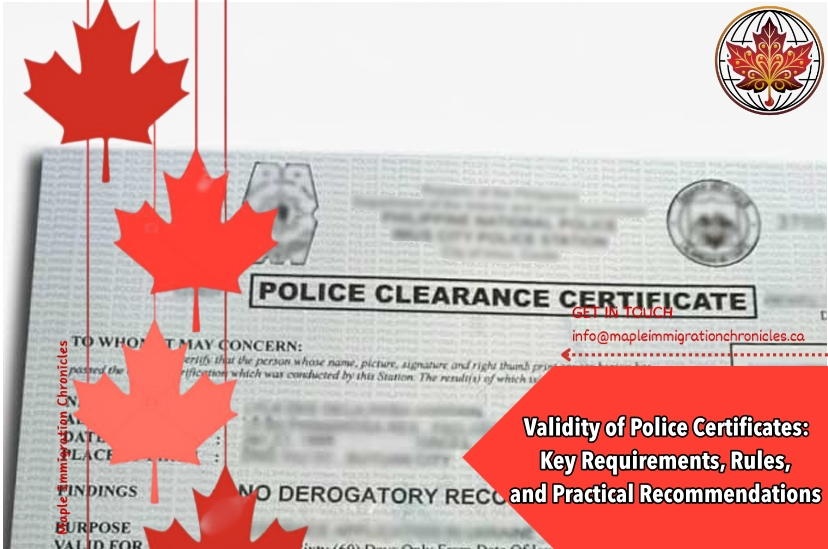
One of the critical documents required for Canadian immigration is the police certificate. This document serves as formal confirmation that the applicant has no criminal record in their country of citizenship or countries of previous residence.
Despite appearing to be a straightforward requirement, incorrect handling, delays, or submission of an expired certificate can lead to processing delays, additional document requests, or even refusal of your immigration application.
In this guide, we will explain:
- How to determine the validity period of a police certificate;
- When and under what conditions it is necessary to update the certificate;
- How to avoid common mistakes when preparing police certificates for Canadian immigration purposes.
1. What Is a Police Certificate and Why Is It Required
A police certificate is an official document confirming the absence of a criminal record within a particular country for a specified period.
Canada requires police certificates in the following situations:
- For permanent residence applications (PR), including Express Entry, Provincial Nominee Programs (PNP), Humanitarian and Compassionate (H&C) applications, family sponsorship;
- For certain temporary visa applications, especially if the applicant has a complex immigration history or other risk factors;
- At the request of an immigration officer as part of additional document verification (ADR).
2. Validity Period of Police Certificates: General Rules
Standard validity period — 6 months from the date of issuance, applicable if the applicant continues to reside in the country that issued the certificate.
Unlimited validity is possible only under the following conditions:
- You no longer reside in the country that issued the certificate;
- You have not returned to that country for any reason after obtaining the certificate.
Important to Note:
- If you re-enter the country after obtaining the certificate, even for a short period, the previously issued certificate is considered invalid;
- Each country may have its own procedures, requirements, and timelines for issuing police certificates. It is essential to verify the official requirements for your country on the Government of Canada’s website (canada.ca), specifically under the “Police Certificates” section;
- Many countries require police certificates to be obtained after your final date of stay in that country. In such cases, certificates may need to be requested remotely, and a notarized translation is typically required.
3. When to Submit a Police Certificate for Canada
- Police certificates must be submitted as part of the full immigration application package, typically after receiving an Invitation to Apply (ITA) or provincial nomination confirmation (PNP);
- If you continue to reside in the country that issued the certificate, it is advisable to submit your immigration application no later than 3 months after the certificate’s issuance to avoid it becoming invalid;
- If the processing time of your application exceeds 6 months, an immigration officer may request an updated certificate, even if you initially complied with the requirements;
- Officers have discretionary authority to request a new police certificate at any stage of the process if deemed necessary for further verification.
4. Special Situations Regarding Police Certificates
You do not reside in your country of citizenship:
- The certificate must be obtained through your country’s consulate or authorized representatives remotely.
You resided in another country for more than 6 months after turning 18:
- A police certificate is required from each such country, regardless of citizenship status;
- If you have not returned to that country since leaving, the certificate is considered valid indefinitely.
The country has a complex or lengthy police certificate issuance process:
- Plan well in advance, as processing times may take several weeks or even months (common examples include Iran, China, and certain CIS countries).
5. Practical Recommendations for Applicants
- Always verify the most up-to-date police certificate requirements for your country on the official Government of Canada website (canada.ca);
- Plan the timing of obtaining your certificate carefully, especially if the procedure involves translation, legalization, or apostille;
- Aim to obtain the certificate as close as possible to your intended application submission date to avoid the risk of it expiring;
- Keep copies of all original certificates, translations, and notarizations for your records;
- Be prepared to provide an updated police certificate if requested during application processing.
Conclusion
The police certificate is a critical document in the Canadian immigration process, confirming your legal integrity and absence of a criminal record. Proper handling of its validity, timely issuance, and strict adherence to procedural requirements directly impact the success of your application.
Failure to comply with deadlines, obtaining the certificate incorrectly, or neglecting translation requirements may lead to delays or even refusal of your application.
We strongly recommend:
- Verifying the current IRCC requirements for police certificates for each relevant country;
- Initiating the certificate request process early, especially for countries with complex procedures;
- Consulting qualified professionals to assist with the preparation and translation of supporting documents.
Diligent preparation of your police certificate ensures a smoother application process and brings you closer to legally residing in Canada.