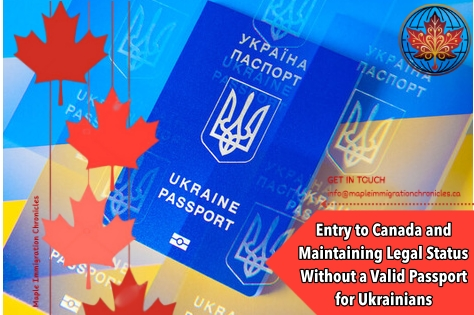
Since the launch of the CUAET program, thousands of Ukrainian citizens have entered Canada without valid international passports due to the extraordinary circumstances of war. To address this, Canadian authorities implemented special measures allowing individuals to cross the border and remain in Canada temporarily by issuing documents such as the Single Journey Travel Document (SJTD) and the Temporary Resident Permit (TRP).
However, it is essential to understand that these documents are exceptional, temporary mechanisms and cannot replace a valid passport for immigration purposes. Misunderstanding their legal effect may result in complications when extending status or applying for further permits.
This guide provides clarity on how these documents work, how they affect your immigration history, and what you must consider to legally maintain your status in Canada.
Is Entry to Canada Without a Passport Legally Permitted?
According to Canadian immigration law, foreign nationals must present a valid international passport when crossing the border. In the absence of such a document, the individual is deemed inadmissible to Canada.
Nevertheless, in exceptional humanitarian circumstances, the law allows for the issuance of a Temporary Resident Permit (TRP), granting temporary entry despite inadmissibility due to the absence of proper travel documents.
SJTD and TRP: Legal Nature and Implications
Under the CUAET framework, thousands of Ukrainians were admitted to Canada without passports by utilizing:
- SJTD (Single Journey Travel Document) — a one-time travel document permitting entry to Canada;
- TRP (Temporary Resident Permit) — a special permit issued when an individual does not meet entry requirements but has compelling reasons to enter.
The issuance of an SJTD with a TRP endorsement confirms that your entry was permitted as an exception, based on temporary humanitarian relief rather than full compliance with immigration standards.
A common indicator on these documents is the PA-1 code, meaning:
- The person received a TRP due to the absence of a passport;
- They were formally considered inadmissible at the time of entry;
- Their immigration file will reflect this special status for future applications.
Impact of TRP on Legal Status Within Canada
The TRP is not a substitute for permanent immigration status or a valid passport. Rather, it serves as a temporary measure allowing legal stay in Canada under exceptional conditions.
Key legal implications of the TRP include:
- You may legally remain in Canada for the duration of the TRP, even without a valid passport;
- You may work or study if you hold the relevant accompanying permits;
- After obtaining a valid passport, you must update your status by submitting proper applications;
- You must proactively apply to extend the TRP before it expires to avoid loss of legal status.
Failure to comply with these steps may result in losing your ability to remain in Canada lawfully.
Extending Status After Obtaining a Passport: Legal Risks
Once a valid passport is obtained, individuals wishing to extend their status (Work Permit, Study Permit, Visitor Record) must exercise caution, as immigration officers may:
- Review your file and see that you entered Canada under a TRP due to inadmissibility;
- Automatically assume you remain inadmissible without further clarification;
- Reject your application or return it for additional information if your situation is unclear.
In such cases, the burden of proof lies with the applicant to demonstrate that:
- A valid passport has been obtained;
- The conditions that led to inadmissibility no longer apply;
- Supporting documentation is provided to confirm compliance with immigration requirements.
Failure to proactively explain your updated circumstances may result in a negative decision based on the officer’s formal interpretation of your file.
Recommendations for Applicants Who Entered on a TRP
- Upon receiving a valid passport, always include a detailed explanatory letter in any new application;
- Clearly explain when and why you initially entered Canada without a passport;
- Provide documentary evidence confirming the issuance of your new passport;
- Ensure your application explicitly states that you now meet the standard requirements for entry and status extension;
- Do not delay action—apply to extend your status well before the expiration of your TRP;
- Seek professional immigration advice in complex cases to avoid procedural mistakes.
Conclusions
Possessing an SJTD or TRP is not equivalent to holding a valid passport and does not permanently regularize your status in Canada. These are temporary, exceptional measures used under humanitarian grounds.
Ukrainians admitted to Canada via these mechanisms should:
- Understand the temporary nature of their initial status;
- Act proactively to obtain valid documents and update their legal status;
- Provide immigration authorities with transparent, well-documented explanations during all subsequent applications;
- Not rely solely on a TRP as a long-term solution for legal residency.
By maintaining transparency, carefully documenting your case, and adhering to legal procedures, you can safeguard your immigration status and minimize risks associated with your stay in Canada.