
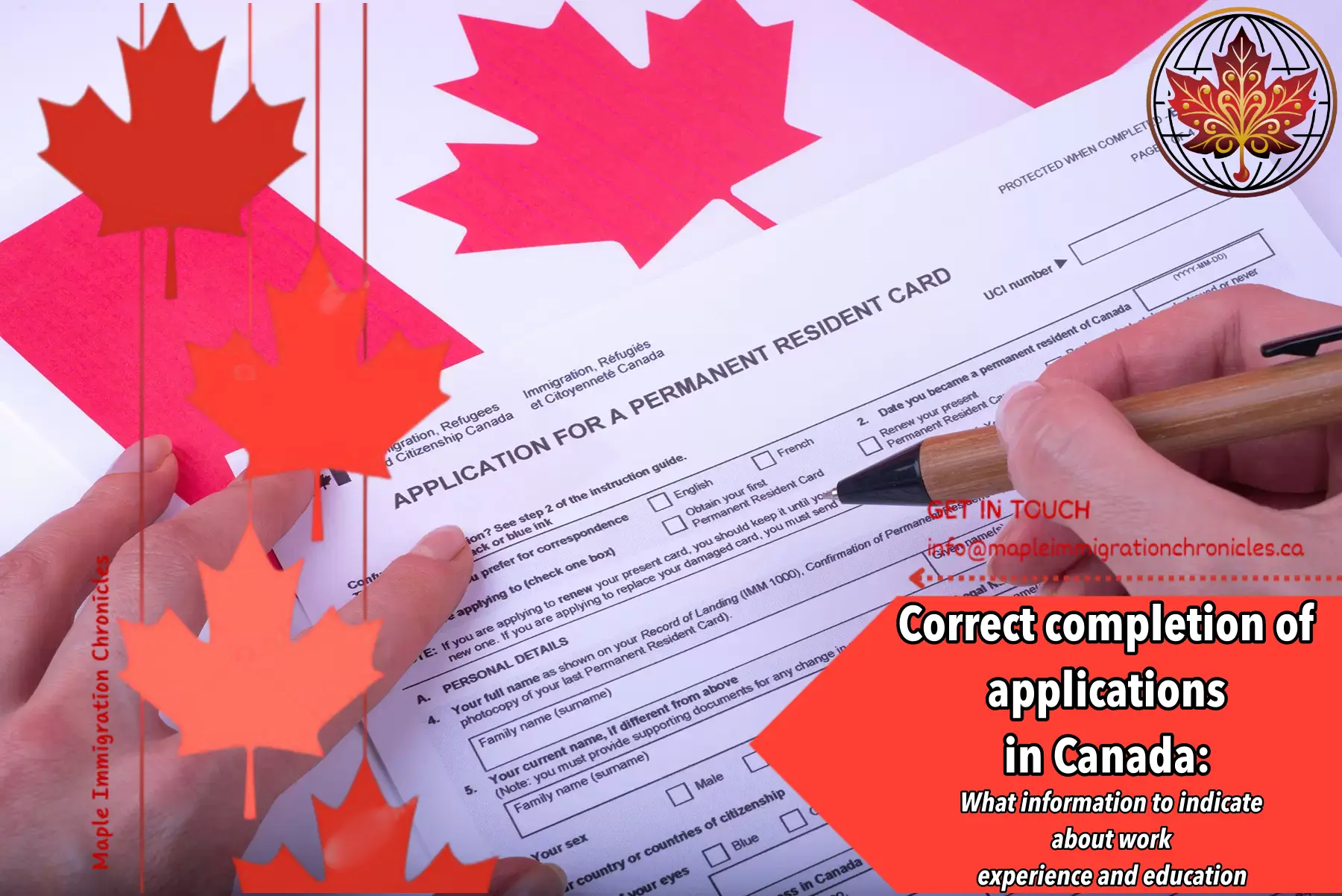
Correct and complete completion of forms and applications for immigration, permits, or status in Canada is the legal responsibility of the applicant. The success of your case, as well as the absence of risks of refusal or accusations of misrepresentation, depends on how accurately and consistently you indicate your professional and educational background.
This material explains exactly what information should be provided in forms and profiles for various types of applications, even if some data seems insignificant or difficult to confirm.
Why it is necessary to indicate all experience and education — even unofficial or incomplete
The principle of completeness and accuracy of information applies to the Canadian immigration process. The applicant is obliged to provide exhaustive data about:
- All previous work experience (official and unofficial);
- Completed and incomplete education;
- Education and employment for which additional points are not claimed (but which must be reflected in the personal history).
Why this is important:
1. The possibility to confirm experience even in difficult situations
In practice, immigration officers accept various alternative evidence if standard documents (certificates, references, contracts) are missing. Your task is not to hide experience but to justify its existence.
Even in cases of unofficial employment or absence of a letter from the employer, it is possible to provide explanations, testimonies, or factual confirmations that allow the officer to conclude that the declared period of work is real.
2. Incomplete indication of experience can have negative consequences
If you fail to indicate a certain period of experience or education, and later it turns out that precisely this period is lacking to:
- meet the eligibility criteria of the program;
- have sufficient total experience;
- obtain the required number of points in the Express Entry system;
then adding this experience later will be legally difficult. The system may interpret this as deliberate concealment of information or manipulation.
It is much easier and safer to immediately indicate all experience and education, even if some periods are difficult to document.
Rules for entering information in applications
General strategy:
- We provide a complete list of experience and education — regardless of formality, completion status, or possibility of obtaining standard documents.
- If additional documents are needed to confirm the required experience — we prepare all available evidence.
- If the officer considers the confirmation insufficient, he or she will independently exclude this period from consideration, which is better than you hiding the information yourself.
Features for Express Entry:
- Experience and education for which you claim points — must be specified in the relevant sections of the application.
- Other experience and education — should be indicated in the Personal History section.
- All dates, facts, and events must be consistent across different applications: CUAET, Work Permit, LMIA, PR, etc.
If you made inaccuracies or “forgot” to indicate something in previous applications — be sure to prepare a Letter of Explanation, in which you honestly explain all discrepancies and provide corrections.
Recommendations to avoid mistakes and risks:
- Collect as much evidence as possible for each period of work and education in advance.
- Even unofficial or incomplete experience is better to indicate with explanations than to hide.
- Ensure complete consistency of all application data across different types of applications.
- In complex situations (lack of certificates, problems with confirmation), consult an immigration lawyer.
- Remember the strict liability for providing false or contradictory information — this may result in a refusal due to Misrepresentation, which entails a long-term ban on applying.
Conclusion
Providing complete and reliable information in all applications is the applicant’s legal obligation. This not only protects you from accusations of concealing facts but also allows you to properly assess your chances, build an effective immigration strategy, and avoid unnecessary refusals.
Honesty, consistency, and advance preparation are the key conditions for successfully going through any Canadian immigration process.