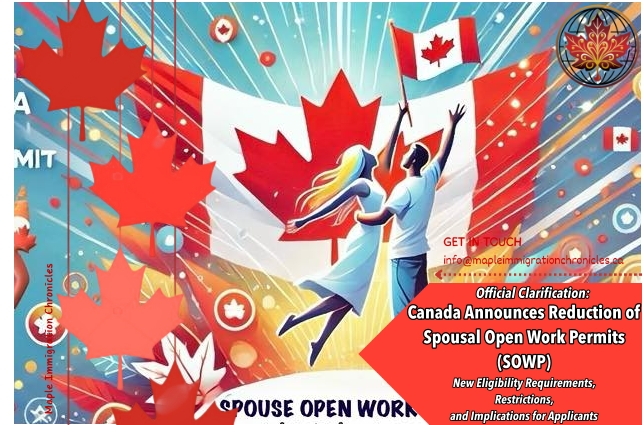
Immigration, Refugees and Citizenship Canada (IRCC) has officially announced a phased reduction in the number of Spousal Open Work Permits (SOWP) and the introduction of stricter eligibility criteria for spouses and partners of international students and temporary foreign workers. These changes form part of Canada’s broader strategy to control temporary resident numbers, protect the labour market, and ensure sustainable economic growth.
Key Changes to Spousal Open Work Permits (SOWP)
- New Restrictions for Spouses of International Students
- As of September 2023, work permits for spouses of international students are only granted if:
- The student is enrolled in a Master’s or Doctoral program;
- The program has a minimum duration of 16 months.
- Starting in 2025, a new quota system will apply:
- Canada will reduce the number of SOWP for spouses of students by 50,000 over a three-year period.
- As of September 2023, work permits for spouses of international students are only granted if:
- Restrictions for Spouses of Temporary Foreign Workers
- SOWP will be granted exclusively to spouses of foreign workers who:
- Hold high-skilled positions;
- Work in priority sectors such as engineering, law, education, medicine, or scientific research.
- The number of SOWP issued for spouses of foreign workers will be reduced by up to 100,000 in the coming years.
- SOWP will be granted exclusively to spouses of foreign workers who:
- Additional Language Requirements
- Language proficiency standards will be reinforced, especially for post-graduate work permit holders:
- Applicants must successfully complete an official English or French language test as part of the work permit application process.
- Language proficiency standards will be reinforced, especially for post-graduate work permit holders:
Purpose of the Restrictions
According to IRCC, the primary objectives of these measures include:
- Aligning the issuance of work permits with the real needs of Canada’s labour market;
- Preventing oversaturation of the job market by accompanying family members of temporary residents;
- Strengthening the integrity of Canada’s immigration and employment systems by introducing stricter eligibility requirements.
Who Will Be Affected
- Individuals planning to come to Canada under temporary worker or student programs, with the intention of applying for a SOWP for their spouse or partner;
- Partners of applicants who do not meet the updated education or qualification thresholds;
- Prospective applicants considering pathways to legal status via accompanying spouses.
Implementation Timeline
- Restrictions for spouses of international students have been in force since September 2023;
- Additional limits, including quota reductions and stricter eligibility for spouses of workers, will be gradually implemented from January 2025.
Important Information for Applicants
- These policy changes do not apply to individuals who already hold a valid Spousal Open Work Permit;
- Applicants intending to submit a SOWP application are strongly advised to:
- Apply as soon as possible before stricter measures take effect;
- Confirm their eligibility under the updated criteria;
- Consult licensed immigration professionals to ensure accurate document preparation and application strategy.
Conclusion
Canada is moving towards more restrictive regulations for Spousal Open Work Permits as part of its efforts to control temporary resident volumes and preserve labour market stability. Applicants should closely monitor official updates from IRCC, act proactively, submit applications in accordance with new requirements, and plan their immigration strategy with consideration of the evolving restrictions on SOWP issuance, language requirements, and occupational eligibility criteria.