How Does Express Entry Work?
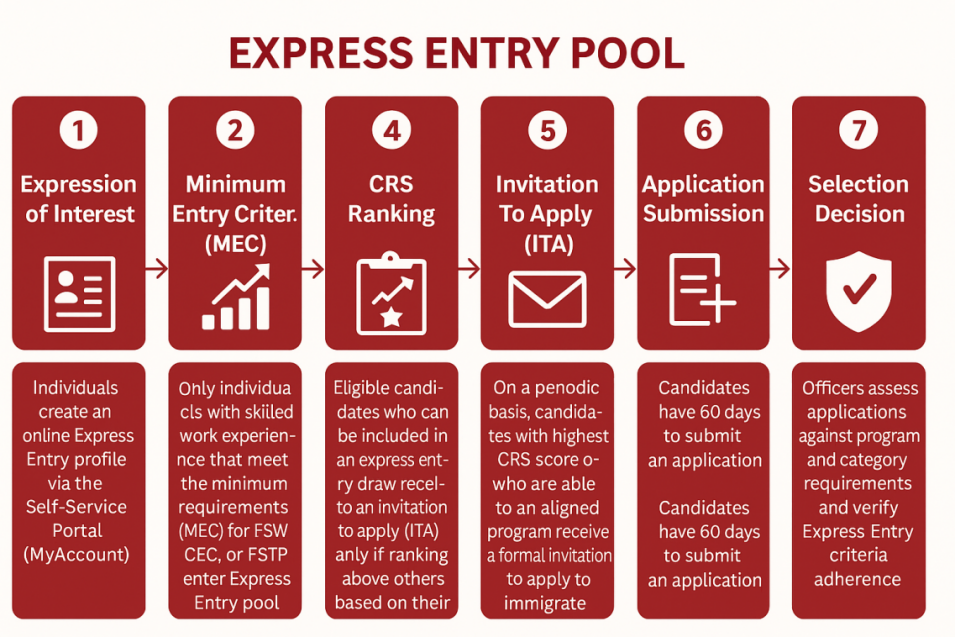
The process is simple and consists of two main steps:
Step 1: Create an Express Entry Profile
-
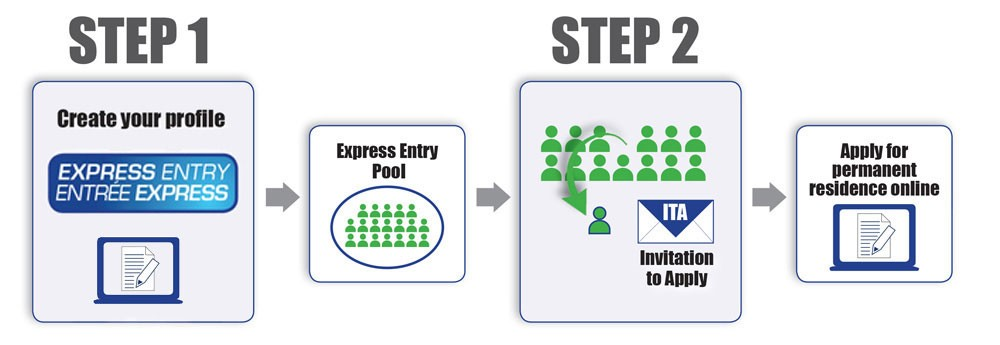
Submit an online profile with details about your skills, work experience, education, and language proficiency.
-
If eligible, you enter the Express Entry pool and receive a Comprehensive Ranking System (CRS) score.
-
Your CRS score determines your ranking—higher scores mean better chances of receiving an Invitation to Apply (ITA).
Pro Tip: Use the CRS calculator (available on the IRCC website) to estimate your score before applying.
Step 2: Receive an Invitation to Apply (ITA)
-
IRCC holds Express Entry draws (usually every 2 weeks) and invites top-ranking candidates.
-
If you get an ITA, you have 60 days to submit a complete permanent residence application.
-
Processing time is typically 6 months or less for most applicants.
Key Fact: Some draws target specific categories (like healthcare, trades, or French speakers), giving certain candidates an advantage.
What is the CRS Score?
Your Comprehensive Ranking System (CRS) score (max 1,200 points) is based on:
Core Factors (Max 600 Points)
-
Age (Younger candidates score higher)
-
Education (Higher degrees = More points)
-
Language Proficiency (English/French test scores)
-
Work Experience (Canadian or foreign experience)
Additional Points (Max 600 Points)
-
Provincial Nomination (+600 points – Guarantees ITA!)
-
Canadian Job Offer (+50 or 200 points)
-
Canadian Education (+15 or 30 points)
-
French Proficiency (+25 or 50 points)
-
Sibling in Canada (+15 points)
Want a higher CRS score? Improve your language test results, gain more work experience, or secure a PNP nomination.
Express Entry Category-Based Draws: A Targeted Approach to Economic Immigration
Traditionally, Express Entry draws were conducted based primarily on a candidate’s Comprehensive Ranking System (CRS) score, which reflects factors such as age, education, language proficiency, and work experience. Over time, rising CRS cut-off thresholds—driven by a growing pool of highly qualified applicants—have made it increasingly difficult for skilled professionals in key sectors to receive an Invitation to Apply (ITA) for permanent residency.
In response to evolving labour market demands and to refine its economic immigration strategy, Immigration, Refugees and Citizenship Canada (IRCC) launched category-based draws in 2023. This new system allows IRCC to target candidates with specific skills or experience in high-demand fields, or those with strong French-language proficiency, offering them a pathway to permanent residence even if their CRS scores fall below the thresholds seen in general draws.
How to Maximize Your Express Entry Potential in 2025
Enhance Your CRS Score – Consider improving your language test results, gaining additional work experience, or completing a Canadian educational credential to increase your ranking.
Pursue a Provincial Nomination (PNP) – Earning a nomination from a province or territory can add 600 points to your CRS score, significantly increasing your chances of receiving an Invitation to Apply (ITA).
Apply Through a Priority Category – If your occupation falls within high-demand sectors such as healthcare, technology, or skilled trades, you may benefit from category-based draws with lower CRS thresholds.
Stay Informed – Express Entry policies evolve frequently. Monitor IRCC updates to ensure you take advantage of the most current opportunities.
Instead of Conclusion
Express Entry remains Canada’s most efficient immigration pathway for skilled workers. With the introduction of category-based selections, eligible candidates in targeted professions have a clearer route to success.
Thinking of Applying?
Start by verifying your eligibility, calculating your CRS score, and gathering your supporting documents.
Need Assistance?
Reach out to MIC Immigration Experts for tailored support throughout your Express Entry process.
Visit our blog for the latest updates on Express Entry 2025.