Competition in Express Entry Is Increasing Despite the Reduction of the Pool: A Detailed Review as of October 26, 2025
As of October 26, 2025, there are 248,253 profiles in the Express Entry pool. This

Trends 2025: As of 2025, IRCC has not conducted any general or FSW-specific Express Entry draws. Standalone FSW profiles with high CRS scores are no longer invited unless aligned with those targeted categories.This marks a continued shift in Canada’s immigration strategy away from large general invitations.
ITAs issued in 2025: As of mid‑2025, there have been no Express Entry draws that targeted Federal Skilled Worker (FSW) candidates exclusively─meaning no FSW-specific invitations have been issued since 2024. FSW applicants are now invited only through broader category-based or general draws, alongside other programs.While there’s no public breakdown specifying how many ITAs went to FSW-eligible candidates specifically, it’s clear that all FSW candidates must now qualify under broader draws rather than FSW-only rounds.
The Federal Skilled Worker Program (FSW), introduced in 1967, was the first point-based immigration system in the world. It allows Canada to select skilled professionals from abroad based on a transparent scoring system evaluating language proficiency, education, foreign work experience, and adaptability.
Since 2015, FSW applications are submitted through the Express Entry system, where eligible candidates receive a Comprehensive Ranking System (CRS) score and compete for Invitations to Apply (ITAs) for permanent residence.
While FSW has historically been Canada’s most popular economic immigration stream—particularly for candidates without Canadian experience—in 2024 and 2025, there have been no dedicated FSW draws. Instead, FSW applicants now receive ITAs only through general or category-based Express Entry draws, typically aligned with targeted occupations or strong French-language ability. This shift reflects IRCC’s evolving focus on labor market needs and category-specific selection.
Skilled Foreign Worker
You must have at least 12 months of continuous work experience in a skilled occupation (TEER 0, 1, 2, 3) within the past 10 years, obtained in Canada or abroad.
Proficient in English or French
You must know at least one of Canada’s official languages with CLB/NCLC 7 in Speaking, Listening, Reading, and Writing.
Well-Educated
You must have secondary or post-secondary education in Canada or abroad (and obtain an Educational Credential Assessment)
Express Entry is the application management system used by Immigration, Refugees and Citizenship Canada (IRCC) to select skilled immigrants for permanent residence. It handles applications under three key federal economic immigration programs: the Federal Skilled Worker (FSW), Federal Skilled Trades (FST), and Canadian Experience Class (CEC). Since its launch in 2015, Express Entry has become the most streamlined and competitive pathway for skilled foreign nationals to immigrate to Canada. In recent years—especially since 2024—IRCC has placed greater emphasis on in-Canada applicants through the CEC and category-based draws, further enhancing Express Entry’s role in meeting labour market needs.
To qualify under the Federal Skilled Worker Program (FSW), candidates must obtain a minimum of 67 points out of 100, based on the selection grid.
| Factor | Maximum Points |
| Education | 25 |
| Language Proficiency | 28 |
| Age | 12 |
| Work Experience | 15 |
| Arranged Employment | 10 |
| Adaptability | 10 |
Points are awarded across several selection criteria, as detailed below:
Proficiency in one of Canada’s official languages—English or French—is mandatory. Language ability is assessed through IRCC-approved standardized tests:
IELTS General Training
CELPIP General
PTE Core
TEF (Test d’évaluation de français)
TCF (Test de connaissance du français)
Applicants can score up to 28 points for their language skills. Scoring is determined based on Canadian Language Benchmarks (CLB) for English or Niveaux de compétence linguistique canadiens (NCLC) for French. To receive points, candidates must achieve at least CLB/NCLC level 7 in all four abilities: reading, writing, listening, and speaking.
Language Proficiency (First Official Language):
IELTS (English)
| CLB Level | Speaking | Listening | Reading | Writing | Points per Ability |
| CLB 9 | 6.0+ | 6.0+ | 6.0+ | 6.0+ | 6 |
| CLB 8 | 5.0–5.9 | 5.0–5.9 | 5.0–5.9 | 5.0–5.9 | 5 |
| CLB 7 | 4.0–4.9 | 4.0–4.9 | 4.0–4.9 | 4.0–4.9 | 4 |
Second Official Language (IELTS – Optional)
| Speaking | Listening | Reading | Writing | Points |
| ≥4.0 | ≥4.0 | ≥4.0 | ≥4.0 | 4 |
CELPIP (English)
| CLB Level | Speaking | Listening | Reading | Writing | Points per Ability |
| CLB 9 | 9 | 9 | 9 | 9 | 6 |
| CLB 8 | 8 | 8 | 8 | 8 | 5 |
| CLB 7 | 7 | 7 | 7 | 7 | 4 |
Second Official Language (CELPIP – Optional)
| Speaking | Listening | Reading | Writing | Points |
| ≥5 | ≥5 | ≥5 | ≥5 | 4 |
TEF (Français)
| NCLC Level | Expression Orale | Compréhension Orale | Compréhension Écrite | Expression Écrite | Points per Skill |
| NCLC 9 | 371+ | 298+ | 248+ | 371+ | 6 |
| NCLC 8 | 349–370 | 280–297 | 233–247 | 349–370 | 5 |
| NCLC 7 | 310–348 | 249–279 | 207–232 | 310–348 | 4 |
Seconde langue officielle (TEF – Optionnelle)
| Expression Orale | Compréhension Orale | Compréhension Écrite | Expression Écrite | Points |
| 226–371+ | 181–298+ | 151–248+ | 226–371+ | 4 |
TCF (Français)
| NCLC Level | Expression Orale | Compréhension Orale | Compréhension Écrite | Expression Écrite | Points per Skill |
| NCLC 9 | 14+ | 523+ | 524+ | 14+ | 6 |
| NCLC 8 | 12–13 | 503–522 | 499–523 | 12–13 | 5 |
| NCLC 7 | 10–11 | 458–502 | 453–498 | 10–11 | 4 |
Seconde langue officielle (TCF – Optionnelle)
| Expression Orale | Compréhension Orale | Compréhension Écrite | Expression Écrite | Points |
| ≥6 | 369–397+ | 375–405+ | ≥6 | 4 |
Maximum Language Points: 28
Age-based points are awarded according to the applicant’s age at the time of application. A maximum of 12 points is given to those in the prime age range. Applicants under 18 or over 45 receive no points under this factor.
Age Points:
| Age | Points |
| Under 18 | 0 |
| 18–35 | 12 |
| 36 | 11 |
| 37 | 10 |
| 38 | 9 |
| 39 | 8 |
| 40 | 7 |
| 41 | 6 |
| 42 | 5 |
| 43 | 4 |
| 44 | 3 |
| 45 | 2 |
| 46 | 1 |
| 47+ | 0 |
Foreign credentials must be accompanied by an Educational Credential Assessment (ECA) to be considered valid.
Education Points:
| Level of Education | Points |
| Doctoral (PhD) level | 25 |
| Master’s level | 23 |
| Two or more post-secondary degrees (one must be ≥ 3 years) | 22 |
| Post-secondary degree (3 years or longer) | 21 |
| Post-secondary degree (2 years) | 19 |
| Post-secondary degree (1 year) | 15 |
| Secondary school | 5 |
Applicants with a qualifying job offer from a Canadian employer may earn up to 10 points. The offer must meet the following criteria:
Continuous, paid, full-time (minimum 30 hours/week)
Non-seasonal employment for at least one year
The occupation must fall under TEER 0, 1, 2, or 3 of the NOC 2021 classification
The applicant must demonstrate the ability to perform the job and meet licensing or regulatory requirements, if applicable
Arranged Employment (up to 10 points):
| Scenario | Conditions | Points |
| You currently work in Canada on a valid temporary work permit. | – Work permit must be valid both at the time of application and when the visa is issued (or you are authorized to work in Canada without a permit). | Breakdown below |
Points are awarded for foreign skilled work experience in TEER 0, 1, 2, or 3 occupations. To claim these points:
Work must be full-time, paid, and fall within the past 10 years
The duties performed must correspond to the main duties listed in the National Occupation Classification (NOC) for the claimed occupation
At least one continuous year of experience is required
We recommend professional consultation to ensure your NOC code selection aligns with your actual job duties.
Work Experience:
| Experience | Points |
| 1 year | 9 |
| 2–3 years | 11 |
| 4–5 years | 13 |
| 6+ years | 15 |
Additional points are available for factors that may help the applicant integrate more easily into Canadian society. These include:
Spouse’s education or language skills
Previous work or study in Canada
Relatives in Canada
Arranged employment in Canada
These factors collectively support the candidate’s ability to successfully settle and contribute to Canada’s economy and society.
Adaptability (up to 10 points):
| Criteria | Description | Points |
| Applicant’s past work in Canada | At least one year of full-time work (NOC 0, A, or B) with a valid work permit or legal authorization. | 10 |
| Spouse/partner’s past work in Canada | At least one year of full-time work on a valid work permit or with legal authorization. | 5 |
| Applicant’s past study in Canada | Completed at least two academic years of full-time study (minimum 15 hours/week) in a program of two years or more at a Canadian secondary or post-secondary institution, in good academic standing. | 5 |
| Spouse/partner’s past study in Canada | Same as above: two academic years of full-time study in a program of two years or more at a recognized Canadian institution. | 5 |
| Arranged Employment | Candidate received points under Factor 5: Arranged Employment. | 5 |
| Spouse/partner’s language proficiency | Language level in English or French at CLB 4 or higher in all four abilities (e.g., IELTS: Listening 4.0, Reading 4.5, Writing 3.5, Speaking 4.0). | 5 |
| Relatives in Canada | You or your spouse/common-law partner have a relative in Canada who is 18+ years old, a Canadian citizen or permanent resident, and is a parent, grandparent, child, grandchild, sibling, aunt/uncle, or niece/nephew. | 5 |
Minimum amount of money you need to immigrate to Canada based on the size of your family
Updated July 29, 2025
| Number of family members | Funds you need (in Canadian dollars) |
|---|---|
| 1 | $15,263 |
| 2 | $19,001 |
| 3 | $23,360 |
| 4 | $28,362 |
| 5 | $32,168 |
| 6 | $36,280 |
| 7 | $40,392 |
| If more than 7 people, for each additional family member, add | $4,112 |
Eligible within Express Entry system
To qualify under the FSWP, a candidate must meet the following minimum requirements:
Work Experience:
Language Proficiency:
Education:
Financial Support:
Residence in Canada:
Points Threshold:
Candidates must also meet Canada’s basic admissibility requirements. Certain criminal offences and medical conditions may render an applicant inadmissible to Canada.
Processing Timeline
Factors that may affect processing time:
FSW Points determine your eligibility for the Federal Skilled Worker Program. You need at least 67 out of 100 to enter the Express Entry pool.
CRS Points rank eligible candidates in the Express Entry pool across all programs (FSW, FST, CEC). Only the highest-ranking candidates receive an Invitation to Apply (ITA) for permanent residence.
⚠️ The 67-point FSW requirement only applies to FSW applicants. If you’re applying under FST or CEC, it’s not required.
How does the Federal Skilled Worker (FSW) Program work?
Applying for permanent residence through the Federal Skilled Worker Program (FSW) involves several important steps. The process is multi-stage and requires meeting both eligibility and documentation standards set by Immigration, Refugees and Citizenship Canada (IRCC).
Before proceeding, you must confirm that you meet the minimum eligibility requirements under the FSW program:
At least one year of continuous, full-time, paid work experience in a skilled occupation (within the last 10 years)
Minimum language proficiency in English or French
A total score of at least 67 points out of 100 on the FSW selection factors grid (based on age, education, language ability, work experience, arranged employment, and adaptability)
Meeting these requirements allows you to create an Express Entry profile and enter the candidate pool.
Once you’re eligible, submit an online Express Entry profile through the IRCC portal. You will receive a Comprehensive Ranking System (CRS) score, which ranks you against other applicants in the Express Entry pool.
The CRS evaluates factors such as:
Age
Education (including Canadian or foreign credentials)
Language proficiency (CLB scores)
Work experience (both Canadian and foreign)
Spouse’s credentials (if applicable)
Provincial nomination
Valid job offers and adaptability criteria
The maximum CRS score is 1,200 points.
Candidates in the Express Entry pool are ranked by CRS score. IRCC holds regular invitation rounds, typically every two weeks. If your score meets or exceeds the cut-off in a given draw, you will receive an Invitation to Apply (ITA) for permanent residence.
Upon receiving an ITA, you must submit a complete eAPR within 60 days. Your application must include:
Immigration forms
Language test results
Work experience documentation
Educational Credential Assessment (ECA), if applicable
Proof of funds (unless exempt)
Police certificates and medical exams
Timely and accurate submission is essential to avoid refusal or delays.
If your application is approved, you will be issued a Confirmation of Permanent Residence (COPR). If you’re outside Canada and require a visa, a permanent resident visa will also be placed in your passport.
To finalize your status, you must enter Canada and complete the landing process. Only then will you officially obtain Permanent Resident status in Canada.
The full package of documents typically required for applying through Express Entry under the Federal Skilled Worker (FSW) program in Canada.
The process involves two major stages:
The documents vary by stage.
You need these documents to enter the EE pool:
Minimum language requirements:
Must be less than 2 years old
Valid for 5 years from issue date
Not required if you have a valid job offer under LMIA/ LMIA exemption code or are eligible under CEC
These documents must be uploaded within 60 days of receiving an ITA.
You need these documents to apply for Permanent Residence:
For any document that needs clarification or explanation
if claiming CRS points
if have extensive travel history
sometimes requested, even if the Applicant has ECA
to support employment (if reference letters are weak)
Point-Based System: Understand Your Chances Before You Apply
Express Entry allows you to assess your likelihood of receiving an Invitation to Apply (ITA) for permanent residence before submitting your application or paying any processing fees.
Fully Digital Process: No Paper Submissions
When applying for the Canadian Experience Class (CEC) through Express Entry, the entire process—from profile creation to final submission—is completed online.
Expedited Processing: True to Its Name
Applications under CEC and other Express Entry-managed programs are typically processed within six months, making it one of the fastest routes to permanent residency in Canada.
The Federal Skilled Worker (FSW) Program is a Federal Economic Immigration Program processed through Canada’s Express Entry immigration system, designed for skilled workers with foreign work experience who want to immigrate to Canada permanently.
To qualify for the FSW Program, you must have at least one year of full-time skilled work experience, meet the minimum language ability in English or French, and obtain at least 67 FSW points under the program’s eligibility criteria, which assess factors such as your age, education, work experience, and adaptability.
Federal Skilled Worker applicants must score at least CLB 7/NCLC 7 in listening, reading, writing, and speaking in English or French. To prove your language abilities you need to take IELTS General Training, CELPIP General, PTE Core, TEF, or TCF language test exams.
Express Entry is a system used to process the applications submitted through the Federal Skilled Workers program. It involves creating a profile and being entered into a pool of Express Entry candidates. Your Express Entry profile is ranked based on a Comprehensive Ranking System (CRS) score. High-ranking candidates are then invited to apply for permanent residence in Canada.
The main difference is the requirement for Canadian work experience. The Canadian Experience Class (CEC) is aimed at those with at least one year of work experience in Canada, whereas the Federal Skilled Worker program is open to those with at least one year of skilled work experience from anywhere in the world. You don’t need to have Canadian skilled work experience to qualify for FSW.
You can improve your CRS score by gaining additional work experience, improving your language scores, obtaining higher education, or receiving a provincial nomination which grants additional points. Speak to one of our lawyers to identify your best strategy to get PR in Canada.
Jobs that qualify are categorized under Canada’s 2021 National Occupational Classification (NOC) as TEER 0, 1, 2, or 3. These are managerial, professional, or technical jobs.
Yes, you can apply for FSW without a job offer in Canada. However, having a valid job offer can increase your Comprehensive Ranking System (CRS) score, enhancing your chances of receiving an invitation to apply (ITA).
To prove work experience for Express Entry you must provide reference letters from your employers that outline your positions, duties, and duration of employment, ensuring that they match the NOC descriptions.
Yes, unless you are already authorized to work in Canada and have a valid job offer, you must provide proof of settlement funds. The required amount depends on the number of family members and is updated annually by IRCC.
FSW points (out of 100) determine your eligibility for the program—you need at least 67 points. CRS points (out of 1200) are used to rank candidates in the Express Entry pool. Only top-scoring profiles receive Invitations to Apply (ITAs).
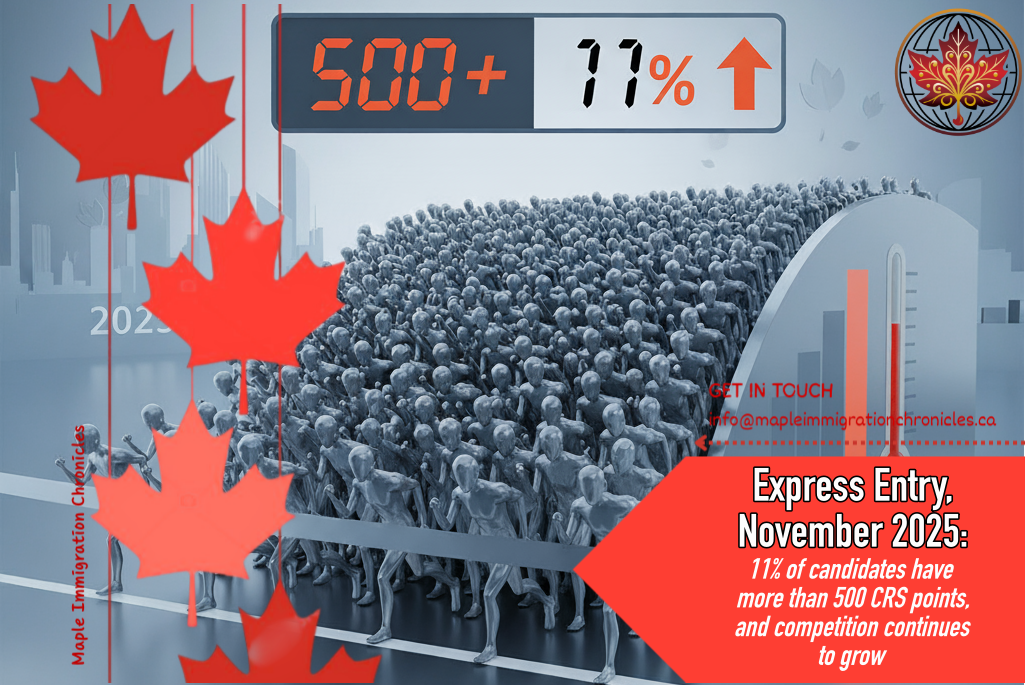
As of October 26, 2025, there are 248,253 profiles in the Express Entry pool. This

As of 9 November 2025, the Express Entry pool has remained very saturated and at
Throughout 2025, Canada’s provincial immigration experienced significant fluctuations. Most provinces and territories received an increase
The Express Entry system remains the main mechanism for selecting skilled workers who seek to
On the basis of summarized statistics for January–April 2025 we see essential difference between programs
Canada in 2025 year set ambitious goal: to grant 395,000 permits for permanent residence (PR).This
The Express Entry system is one of the main mechanisms for obtaining permanent resident status
August and early September 2025 became record-breaking for Canadian immigration. Several provinces and territories held
There is a widespread myth that after reaching 40 years old, obtaining permanent residence in
In 2025, Canada’s federal immigration policy moves to a moderate reduction of overall inflows of
Importance of Language Proficiency for Immigration Proficiency in English is one of the fundamental eligibility
Analysis developed on the basis of data from ATIP (Access to Information and Privacy request,
The Canadian Express Entry system, introduced back in 2015 as an innovative tool for selecting
Relevant as of August 12, 2025 The Ministry of Immigration, Refugees and Citizenship Canada
Recent trends in the processing of permanent residence applications through the Express Entry system raise
For any inquiries or assistance, feel free to reach out to us via email at [email protected]. We aim to respond within 24 hours.
You can contact us directly at +1 (647) 464-4526. Our team is available to assist you from Monday to Friday, 9 AM to 6 PM EST.
We welcome you to visit our office located at 295-297 Cosburn Ave., Toronto, Canada, M4J 2M5. Please call ahead to schedule an appointment.
© 2023 – 2025 Maple Immigration Chronicles. All rights reserved.