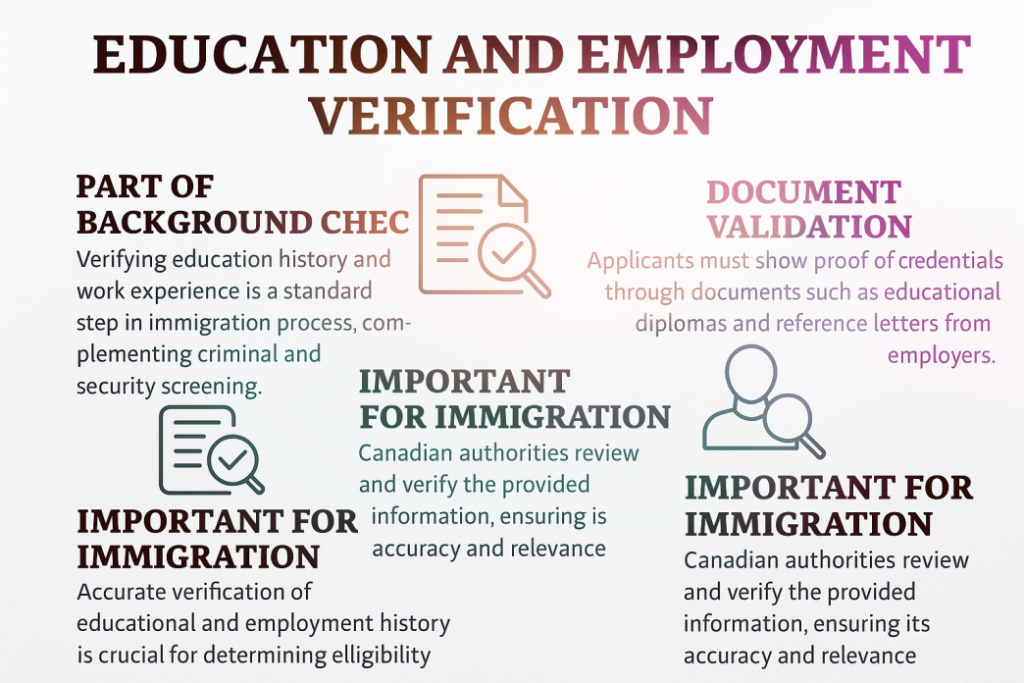
Employment verification is a critical component of the Canadian immigration background check process, especially for applicants applying under economic immigration streams such as the Federal Skilled Worker Program (FSWP), Canadian Experience Class (CEC), or Provincial Nominee Programs (PNPs). This step is designed to confirm the authenticity, accuracy, and relevance of an applicant’s declared work experience, which often forms the basis for eligibility and selection under these programs.
Verification Procedure and IRCC Requirements
To validate past and current employment, Immigration, Refugees and Citizenship Canada (IRCC) requires applicants to submit detailed and properly formatted reference letters from each employer. These letters must include the following key elements:
Job title(s) held during the period of employment;
Start and end dates (with exact day/month/year);
Detailed description of main duties and responsibilities;
Number of hours worked per week (full-time/part-time status);
Salary or wage received;
Name, title, and contact details of the person signing the letter.
In addition to reference letters, IRCC may request or consider additional supporting documents such as:
Pay stubs or salary slips;
Employment contracts;
Tax documents (e.g., T4 slips or Notice of Assessment in Canada);
Bank statements showing payroll deposits;
Business registration (for self-employed applicants);
Records of professional licenses or registrations (if applicable).
Government Verification Methods
Once the applicant submits these documents, IRCC may initiate independent verification as part of the background screening process. This may involve:
Contacting former employers or HR departments to confirm the authenticity of reference letters or verify specific employment details.
Reaching out to co-workers or listed references, particularly in cases where the employer cannot be reached.
Checking publicly available information, such as the applicant’s social media (FB, LinkedIn etc), the company’s registration status, website, business directories, or social media presence.
Cross-referencing employment dates with other parts of the application, including travel history, study history, and tax or immigration records, to ensure consistency and credibility.
Because employers may be contacted directly, it is advisable—when appropriate and feasible—to inform your current or former employer of your immigration application in advance. This can help ensure timely and accurate responses during verification and avoid confusion that might delay your file or trigger additional review.
Impact on Immigration Eligibility
Employment verification directly impacts an applicant’s eligibility and ranking under points-based programs like Express Entry. Verified work experience in a recognized National Occupational Classification (NOC) at TEER levels 0, 1, 2, or 3 can contribute significantly to CRS (Comprehensive Ranking System) scores or fulfill mandatory program criteria. For example:
Under the Federal Skilled Worker Program, a minimum of one year of continuous full-time (or equivalent) skilled work experience is required.
Under most PNP streams, the province may require two or more years of experience in a specific occupation or industry.
A strong and verifiable employment history not only fulfills eligibility conditions but may also increase competitiveness in candidate pools and expedite the issuance of Invitations to Apply (ITAs).
Consequences of Inconsistencies or Misrepresentation
Any inconsistency, omission, or inaccurate detail in declared work experience can trigger procedural fairness letters, delay processing, or result in refusal due to misrepresentation, which may carry serious consequences including a five-year ban from reapplying. Therefore, it is essential that all employment-related information be truthful, well-documented, and consistent across all forms and supporting documents.