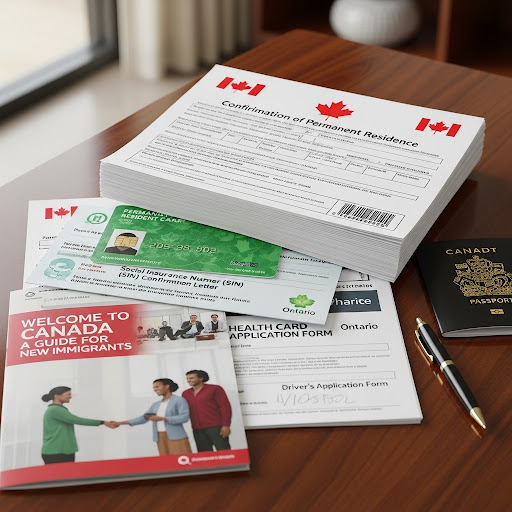
Settling In: Documents

Trends 2025:

In 2025, newcomers to Canada face tighter documentation rules and slower processing times, especially in health, government services, and provincial access.

1. Stricter Health Document Requirements

Provinces are now more rigorous in verifying medical records and vaccination histories, especially for children and seniors. Missing or untranslated documents can delay school enrollment and healthcare access.

2. Longer Wait Times

Applying for SINs, health cards, driver’s licenses, and child benefits now often requires advance appointments and longer queues, particularly in high-demand provinces like Ontario and B.C.

3. Digital ≠ Instant

Online submission options are expanding, but approval still takes time. Missing certified copies or translations can lead to unexpected rejections or delays.

4. Provincial Differences Growing

Provinces are applying their own specific rules, especially for health and education access. A document accepted in Alberta might not work in Quebec—check in advance.

What You Can Do
  • Review province-specific requirements before arriving.

  • Bring translated, certified hard copies.

  • Expect delays—plan ahead, not on arrival.

Your First Step to Adapting in Canada: Document Preparation

Settling in Canada can be both exciting and overwhelming. From adapting to a new culture and language to navigating government services, the transition takes planning and patience. One of the most effective ways to ease your settlement and immigration process is to prepare your documents well in advance. Whether you’re applying for permanent residency, enrolling your children in school, seeking healthcare, or starting employment, having your paperwork in order—from translations and certified copies to educational credentials and proof of funds—can save you time, reduce stress, and help you integrate more smoothly into Canadian life.

Advance preparation not only helps reduce stress and uncertainty during your first weeks in Canada, but it also lays a strong foundation for long-term success — enabling you to secure housing, apply for jobs or education programs, access healthcare and banking services, and begin building meaningful connections within your new community with greater confidence, efficiency, and peace of mind.

Are you settlement-ready or just travel-ready?

Travel-ready means you have the bare minimum:

✔️ A valid visa or work/study permit
✔️ A passport
✔️ A plane ticket
✔️ Possibly a few printed documents (just in case)

📁 You have all the documents needed to:
– Open a bank account
– Get your SIN and health card
– Apply for provincial programs
– Register your children for school
– Show proof of your work history and education for PR
– Rent an apartment and sign legal documents
– Navigate future immigration steps (PR, citizenship, etc.)

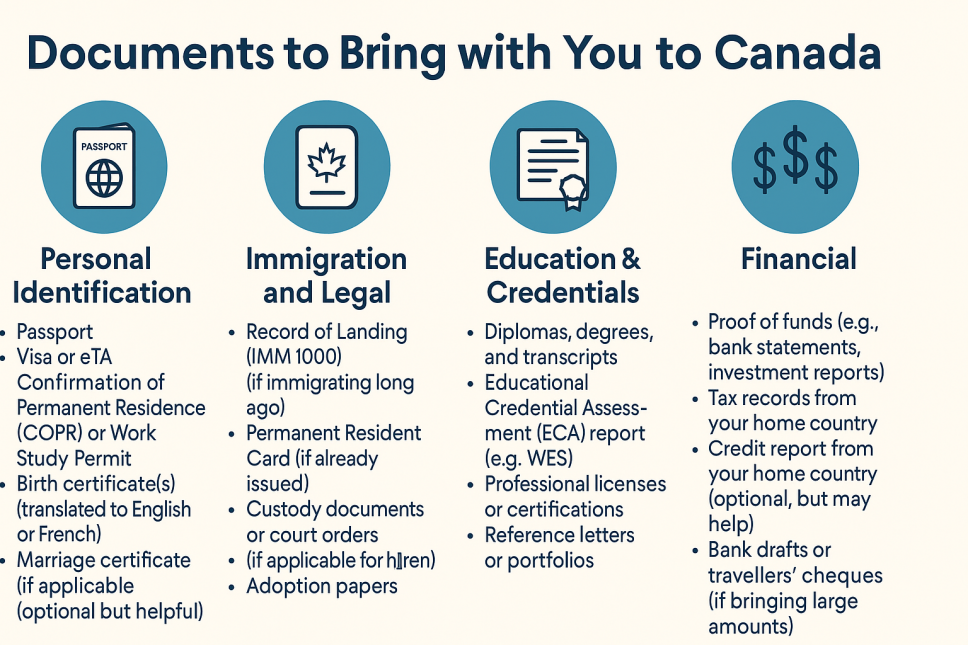
Documents to Bring with You to Canada

Moving to a new country is both exciting and complex. One of the best ways to ensure a smooth transition is by preparing and organizing your key documents in advance. Below are the main categories of documents you should bring with you to Canada, along with explanations of their importance and a detailed checklist under each section.

Preparing in advance not only eases the emotional and logistical stress that often comes with starting a new life in Canada, but also lays the foundation for a smoother and more confident transition. When your documents, personal records, and essential information are organized ahead of time, you’re better positioned to respond to everyday needs, adapt to new systems, and take advantage of opportunities in work, education, healthcare, and community life. 
Early planning allows you to settle in with greater clarity and focus, helping you build stability and feel more in control during a time of major change.

Personal Identification

Why it matters:
Personal identification is required for virtually all aspects of your life in Canada—from verifying your identity at the airport and opening a bank account to applying for health insurance, enrolling your children in school, and signing rental agreements.

Key documents to bring:

  • Passport (must be valid; include all family members)

  • Visa or eTA (Electronic Travel Authorization) – depending on your entry type

  • Confirmation of Permanent Residence (COPR) or Work/Study Permit – presented upon arrival

  • Birth certificate(s) for all family members (with certified translation in English or French)

  • Marriage certificate (if applicable; also translated if not in English/French)

  • Driver’s license from your home country – helps for ID purposes and vehicle rental

  • International Driving Permit (IDP) – optional but recommended if you plan to drive in the first few months

Why it matters:
These documents confirm your legal status in Canada and may be requested by immigration officers, service providers, or schools. Retaining proper documentation also protects your rights and assists with future applications for PR, citizenship, or sponsorships.

Key documents to bring:

  • Record of Landing (IMM 1000) – for those who immigrated to Canada before June 2002

  • Permanent Resident Card (PR Card) – if issued before arrival or for returning residents

  • Custody documents or court orders – essential when traveling with children without both parents

  • Adoption papers – if applicable to your family situation

  • Legal name change documents – if your name has changed and differs on official IDs

Why it matters:
Bringing a complete and well-documented record of your education and professional qualifications is critical if you plan to study, work in a regulated profession, or seek credential recognition in Canada.

Key documents to bring:

  • Diplomas and degrees – including high school, college, and university certificates

  • Academic transcripts – showing courses completed and grades received

  • Educational Credential Assessment (ECA) report – such as from WES, ICAS, or CES (required for Express Entry and sometimes for employment)

  • Professional licenses or certifications – e.g., nursing, engineering, teaching

  • Reference letters from former employers or academic institutions

  • Portfolio of work samples – for professionals in creative or technical fields

Why it matters:
Having proper financial documentation ensures that you can demonstrate proof of funds (if required for immigration), open a bank account, apply for credit, and manage your finances responsibly upon arrival.

Key documents to bring:

  • Proof of funds – such as:

    • Recent bank statements

    • Investment account summaries

    • Official letters from financial institutions

  • Tax records from your home country – useful when applying for certain credits or during tax filing in Canada

  • Credit report from your home country – optional, but may help you qualify for a Canadian credit card or loan

  • Bank drafts or traveler’s cheques – if bringing a large sum of money (note: cash over CAD $10,000 must be declared at the border)

Why it matters:
If you’re immigrating with children, having the proper documents ensures they can enroll in school without delay, access healthcare services, and receive any necessary accommodations for learning or medical needs. Canadian schools and health authorities often request original documents, so preparing ahead avoids unnecessary interruptions in your child’s adaptation process.

Key documents to bring:

  • Birth certificates – required for school registration and healthcare (translated into English or French)

  • Immunization/vaccination records – mandatory in most provinces for school enrollment
    (e.g., proof of MMR, DTP, polio, hepatitis B, etc.)

  • Medical and dental records – including:

    • Past health history and chronic conditions

    • Specialist reports (e.g., allergies, asthma, autism, ADHD)

    • Dental exams or treatment records

  • School transcripts and report cards – from the last academic year and earlier, if available

  • School attendance certificates – if transcripts are unavailable

  • Letters of reference from teachers or principals – describing the child’s academic progress and behavior

  • Psychological assessments or IEPs (Individual Education Plans) – if applicable, to support learning accommodations

  • Extracurricular certificates – music, sports, dance, coding, etc., to support integration and school placement

  • Custody or guardianship papers – if one parent is not present or if the child travels with a legal guardian

  • Passports and visas – same as for adult family members

Bringing the correct documents when arriving in Canada is essential not only for immediate needs such as accessing healthcare, enrolling children in school, or opening a bank account, but also for long-term goals like extending your status, applying for permanent residence, or proving your work and education history. Incomplete documentation can lead to delays, missed opportunities, or complications with immigration and government processes. It is therefore strongly recommended to prepare thoroughly in advance, keep both original and digital copies safely stored, and ensure all documents are up to date and, where necessary, translated and certified. Careful preparation now will significantly ease your settlement and strengthen your future applications in Canada.

Documents to Obtain After Arrival

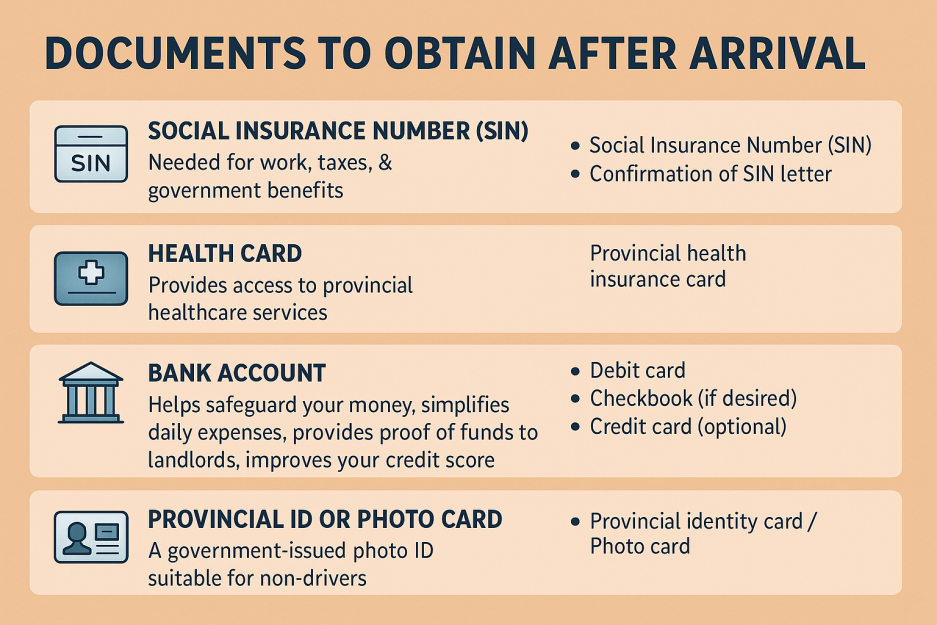
Arriving in Canada is an important milestone, but settling successfully requires more than just landing at the airport. In the first few days or weeks, you will need to obtain a number of essential Canadian documents that enable you to access healthcare, open bank accounts, work legally, enroll your children in school, and begin your new life with stability. These documents are critical for your integration and help confirm your legal status, identity, and eligibility for public services.

Each province or territory may have its own procedures, so it is important to check local guidelines. However, certain documents are necessary regardless of where you settle. These include your Social Insurance Number (SIN), health card, provincial ID or driver’s license, and school registration documents for children. Obtaining these promptly helps you access key services without delay and demonstrates your proactive approach to building a new life in Canada.

The Social Insurance Number (SIN) is one of the first and most important documents you should apply for after arriving in Canada. This nine-digit number is required to legally work in Canada and to access a wide range of government programs and services, including tax benefits and employment insurance. You should apply for your SIN as soon as possible, ideally within your first week in Canada. It is issued by Service Canada and can be obtained either online, in person at a Service Canada Centre, or by mail.

You will need:

  • Confirmation of Permanent Residence (COPR) or Work/Study Permit

  • Valid passport

  • Canadian mailing address (to receive documents if applying by mail)

In order to access public healthcare in Canada, you must register for a health insurance card specific to your province or territory of residence. This card proves your eligibility for publicly funded health services and is required each time you visit a doctor, clinic, or hospital. Each province has its own process and waiting period, so you should apply as soon as possible. Some provinces offer temporary coverage through private insurance during the waiting period.

You will need:

  • SIN (in some provinces)

  • Proof of residence (rental lease, utility bill, etc.)

  • COPR or Work Permit

  • Passport

  • For children: birth certificate and immunization records

Having a Canadian-issued photo ID is essential for everyday tasks such as banking, proving your identity, signing leases, or purchasing goods that require age verification. If you do not plan to drive, you can apply for a provincial photo identification card. If you hold a valid foreign driver’s license, some provinces allow you to exchange it without a driving test or with minimal requirements. Otherwise, you may need to undergo a knowledge and road test.

You will need:

  • Valid passport

  • COPR or Work Permit

  • Proof of residence

  • Existing foreign driver’s license (if applicable)

  • Passport-sized photos (depending on province)

Opening a Canadian bank account allows you to deposit money, receive payments, pay bills, and begin building your credit history. Many banks offer newcomer packages with no monthly fees for the first year. When opening a bank account, you’ll be asked to provide specific documents verifying your identity and immigration status. Applying for a credit card early is also recommended to establish a Canadian credit history.

You will need:

  • Passport

  • SIN

  • COPR or Work/Study Permit

  • Proof of address (lease, utility bill)

If you arrive with children, enrolling them in school is a priority. All children aged 6 to 18 must attend school in Canada. Public education is free for permanent residents and most temporary residents. To register, you’ll need documents that verify identity, legal status in Canada, and educational background. Schools may also request health and vaccination records before finalizing enrollment.

You will need:

  • Child’s passport

  • Child’s birth certificate (translated if needed)

  • Proof of immigration status (e.g., COPR, study permit of parent, etc.)

  • Proof of address

  • School records or report cards from previous schools

  • Immunization/vaccination records

  • Custody or guardianship documents (if applicable)

Having your medical documents ready can ease your transition into the Canadian healthcare system. Doctors and clinics may request your previous medical history, immunization records, and prescriptions. These documents are especially important for children, those with chronic illnesses, or anyone needing specialized care. Bringing records translated into English or French is highly recommended.

You should bring:

  • Personal and family medical history

  • Vaccination/immunization records (especially for children)

  • Prescription records (including dosage and reason for use)

  • Records of previous surgeries or major treatments

  • Allergy documentation

  • Blood type information (if known)

Securing key documents soon after arriving in Canada is essential for starting real life—from accessing healthcare and schooling to opening a bank account and getting a job. These documents also set the foundation for your long-term immigration journey. Acting early helps you settle faster and positions you for success in Canada.

Think you’ve packed all the right papers? Let’s double-check...

📝 Before you land:
  • Check our settlement document checklist – Make sure you’re bringing both original and certified translated copies of key documents.

  • Scan and back up all important documents (cloud + USB).

  • Organize your documents by purpose (e.g., Immigration, Housing, Employment, Education).

  • Review provincial requirements – each province has slightly different rules for ID, healthcare, driver’s licence, etc.

💬 Not sure what’s missing? We can help:

  • Book a Settlement Readiness Consultation – 45 minutes to review your situation and flag any document risks.

  • Ask us to translate or notarize your critical documents before departure.

  • Request help preparing a “PR-ready” work experience package (even if you’re not applying right away).

Province-Specific Documents & Procedures for Newcomers

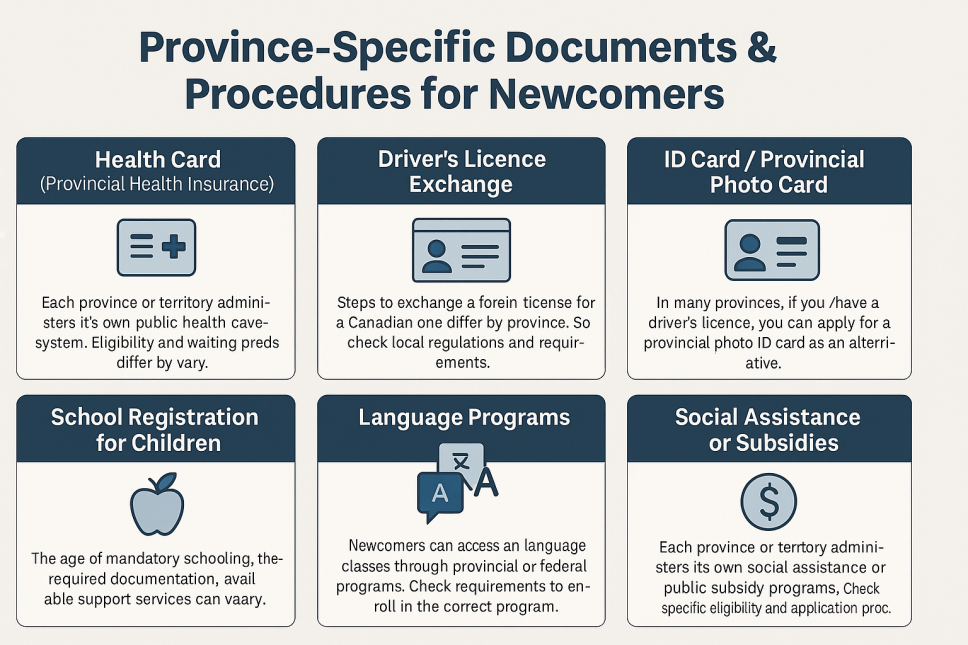
While many aspects of settling in Canada are consistent nationwide, each province and territory has its own procedures, requirements, and timelines when it comes to certain key documents and services. These include access to health insurance, driver’s licensing, provincial identification cards, and education registration. Understanding the differences between provinces is essential for a smooth transition, especially in your first few weeks after arrival.

🌐 Why Provincial Procedures Matter

Canada operates under a federal system where certain responsibilities—such as healthcare, education, and transportation—are managed at the provincial or territorial level. This means that services such as obtaining a health card, registering for school, or getting a driver’s license vary depending on where you live. For example, while Ontario and British Columbia offer immediate access to public healthcare for permanent residents, newcomers in Alberta or Quebec may face waiting periods. Similarly, driver’s license exchange rules differ across provinces.

Before arriving, or as soon as you settle, it’s highly recommended to review your province’s newcomer guide or consult an official government website. These guides often outline exact steps for accessing local services and list documents you’ll need to apply.

Access to public healthcare in Canada is provided through each province’s or territory’s health insurance plan. In order to receive free or subsidized medical services such as doctor visits, hospital care, and diagnostic tests, newcomers must apply for a provincial or territorial health card. This card confirms your eligibility and must be presented at every medical appointment.

ProvinceWaiting PeriodHealth PlanNotes
Ontario (ON)✅ No wait (since March 2020)OHIPApply with ID and proof of address
British Columbia (BC)⏳ 3 monthsMSP (Medical Services Plan)Coverage starts after wait; private insurance needed in the meantime
Alberta (AB)✅ Immediate (if eligible)AHCIPApply with work permit or PR + proof of address
Quebec (QC)⏳ 3 monthsRAMQMust apply separately and may need private insurance during wait
Manitoba (MB)⏳ 3 monthsManitoba HealthWaiting period applies unless exempt
Saskatchewan (SK)✅ Immediate (if eligible)Saskatchewan Health CardBring immigration documents and proof of address
Nova Scotia (NS)⏳ 3 monthsMSIMust reside in NS and plan to stay for 12+ months
New Brunswick (NB)✅ ImmediateNB MedicareNo waiting for PRs or valid work permit holders
Prince Edward Island (PEI)✅ Immediate (in most cases)PEI Health CardMust reside in PEI and intend to stay for 6+ months
Newfoundland & Labrador (NL)✅ ImmediateMCPPRs and most work permit holders eligible
Yukon / NWT / Nunavut⏳ 3 months (varies)Territorial Health PlansApply after arrival; details vary
📝 Why It Matters

The health card is one of the most essential documents you should obtain soon after arrival. Without it, you may be required to pay out of pocket for routine healthcare or emergency services. Each province has its own health insurance plan—such as OHIP in Ontario or MSP in British Columbia—and the rules for registration, eligibility, and waiting periods vary depending on your immigration status and the province where you live.

For permanent residents, most provinces allow registration upon arrival, although a few (like British Columbia and Quebec) impose a waiting period of up to three months before coverage begins. In such cases, it is advisable to purchase private health insurance for that interim period.

For temporary residents, such as those on work or study permits, eligibility for public healthcare varies more significantly. Some provinces offer full access to temporary workers and international students, while others require employer-sponsored insurance or student health plans.

🔍 What You Need to Apply

To register for a health card, you will typically need the following:

  • Immigration documents (COPR, PR card, work or study permit)

  • Proof of residency in the province (e.g., rental agreement, utility bill)

  • Personal identification (passport, provincial ID if already issued)

You must visit a designated service centre, such as:

  • ServiceOntario (Ontario)

  • Health Insurance BC (British Columbia)

  • Service Alberta

  • RAMQ (Quebec)

Some provinces also allow you to start the process online and later complete it in person.

🛡️ What’s Covered?

Once issued, your provincial health card grants you access to medically necessary services including:

  • Visits to family doctors and walk-in clinics

  • Emergency room care

  • Hospitalization

  • Medical imaging (X-rays, MRIs)

  • Laboratory services

Prescription drugs, dental care, and vision services are not covered under most provincial plans for adults, but may be partially covered for children or low-income residents through supplemental programs.

For many newcomers to Canada, driving is essential for commuting to work, running errands, or accessing services—especially in smaller cities or rural areas with limited public transit. One of the most practical steps after settling in a new province is to exchange your foreign driver’s license for a Canadian one.

Each province has its own rules for exchanging a foreign driver’s license:

  • Ontario: Exchange possible for some countries (e.g., Ukraine, U.S., South Korea) with a written test or road test exemption depending on experience.

  • BC: Allows license exchange for a limited number of countries. Others must take knowledge + road test.

  • Alberta: Also has agreements with selected countries; newcomers from other countries must go through GDL program.

  • Quebec: Offers exchange if your home country has a reciprocal agreement.

  • Atlantic provinces: Similar to Ontario/Alberta but may require additional documents like translation or driving experience letter.

👉 Bring a certified translation of your foreign license + driving history letter (if available).

📄 Why It’s Important

Your foreign driver’s license may be valid for a limited time only (usually 60 to 90 days) after you arrive in Canada, depending on the province. After this period, you must hold a valid Canadian license to legally drive. Driving without a valid license or insurance is a serious offence and can result in fines, penalties, or denial of coverage in case of an accident.

🔁 Exchange Process

Canada has reciprocal license exchange agreements with several countries. If you’re from one of these jurisdictions (such as the U.S., U.K., France, Germany, South Korea, or Australia), you may exchange your license directly without having to take a written knowledge test or road test—provided you meet the criteria and present proper documentation.

If you’re from a country without an exchange agreement, you will typically need to:

  1. Take a written knowledge test on local traffic rules and signage.

  2. Pass a vision test.

  3. Provide proof of driving experience (e.g., an official letter from your home country’s licensing authority).

  4. Schedule a road test, depending on your experience and provincial rules.

🧾 What You’ll Need

To exchange or apply for a driver’s license, you typically must present:

  • Valid foreign driver’s license (with certified translation if not in English/French)

  • Proof of immigration status (PR card, COPR, work or study permit)

  • Proof of residency in the province (e.g., utility bill, lease)

  • Identity documents (e.g., passport)

  • Proof of driving history (optional but strongly recommended)

Each province has its own licensing authority:

  • ServiceOntario (Ontario)

  • ICBC – Insurance Corporation of BC (British Columbia)

  • SAAQ (Société de l’assurance automobile du Québec)

  • Service Alberta

Visit your province’s transportation ministry website for detailed steps and fee information.

🚘 Graduated Licensing

If you cannot exchange your license, or if you are a first-time driver, you may be required to go through Canada’s Graduated Licensing System, which involves:

  • A written test and vision test (Level 1 / G1)

  • A mandatory waiting period and road test (Level 2 / G2)

  • A final road test for a full license (G class in Ontario, Class 5 in Alberta, etc.)

For newcomers who do not drive, obtaining a government-issued photo identification card is essential. This Provincial Photo Card, sometimes called a Non-Driver’s ID, provides an official form of identification that can be used for various day-to-day needs.


Each province offers its own non-driver ID card for residents without a driver’s license:

  • Ontario Photo Card

  • Alberta ID Card

  • BC Services Card (also used for healthcare and other services)

  • Québec Health Insurance Card doubles as ID

These require proof of:

  • Identity

  • Residency in the province

  • Legal status in Canada

📌 Why It’s Important

Having an official photo ID helps you:

  • Open a bank account

  • Verify your identity for government services

  • Access healthcare

  • Pick up parcels or registered mail

  • Prove your age (for example, when purchasing restricted products)

  • Travel domestically within Canada

While your passport or immigration documents can serve as ID, it’s safer and more practical to carry a local ID card for daily use. This helps avoid the risk of losing your passport or important immigration paperwork.


🏛 Where and How to Apply

You can apply for a Provincial Photo ID card at your local provincial service centre, such as:

  • ServiceOntario in Ontario

  • SAAQ in Quebec

  • Service Alberta

  • Access Nova Scotia

  • Manitoba Public Insurance (MPI)

These cards are available to Canadian citizens, permanent residents, temporary residents, and refugee claimants, depending on the province. Some provinces allow applicants as young as 12 or 16 to apply with parental consent.


📑 What You’ll Need to Apply

While exact requirements vary by province, you generally need to present:

  • Proof of legal status in Canada (e.g., PR card, COPR, study/work permit)

  • Proof of residence in the province (e.g., utility bill, lease agreement)

  • Supporting identity documents (passport, birth certificate, etc.)

  • Application form (may be completed online or in person)

  • Fee payment (ranges from $25 to $40, depending on province)


🧠 Tips and Notes
  • The card is not valid for international travel, but it’s accepted for most domestic identification purposes.

  • If you later obtain a driver’s license, you may be required to surrender your non-driver ID (as you generally cannot hold both).

  • Keep your address updated. If you move within the province, notify the issuing office to avoid delays in receiving renewals or service interruptions.

One of the most important tasks for newcomer families is registering their children in school. Canada offers publicly funded elementary and secondary education that is generally free for residents, including permanent residents, refugee claimants, and most work or study permit holders. Education is not only a right but also a legal requirement for school-age children in Canada.

All provinces require:

  • Proof of child’s age (passport or birth certificate)

  • Proof of address (lease, utility bill)

  • Immunization record

  • Immigration documents (e.g., COPR, visa)

📝 Some provinces (e.g., Ontario, Quebec) also offer language assessment centres to place students in appropriate ESL/FSL support programs.


📌 Why It Matters

Registering your child for school early helps ensure:

  • A smooth academic transition

  • Faster language learning and social integration

  • Access to additional newcomer support services

  • A stable routine that supports mental and emotional well-being

Each province administers its own education system, so policies, start dates, and grade levels may vary slightly.


🏫 When and Where to Register

You can register your child before the school year begins (typically in September) or at any point during the year if you’ve just arrived. Contact the local public school board (or Catholic/Francophone board if applicable) to find out:

  • Which school your child is eligible to attend

  • What documents are needed

  • Whether any language assessments are required

Many school boards also offer Welcome Centres for Newcomers, which provide settlement assistance and school orientation.


📑 Documents Typically Required

Although each school board may have slightly different requirements, you will usually need to provide:

  • Proof of child’s identity:
    ▫ Passport or birth certificate
    ▫ Immigration document (e.g., COPR, refugee claimant document, PR card)

  • Proof of parent/guardian’s legal status:
    ▫ Study permit, work permit, COPR, or PR card

  • Proof of address in the school district:
    ▫ Utility bill, rental/lease agreement, or bank statement

  • Immunization and health records:
    ▫ Required for school entry in most provinces

  • Previous school records (if available):
    ▫ Report cards, transcripts, or school transfer certificates


🧠 Tips and Notes
  • Some boards may require a language placement test (e.g., for English or French as a second language).

  • Children are usually placed in a grade according to age, even if their academic background differs.

  • Ask about free programs such as ESL/FSL support, breakfast clubs, after-school care, and tutoring.

  • If your child has special needs, mention this during registration so that an Individual Education Plan (IEP) can be prepared if needed.

Language skills are one of the most important factors in helping newcomers settle successfully in Canada. English or French proficiency enhances access to education, employment, and public services, and supports long-term integration into Canadian society. That’s why federal and provincial governments offer free or subsidized language programs for eligible newcomers.

However, the requirements, availability, and administration of these programs vary by province and territory, so it is important to understand your options based on where you settle.

Funded by IRCC or provinces:

  • Ontario, Alberta, BC: LINC (Language Instruction for Newcomers to Canada)

  • Quebec: Offers Francisation programs via Ministère de l’Immigration

  • Atlantic & Prairie provinces: LINC + regional settlement agencies


🇨🇦 National Framework

Federally funded language training programs such as Language Instruction for Newcomers to Canada (LINC) and Cours de langue pour les immigrants au Canada (CLIC) are offered across Canada (except Quebec) to eligible permanent residents and protected persons. These programs are free of charge and include:

  • General English or French

  • Workplace and academic language training

  • Childcare services for parents attending classes (where available)

  • Full-time or part-time formats

To register, newcomers must first take a language assessment at a designated testing centre, which determines placement based on the Canadian Language Benchmarks (CLB).


🏛️ Provincial Differences and Programs

Each province may offer additional language training beyond federal LINC/CLIC, often tailored to employment, specific professions, or regional needs. Here’s a brief overview:

  • Ontario: Offers both LINC and Enhanced Language Training (ELT) programs focused on workplace skills, plus Occupational-Specific Language Training (OSLT). School boards and colleges are major providers.

  • British Columbia: BC Settlement and Integration Services deliver free language training for eligible adults. The ELSA program was replaced by LINC, but other provincially funded programs remain available through community colleges.

  • Alberta: Offers LINC and Community Adult Learning Programs (CALP) with ESL support. Calgary and Edmonton have dedicated newcomer language centres.

  • Manitoba: Has the English Online program and Manitoba Start, which combines employment and language training. Language Bank services also exist for job seekers and professionals.

  • Saskatchewan: Provides English training through regional colleges and Settlement Workers in Schools (SWIS) who help newcomer families. There are also specialized rural language programs.

  • Quebec: Does not participate in LINC. Instead, it offers Francisation Québec, a provincial program run by the Ministry of Immigration, Francisation and Integration (MIFI). These French courses are often free and may include financial assistance.

  • Atlantic Provinces (Nova Scotia, New Brunswick, PEI, Newfoundland and Labrador): Provide LINC and provincial ESL programs through immigrant settlement associations and community colleges.

  • Territories: Language services are adapted for remote and multilingual populations, with offerings through territorial governments and local NGOs.


📋 Typical Requirements

To enroll in most government-funded language programs, you will typically need:

  • Proof of immigration status (e.g., PR card, COPR, refugee status)

  • Language assessment results (from a recognized centre like YMCA or ISSofBC)

  • Proof of address (for provincial eligibility)

  • Age requirement (usually 18+, though some programs for youth exist)

Temporary residents such as work or study permit holders may not be eligible for federally funded LINC/CLIC but may still access fee-based or community-sponsored ESL/FSL programs.


🔍 How to Register
  1. Locate the nearest Language Assessment and Referral Centre.

  2. Book a free language assessment (CLB or NCLC).

  3. Receive placement in an appropriate class (daytime, evening, online).

  4. Attend regularly and track your CLB progress.

Social assistance programs in Canada provide financial support and essential benefits to individuals and families who are experiencing financial hardship. These programs are administered by provinces and territories, which means that eligibility rules, benefit amounts, and required documentation vary depending on where you live.

While permanent residents, refugees, and some protected persons may be eligible for income assistance, temporary residents (including work and study permit holders) are usually not eligible unless a specific program states otherwise.

If needed, each province has different criteria and application processes for:

  • Housing subsidies

  • Child benefits (provincial supplements in addition to CCB)

  • Income assistance or emergency aid

  • Childcare subsidies

🧾 Documentation usually needed: PR/permit documents, proof of income, rent, bank statements.


🇨🇦 Federal vs. Provincial Roles
  • The federal government oversees immigration and provides some nationwide benefits (e.g., Canada Child Benefit).

  • Provinces and territories are responsible for delivering income support programs, including:

    • Basic financial assistance

    • Rental or housing subsidies

    • Utility or heating subsidies

    • Childcare subsidies

    • Medical or dental coverage for low-income residents

Each jurisdiction uses different program names, application procedures, and eligibility criteria.


🏛️ Provincial Differences at a Glance
Ontario – Ontario Works (OW)
  • Offers basic income, drug coverage, vision and dental for children, job search support.

  • Eligibility is based on financial need, immigration status, and willingness to seek work.

  • Permanent residents, Convention refugees, and protected persons may apply.

British Columbia – BC Employment and Assistance (BCEA)
  • Includes basic needs assistance, rental supplements, emergency hardship assistance, and health support.

  • Some services available to refugee claimants and temporary residents under special cases.

  • BC Housing also offers rental subsidy programs like SAFER (for seniors) and RAP (for families).

Alberta – Income Support Program
  • Offers financial aid for living expenses and job training programs.

  • Must be a Canadian citizen, permanent resident, or refugee.

  • Alberta also offers Childcare Subsidy and Alberta Child and Family Benefit for eligible families.

Manitoba – Employment and Income Assistance (EIA)
  • Financial help for basic needs, shelter, and employment training.

  • Open to permanent residents, refugees, and protected persons residing in Manitoba.

  • Manitoba also provides Rent Assist, which is available to low-income earners whether on EIA or not.

Quebec – Social Assistance and Social Solidarity Program
  • Administered by Ministère du Travail, de l’Emploi et de la Solidarité sociale.

  • Eligibility includes residence in Quebec and financial need.

  • Quebec offers unique subsidies, including childcare at reduced rates and income supplements for French language learners.

Atlantic Provinces
  • Nova Scotia: Income Assistance program + shelter allowance; administered by the Department of Community Services.

  • New Brunswick: Social Assistance and Housing Support; varies depending on family size and shelter cost.

  • PEI & Newfoundland: Provide basic financial support, heating subsidies, and special assistance for single parents or people with disabilities.

Territories
  • Each territory (Yukon, Northwest Territories, Nunavut) offers Income Assistance programs tailored to remote and Indigenous communities, often including food and fuel support.


📋 General Eligibility Requirements

While specifics vary, you may typically need to provide:

  • Proof of immigration status (PR card, refugee status, COPR)

  • Proof of address and rent/housing cost

  • Information on household income and assets

  • SIN number (for certain benefits)

  • Bank statements, bills, lease agreements

  • Proof of job search (in many provinces)

  • Childcare or medical expense receipts (if applying for subsidies)


🛑 Important Notes for Newcomers
  • Applying for social assistance does not affect your immigration status if you are a permanent resident, refugee, or protected person.

  • However, sponsors of family-class immigrants (e.g., spousal sponsorship) may be penalized if the sponsored person applies for social assistance during the undertaking period.

  • If you’re a refugee claimant or temporary resident, seek legal advice or speak with a local settlement agency before applying for assistance.

While federal documents such as your Permanent Resident (PR) card, Social Insurance Number (SIN), and banking arrangements are standardized and consistent across all of Canada, many essential aspects of daily life—such as healthcare coverage, driver’s licensing, school enrollment for children, and access to social assistance or public subsidies—are governed at the provincial or territorial level. This means that upon arrival, newcomers must navigate a separate set of rules, procedures, and eligibility criteria depending on the province or territory in which they choose to settle.

Each province has its own health insurance registration system, driver’s license exchange process, and public school admission policies, as well as unique language training programs, housing supports, and social benefit structures. Understanding and completing these provincial requirements in a timely manner is critical for ensuring a smooth and stable integration into Canadian society.

Why the Right Documents Matter: Don’t Just Arrive—Be Ready to Settle

When newcomers arrive in Canada without key documents, they often face unexpected delays and serious barriers:

  • You may be refused service when trying to open a bank account or rent housing.

  • You may struggle to access healthcare or register your children for school.

  • You may be unable to prove your work history or education, delaying your future Permanent Residence or credential recognition.

  • You may face complications with IRCC, especially if you can’t provide consistent or translated documentation when requested.

In the worst-case scenario, missing or incomplete documentation can jeopardize your immigration process altogether—especially if you can’t prove ties, history, dependants, or financial sufficiency when asked.

Arriving with just a suitcase means you’re travel-ready.
Arriving with the right paperwork means you’re future-ready.

FAQ about Settling-In Documents

Travel documents (like a visa and passport) help you enter Canada. Settlement documents help you live, work, study, and access services once you’re here (e.g., diplomas, immunization records, birth/marriage certificates, proof of work experience).

Always carry your passport, visa/permit, COPR, and any supporting documents such as invitation letters, proof of funds, or medical results in your carry-on—never checked baggage.

Bring both the original diploma and a certified translation (if not in English or French). Copies can be useful, but originals may be required for credential assessment or job interviews.

Digital copies are helpful backups, but most government and banking institutions will require originals or certified true copies, especially for identification, education, and legal documents.

Bring reference letters on company letterhead, pay slips, employment contracts, and translated versions if necessary. These are essential for job applications, immigration, and credential recognition. higher in all four abilities).

Yes. Most provinces require immunization records for school enrollment and may ask for them during public health registration. Bring translated copies of your child’s and your own immunization history.

Absolutely. Bring birth certificates, school transcripts, immunization records, custody papers (if applicable), and any education-related documents for a smooth transition into Canadian schools.

Keep all immigration, education, employment, and health documents indefinitely. Many may be needed again when applying for PR, citizenship, jobs, or school admissions.

Yes. For example, health card registration, school enrollment, or driver’s license exchanges may have province-specific requirements. Always check with the provincial government where you plan to settle.

It depends on the document. Some can be obtained later (like bank letters), while others (like foreign police certificates or diplomas) may be hard or slow to retrieve. Delays or refusals are possible. Seek help from a settlement agency or lawyer if this applies to you.

Latest Posts on Documemts

Email Us

For any inquiries or assistance, feel free to reach out to us via email at [email protected]. We aim to respond within 24 hours.

Call Us

You can contact us directly at +1 (647) 464-4526. Our team is available to assist you from Monday to Friday, 9 AM to 6 PM EST.

Visit Us

We welcome you to visit our office located at 295-297 Cosburn Ave., Toronto, Canada, M4J 2M5. Please call ahead to schedule an appointment.