Immigration : Documents

Trends 2025:

In 2025, immigration applications are facing stricter scrutiny than ever. IRCC and its partner agencies now demand full accuracy, truthfulness, and proper formatting—errors are no longer tolerated.


1. Full Disclosure is Mandatory
All history—personal, address, education, employment, and travel—must be complete and gap-free. Even minor omissions may trigger delays or refusals.

2. Zero Tolerance for Misrepresentation
False or incomplete answers on IMM forms can lead to a five-year ban under IRPA s.40. IRCC now routinely cross-checks all details.

3. Deep Background Verification
Security screenings by CSIS and CBSA have expanded. Applicants from flagged regions face extended reviews, especially if any inconsistencies are found.

4. Strict Adherence to IRCC Formatting Rules
Each document (e.g., translations, affidavits, employer letters) must follow IRCC requirements exactly. Non-compliant submissions may be rejected without processing.

5. NOC and Employment Letters Must Match Precisely
Duties listed in job letters must align with the selected NOC. Inconsistencies between documents and forms are a common cause for refusal.

6. Professional Review is Now Standard Practice
Due to complexity, most applicants now seek help from RCICs or immigration lawyers to check forms, supporting documents, and submission sequences.

7. Supporting Documents Are Scrutinized Line-by-Line
Every file is reviewed for content, not just upload. Incomplete, vague, or generic documentation will not pass officer review.


Conclusion:
In today’s immigration landscape, strong documentation is not just important—it is decisive. Accuracy, honesty, and compliance with IRCC standards are the foundation of a successful application.

Your Path to Immigration Success: Document Preparation That Matters

In the immigration process, having the right documents is not just a formality—it is a legal necessity that directly influences the outcome of your application. Each stage, from temporary residence to permanent residency, requires specific, accurate, and timely documentation that proves your identity, eligibility, purpose of stay, and compliance with Canadian regulations. Missing or incorrect documents can lead to delays, refusals, or even inadmissibility, potentially jeopardizing your future in Canada. Proper preparation ensures that your application meets all procedural and legal standards set by Immigration, Refugees and Citizenship Canada (IRCC).

Beyond legal compliance, having the correct documents provides clarity and credibility to your immigration story. It demonstrates your preparedness, strengthens your case, and supports your intent to integrate and contribute to Canadian society. Whether applying for a study permit, work permit, or permanent residency, well-organized documentation—such as proof of funds, medical exams, police certificates, and employment records—reinforces your commitment and reliability in the eyes of immigration officers. In short, documentation is not just paperwork; it is the foundation of a successful immigration journey.

Truth, Details, and Documentation — Or Rejection

Did you leave gaps in your travel or employment history? Is your job letter vague?

IRCC no longer tolerates guesswork or partial answers. If you’re not 100% truthful and detailed, your file could be flagged for security screening or rejected outright.

Book a document review session with an expert today
🔍 Get your submission audited line-by-line before it reaches IRCC

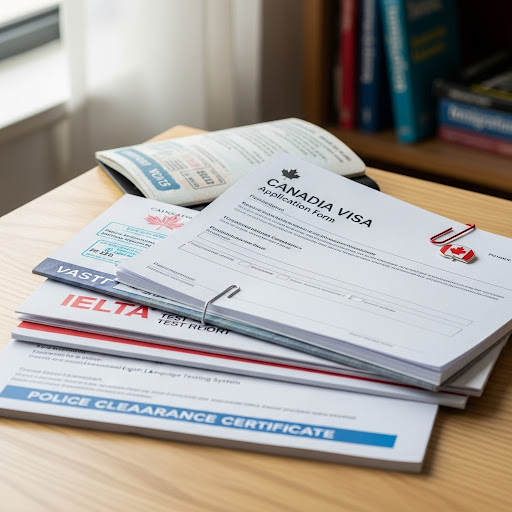
Application Documents (for Visa, Permit, or PR Application)

When applying for any form of immigration status in Canada—whether a temporary visa, a study or work permit, or permanent residence—it is essential to understand that your application is only as strong as the documents you submit. Immigration officers do not assess your intentions based on conversation or interviews; instead, they evaluate the accuracy, consistency, and completeness of your paperwork. Each document must clearly demonstrate that you meet the eligibility criteria, that your case is genuine, and that you have no inadmissibility concerns. Missing, inconsistent, or poorly prepared documents often result in delays, procedural fairness letters, or outright refusals.
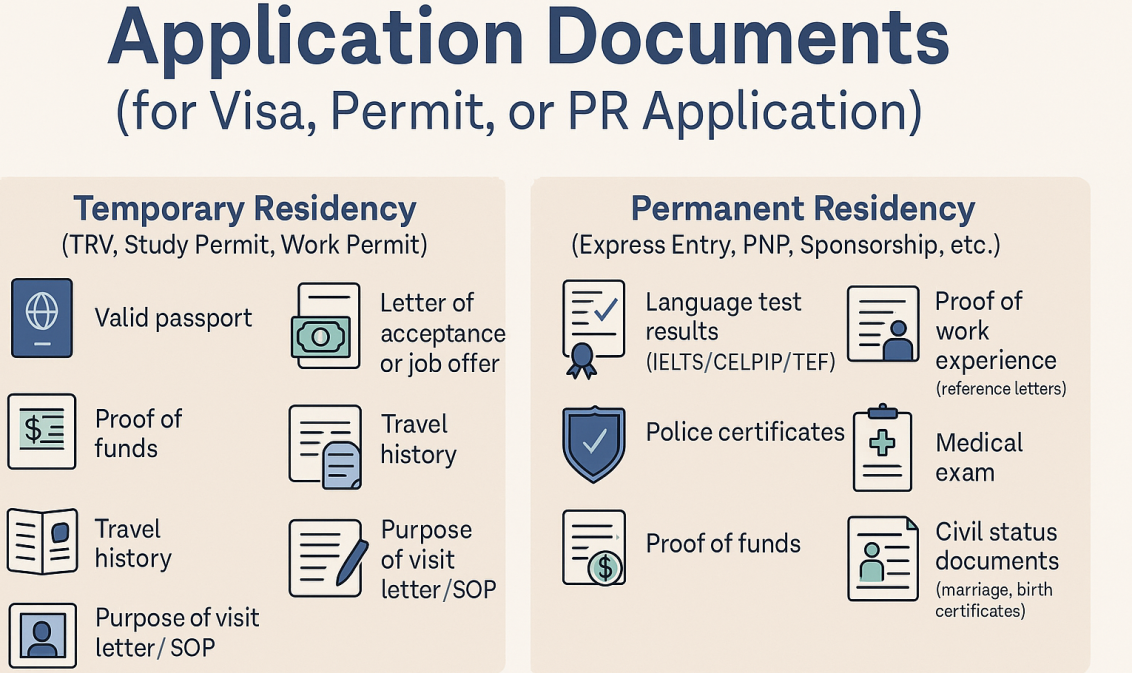
Canada’s immigration system relies heavily on documentary evidence to assess an applicant’s background, purpose, and credibility. This means that even a seemingly small oversight—like an outdated form, a missing signature, or a vague reference letter—can jeopardize your application. Therefore, it is crucial to approach documentation not as an afterthought, but as a core part of your immigration strategy. Preparing the right documents in the correct format, and according to the latest IRCC requirements, is the foundation of a successful application.

These are the core documents required when applying for any immigration status — whether temporary or permanent.

A passport must be valid for the duration of the intended stay in Canada. It should be clear and legible, with at least one blank page, and free from damage. Many visa offices also require copies of all pages containing visas, stamps, and previous travel history.

For study permits, an official Letter of Acceptance from a Designated Learning Institution (DLI) is mandatory. For work permits, a job offer from a Canadian employer—often supported by a Labour Market Impact Assessment (LMIA) or other exemption codes (e.g., under international agreements or spousal policies)—must be submitted. This document must include job title, duties, wage, duration, and workplace location.

Applicants must show sufficient financial capacity to cover tuition (if applicable), travel, and living expenses. This can be demonstrated via personal or joint bank statements, employment letters, financial guarantees, proof of scholarship, or financial support letters from parents or sponsors. Funds must be recent, verifiable, and consistent with the stated purpose of stay.

A well-documented travel history, including visas and entry/exit stamps from other countries, can help demonstrate the applicant’s record of lawful travel and compliance with visa conditions. It may support the credibility of the applicant’s intent to return after their temporary stay in Canada.

This written explanation outlines the applicant’s goals, ties to their home country, reasons for choosing Canada, and plans after their authorized stay ends. It must be personalized, fact-based, and aligned with the documents provided. It is often a key factor in assessing the applicant’s bona fide intent.

As part of the application process, most applicants must submit biometric data (fingerprints and digital photo) at a Visa Application Centre (VAC). IRCC issues a Biometric Instruction Letter (BIL) after submission, which must be brought to the appointment.

Language proficiency in English or French must be proven through an approved test taken within the past two years. Test results are required for all Express Entry streams and most Provincial Nominee Programs (PNPs), and scores must meet the minimum Canadian Language Benchmark (CLB) thresholds relevant to each program.

Foreign degrees or diplomas must be evaluated by a recognized body (e.g., WES, IQAS, CES) to confirm Canadian equivalency. This step is mandatory for the Federal Skilled Worker program and for anyone claiming education points under Express Entry, unless the education was completed in Canada.

Applicants must provide detailed letters from current and previous employers confirming job title, duties (aligned with NOC codes), hours worked, salary, and duration of employment. Letters must be on company letterhead and signed by authorized representatives. Additional supporting evidence (e.g., pay stubs, contracts, T4s) may strengthen the submission.

A criminal background check is required for all countries where the applicant (and adult dependents) lived for six or more consecutive months since the age of 18. These certificates must be recent and meet IRCC’s formatting and translation standards. Delays or issues in obtaining them should be proactively addressed.

A panel physician authorized by IRCC must perform an immigration medical examination (IME). The applicant receives an e-Medical confirmation document, which must be uploaded to the portal. Medicals are valid for 12 months and must be valid at the time of landing.

Unless exempt (e.g., under the Canadian Experience Class or with a valid job offer), applicants must show a minimum settlement fund threshold based on family size. Funds must be available, transferable, and free from debt obligations. Acceptable documentation includes official bank statements, GICs, or financial letters from banking institutions.

These include birth certificates, marriage certificates, divorce or separation judgments, death certificates (if applicable), and custody documents for dependent children. Accurate civil documentation is essential for verifying family relationships, marital status, and eligibility for accompanying family members.

Whether applying for temporary or permanent residency, the strength of your immigration case depends not only on your eligibility but on your ability to clearly demonstrate that eligibility through accurate, well-organized, and complete documentation. Each document serves a specific legal function—proving your identity, background, qualifications, or intent—and immigration officers rely on this evidence to assess your case objectively.

Insufficient, inconsistent, or poorly prepared documents are among the most common reasons for delays, procedural fairness letters, or refusals. Conversely, well-prepared documentation signals credibility, readiness, and compliance—three qualities that increase the likelihood of a positive outcome. Preparing your documents is not merely an administrative step; it is the legal and strategic foundation of your application. Taking the time to ensure every form, certificate, letter, and supporting document is complete, current, and tailored to your immigration purpose is one of the most effective ways to protect your status and your future in Canada.

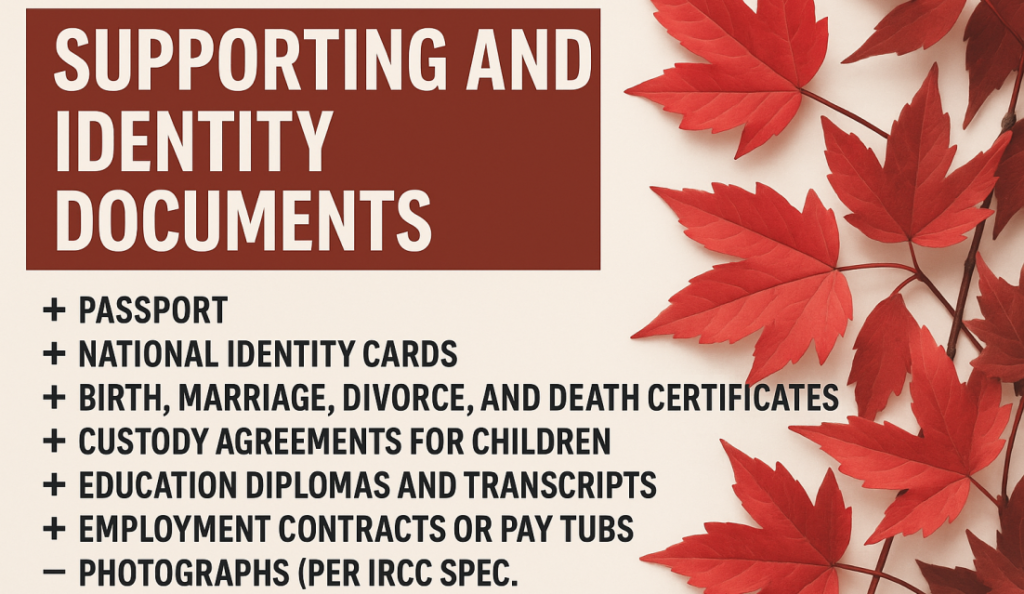
Supporting and Identity Documents

Supporting and identity documents play a critical role in the integrity and credibility of any immigration application. While primary application documents confirm eligibility, it is the supporting records—such as passports, birth and marriage certificates, ID cards, and translations—that provide the factual backbone of your personal and family profile. These documents are essential for confirming your identity, civil status, travel history, and the relationships between accompanying family members. They also help immigration officers validate that your claims are consistent, genuine, and verifiable across different systems and jurisdictions.

In many cases, missing or unclear supporting documents can trigger delays, additional requests, or even procedural fairness letters. In contrast, a clearly documented case—where each fact is backed by an official source—saves time, avoids misinterpretation, and strengthens your application. Whether you’re applying for a visa, work permit, or permanent residence, the correct use of supporting and identity documents ensures that your profile is complete, transparent, and aligned with IRCC’s legal and administrative standards.

These documents support your personal history, identity, and eligibility — and are often requested during background checks, AOR, or later stages.

The passport is the primary international identification document. IRCC requires a clear and valid copy of the bio-data page, and in many cases, copies of all used pages—including visas, entry/exit stamps, and residency permits from other countries. These pages are used to verify your travel history, legal status in previous countries, and compliance with immigration laws. Incomplete or altered passport copies can result in credibility concerns or refusals. Therefore, it is crucial to submit a complete, high-resolution scan, ensuring the passport is current and free from inconsistencies.

National ID cards are often required to confirm an applicant’s legal name, place of birth, citizenship, and civil registration within their country of origin. In some jurisdictions, this ID may also reflect marital status or address. Providing accurate and legible copies of your national ID strengthens your identification records, especially in cases where multiple documents use different naming conventions or date formats. Authenticity is key—any forged, expired, or unofficial documents can lead to a misrepresentation finding, which carries a five-year ban from Canada.

These civil status documents are vital for confirming family relationships, dependent eligibility, and sponsorship claims. For instance, a birth certificate confirms a child’s relationship to the main applicant; a marriage certificate validates a spousal relationship; and a divorce decree is needed if remarried or sponsoring a new spouse. Death certificates are sometimes required to prove legal guardianship or widowhood. Any discrepancies—such as name mismatches or inconsistent dates—must be clarified with supporting affidavits or official amendments. IRCC requires official, government-issued certificates with certified translations into English or French, if applicable.

If you are immigrating with a dependent child and the other parent is not accompanying you, a notarized custody agreement or consent letter is required. This document must demonstrate that the accompanying parent has legal authority to bring the child to Canada. Without proper documentation, IRCC may view the child’s inclusion as unlawful, triggering refusal or delay. The custody agreement must be court-issued or notarized, and include clear terms of custody, guardianship, or travel consent. Accuracy and proper translation are essential to avoid misinterpretation.

Academic documents validate your educational background and may be used to support Express Entry point calculations, work permits under certain LMIA-exempt streams, or provincial nomination eligibility. Diplomas alone are not enough—IRCC often requires full transcripts showing dates of attendance, courses completed, and graduation status. The documents must be issued by accredited institutions, and any false or unverified credentials can trigger allegations of misrepresentation. For foreign education, documents must be submitted to an approved Educational Credential Assessment (ECA) agency for verification.

These documents serve as evidence of your past or current work experience, which is often central to your eligibility under economic immigration streams or work permit applications. They should show job title, duration, salary, employer’s name, and location, and ideally match your reference letters. Pay stubs or tax documents (e.g., T4s in Canada) help verify that employment was genuine and compensated. Submitting altered, incomplete, or unverifiable documents may lead to your work history being disqualified from point calculations or eligibility assessments.

Photographs are a formal requirement across all IRCC applications, from visa applications to permanent residence and PR card renewals. Photos must meet precise dimensions, background colour, and quality standards. IRCC may return your application or delay biometrics if the photos are blurry, the wrong size, or digitally modified. It is advisable to have photos taken by a professional photographer familiar with IRCC guidelines. Proper labeling on the back (name and date) is often required by IRCC for physical submissions.


In all cases, accuracy, consistency, and authenticity are essential. Submitting false or incomplete identity documents—even unintentionally—can result in application refusal, inadmissibility, or a ban for misrepresentation. Ensure that all documents are official, complete, and, if necessary, accompanied by certified translations and affidavits to clarify discrepancies. This diligence significantly increases the credibility of your application and helps build a transparent, verifiable personal history in the eyes of Canadian immigration authorities.

Are your IMM forms complete, consistent, and fully accurate? Let’s double-check...

In 2025, even a small mistake—or missing date—can trigger misrepresentation concerns, delays, or refusals. IRCC now runs deep cross-checks with CBSA, CSIS, and global databases.

💬 Not sure what’s missing? We can help:

  • Book a Final Check Consultation – 60 minutes to review your situation and flag any document risks.

  • Ask us to translate or notarize your critical documents before departure.

  • Request help preparing a “PR-ready” work experience package (even if you’re not applying right away).

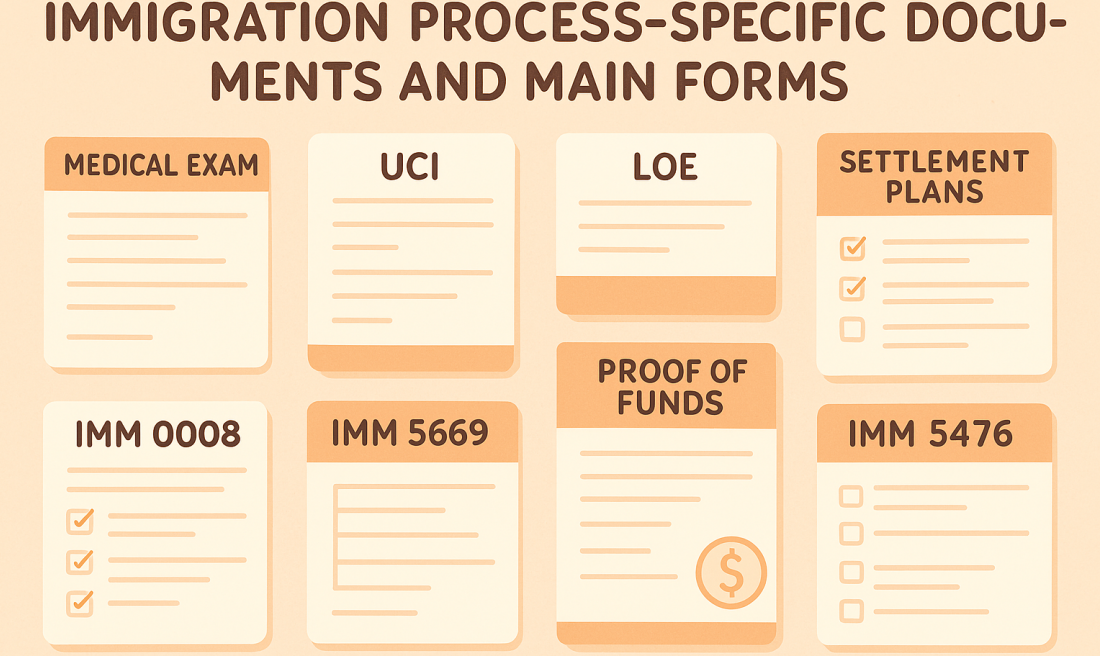
Immigration Process-Specific Documents

Immigration process-specific documents are a distinct category of paperwork that applicants may be required to submit at various stages of their immigration journey, depending on the program, stream, or the specific requests made by IRCC. Unlike core eligibility or identity documents, these forms and confirmations often relate to procedural steps such as biometrics, medical examinations, detailed forms, and additional clarifications requested by officers. Their role is critical—not only for advancing the application but also for demonstrating the applicant’s compliance with IRCC’s formal processes, timelines, and legal obligations.

These documents are often time-sensitive, and failure to submit them correctly or on time can result in significant delays, procedural fairness letters, or refusals. Many are generated by IRCC systems (e.g., Medical Instruction Letters, Biometrics Instruction Letters), while others must be proactively completed and submitted by the applicant, such as statutory forms, letters of explanation, or translations with certified affidavits. A thorough understanding of when and why these documents are required is essential for navigating the process efficiently and avoiding costly errors or omissions.

These are the IMM Forms and documents that may not be required at the start but are essential later or in specific situations.

The e-Medical Information Sheet is an official document issued by an IRCC-approved panel physician after an immigration medical examination (IME) has been completed. This form confirms that the applicant has undergone the required health screening and that their results have been submitted to IRCC electronically. For Express Entry and most permanent residency streams, the medical must be completed before final decision; in some temporary residency cases (e.g. long-term study or work permits), IRCC may request it after initial review.

This document includes the IME number, date of the exam, and clinic information, and must be uploaded to the applicant’s online portal. Medical results are typically valid for 12 months and must remain valid at the time of landing. Inaccurate or expired medicals may result in delays or additional exams. Applicants must ensure they attend their appointments with proper ID and the Medical Instructions Letter (if issued).

The Unique Client Identifier (UCI) is a personal IRCC-assigned number given to each applicant once they have interacted with the immigration system. It may appear as an eight-digit or ten-digit number (e.g., 1234-5678 or 1234-5678-90), and is used to track all applications and correspondence linked to the same person across time and programs.

Although it is not a document in itself, referencing the correct UCI on all communications and forms ensures consistency and avoids confusion in processing. Reusing older documents with the wrong UCI or submitting new applications with mismatched client numbers can lead to record duplication or processing errors.

The Letter of Explanation (LOE) is a personalized, optional document submitted to clarify any aspect of the application that may raise questions or require context. Examples include explaining gaps in employment, variations in names across documents, lack of documentation, or complex family situations. An LOE can also be used to elaborate on travel history, prior refusals, or the reason for choosing a particular educational program or Canadian province.

While not a substitute for required documentation, a well-drafted LOE demonstrates transparency and can proactively prevent misunderstandings. It should be factual, concise, and professional, supported by evidence where possible.

The Use of a Representative Form (IMM 5476) must be completed if the applicant is being assisted by a regulated immigration consultant, lawyer, or authorized family member. It provides IRCC with legal consent to communicate with the representative and share confidential information.

Failure to include a properly completed IMM 5476 when a representative is involved may result in delayed communication or potential rejection of submissions. Applicants must ensure the form is signed, dated, and updated if representation changes during processing.

In family sponsorship and many permanent residence applications, it is essential to prove genuine family relationships. Acceptable documents may include:

  • Marriage certificates, photos, joint leases or utility bills, shared bank accounts (for spouses)

  • Birth certificates, custody orders, adoption papers (for children)

  • Letters of communication, travel itineraries, or affidavits from third parties (to prove the nature of relationships, especially in spousal sponsorship)

These documents must be official, clear, and translated if necessary. Where relationships are questioned (e.g., arranged marriages, long-distance relationships), additional supporting documents and a Relationship Narrative may be required to satisfy IRCC’s scrutiny.

All documents submitted to IRCC must be in English or French. If any original document is in a different language, it must be accompanied by:

  1. A certified translation,

  2. A copy of the original document, and

  3. An affidavit from the translator, if applicable.

Translations must be done by certified professionals or include a sworn declaration from the translator attesting to their language proficiency. Improper translations or missing affidavits may result in rejection or processing delays.

Certain Provincial Nominee Programs (PNPs) and regional pilots (e.g., Rural and Northern Immigration Pilot, Atlantic Immigration Program) require applicants to submit a settlement plan. This document outlines how the applicant plans to integrate into the community, secure housing and employment, and access social services.

Settlement plans often include research on the destination community, intent to remain in the province, job search strategies, and support systems. These documents help demonstrate genuine intent to settle and are carefully reviewed by both provincial and federal authorities.

This is the main application form for most permanent residence (PR) applications, including Express Entry, PNPs, sponsorships, and humanitarian cases. It must be completed by the principal applicant and contains core information about the applicant and all accompanying or non-accompanying family members.

Key details include:

  • Program under which the application is being made

  • Personal details (name, date of birth, nationality)

  • Marital status

  • Immigration history

  • Family composition

Errors or omissions—especially in family composition—can result in inadmissibility or a lifetime ban on sponsoring omitted dependants. The form must be electronically validated before submission.

This form is required for all PR applicants over 18 years of age. It provides a complete history of personal activities and addresses since age 18, and includes declarations about security, criminality, and prior immigration violations.

Sections include:

  • Education history

  • Employment and unemployment history

  • Address history

  • Military service or armed groups

  • Security-related statutory questions

No gaps in history are allowed. Any missing months may result in processing delays or fairness letters. Inaccurate responses to statutory questions may lead to misrepresentation findings.

This form is mandatory for all applicants (principal, spouse, and dependants over 18). It records information about your parents, siblings, and children, regardless of whether they are accompanying you to Canada.

Accurate completion ensures IRCC has a full picture of your family background and can track previous or future applications involving your relatives. Omitting or misrepresenting family relationships may cause sponsorship bars or refusals in the future.

IMM 0248 is a required form for applicants under the Rural and Northern Immigration Pilot (RNIP). It must be completed and submitted alongside the permanent residence application to confirm that the applicant meets RNIP-specific requirements.

This form includes:

  • The name of the recommending community

  • Details of the job offer (employer name, NOC, wage, duties)

  • A settlement plan, showing intent to live and integrate in the community

  • A signed declaration confirming accuracy and intent to settle permanently

Accuracy is essential. Inconsistencies between IMM 0248, the job offer, and the community recommendation can result in delays or refusal. This form demonstrates to IRCC that the applicant has a genuine offer and a realistic plan to remain in the RNIP community.

Used when the applicant and their partner are in a common-law relationship (living together for at least 12 consecutive months) but are not legally married. It serves as proof of the relationship and is often supported by:

  • Joint leases or property ownership

  • Shared financial documents

  • Affidavits from friends or relatives

This form must be signed in the presence of a commissioner of oaths or notary public, and should reflect truthful, consistent details across all application materials.

IMM 5501 is a mandatory form for applicants under the Atlantic Immigration Program (AIP). It serves as a formal declaration that the applicant understands and agrees to the conditions of the AIP, particularly the requirement to live and work in the designated Atlantic province where the job offer is located.

This form includes:

  • The applicant’s declaration to settle in the Atlantic region

  • Confirmation of the authenticity of the job offer and settlement plan

  • Acknowledgment that the applicant meets AIP criteria and will actively participate in settlement services

Both the principal applicant and their spouse (if applicable) must sign the form. Submitting an incomplete or unsigned IMM 5501 can lead to processing delays or refusal. It is a key document IRCC uses to assess your genuine intent to reside in Atlantic Canada.

This form is specifically designed for Humanitarian and Compassionate (H&C) applications. It allows applicants to outline the personal, social, health, safety, and child-related hardships they would face if required to leave Canada.

Key sections include:

  • Reasons for applying under H&C

  • Hardships faced in home country

  • Integration into Canada

  • Best interests of affected children

This form is the core narrative of an H&C case and must be truthful, supported by evidence, and clearly demonstrate exceptional circumstances. Misstatements may lead to outright refusal and a bar on reapplication.

Immigration process-specific documents and forms are essential components of a complete and credible application. Unlike core eligibility documents, these materials address procedural, legal, and administrative requirements that vary depending on the program, applicant’s circumstances, or IRCC instructions. From background declarations and medical confirmations to detailed forms like IMM 0008, IMM 5669, and pilot program declarations, each document plays a unique role in confirming the applicant’s intent, integrity, and compliance with immigration regulations.

Accuracy, consistency, and timely submission of these documents are critical. Errors, omissions, or unsigned forms can lead to delays, procedural fairness letters, or outright refusals. Applicants must understand that these forms are not mere formalities—they are legal declarations subject to scrutiny and verification. Proper completion and clear alignment with other submitted materials can significantly strengthen the application and reflect an applicant’s seriousness, preparedness, and transparency throughout the immigration process.
Immigration Essentials: Documents That Make or Break Your Application

Accuracy, consistency, and truthfulness in your immigration documents are essential. Immigration, Refugees and Citizenship Canada (IRCC) relies heavily on the information provided in your forms, supporting documents, and personal declarations to assess eligibility and admissibility.

Incorrect, inconsistent, or incomplete documents can result in:

  • Refusals or prolonged delays in processing

  • Additional document requests that significantly extend timelines

  • Loss of points in Express Entry or ineligibility for Provincial Nominee Programs

  • Referrals to security screening or inadmissibility reviews

  • Potential findings of misrepresentation under section 40 of IRPA, which may lead to a five-year ban

Forms such as IMM 0008, IMM 5669, IMM 5406, and IMM 5476 must be filled with precise and truthful information. Errors in personal history, NOC duties, address timelines, or missing travel history may be treated as omissions or misrepresentations.

Attention to detail, document consistency, and legal accuracy are not optional—they are fundamental to the success of any immigration application.

FAQ about Immigration Documents

The required documents vary by immigration program but commonly include: a valid passport, language test results, proof of funds, educational credentials, police certificates, medical exams, and work or study history. IRCC provides specific document checklists for each application type.

Yes. Any document not in English or French must be accompanied by a certified translation, an affidavit from the translator, and a copy of the original document.

Police certificates are typically valid for six months from the date of issue. Bank statements and proof of funds should be as recent as possible—usually no more than 30–90 days old at the time of submission.

A Letter of Explanation can clarify any missing, inconsistent, or complex parts of your application. It’s optional but highly recommended if you believe something in your file needs additional context.

In most cases, notarization is not required, but copies of key documents must be clear, complete, and legible. If the instructions specifically ask for certified true copies or affidavits, those must be notarized.

Most applications are now submitted online, so digital scans of original documents are acceptable. However, signatures (where required) must be handwritten and scanned—not typed.

You need employer reference letters that include: job title, duties, dates of employment, salary, hours per week, and company contact details. Pay stubs, contracts, and tax documents can support your claims.

Missing or incorrect documents can result in application delays, procedural fairness letters, or outright refusal. It is essential to carefully review IRCC’s checklist and submit all required materials accurately.

No, never send original documents unless IRCC specifically requests them. Always submit clear, scanned copies unless otherwise instructed.

You can monitor your application status through your IRCC online account. Some programs also offer status trackers or email updates regarding document reviews and next steps.

Latest Posts on Documemts

Email Us

For any inquiries or assistance, feel free to reach out to us via email at [email protected]. We aim to respond within 24 hours.

Call Us

You can contact us directly at +1 (647) 464-4526. Our team is available to assist you from Monday to Friday, 9 AM to 6 PM EST.

Visit Us

We welcome you to visit our office located at 295-297 Cosburn Ave., Toronto, Canada, M4J 2M5. Please call ahead to schedule an appointment.