Federal Stage: Standard Background Check

Trends 2025:

Canada’s federal immigration background checks are becoming more rigorous, digitally integrated, and coordinated across agencies. Key trends include:

  • AI & Automation: Automated tools flag inconsistencies, speed up low-risk files, and direct higher-risk cases for manual review.

  • International Data Sharing: Closer cooperation with countries like the U.S. and U.K. to verify police records, travel history, and past immigration activity.

  • Employment & Education Verification: Stricter checks of job roles and credentials through employers, online sources, and NOC code matching.

  • Travel & Residency Scrutiny: Unexplained absences or time in high-risk regions trigger deeper checks.

  • Earlier Fairness Letters: Sent sooner if work, funds, or documents raise concerns.

  • Relationship Verification: More detailed checks in spousal and dependent cases via documents, interviews, and cohabitation proof.

Overall, applicants must ensure all information is complete, consistent, and verifiable to avoid delays or refusals.

Background check: Criminality Check

The criminality check is a key part of the Canadian immigration background process, used to identify past or current criminal offences. It ensures that applicants do not pose a risk to public safety and meet admissibility requirements under Canadian law.

Background check: Security Screening

Security screening is a critical part of the Canadian immigration background check, aimed at identifying potential threats to national security. It assesses connections to terrorism, espionage, organized crime, or subversive activities through coordination with agencies like CSIS and CBSA.

Background check: Information Sharing

Information sharing is an essential component of the background check, allowing Canadian immigration authorities to verify applicant data through partnerships with domestic and international agencies. This process helps confirm identity, travel history, and past immigration or criminal records across multiple jurisdictions.

Accuracy and honesty matters — dishonesty can jeopardize your future in Canada...

If an immigration officer discovers fraud, false information, or deliberate omissions in an application, the consequences under Canadian immigration law can be severe and long-lasting. These may include:

  • Refusal of the application — even if the applicant would have otherwise qualified.

  • A finding of misrepresentation under section 40 of the Immigration and Refugee Protection Act (IRPA).

  • A 5-year ban from applying for permanent residence or any temporary visa to Canada.

  • Loss of status — for those already in Canada, misrepresentation may lead to revocation of permanent resident status or removal orders.

  • Damage to credibility — future applications may be scrutinized more harshly.

  • Criminal charges — in cases of serious fraud or document forgery, criminal prosecution may be pursued.

Full disclosure, honesty, and consistency are essential. Even unintentional errors can lead to serious consequences if not clarified before a decision is made.

Standard Background Check : Overview

Immigrating to Canada is a detailed and multifaceted journey, and one of its essential components is the background check. Regardless of whether you’re applying for immigration through work, study, business, or family reunification, undergoing a background screening is a mandatory step. This article aims to clarify what background checks entail within the Canadian immigration process, covering key areas such as criminal record verification, employment and education history, identity confirmation, and other assessments conducted by Canadian authorities.

A background check is the process through which the Canadian government verifies the personal and professional information submitted by an immigration applicant. This step plays a critical role in safeguarding the integrity of Canada’s immigration system and protecting national security. Through background checks, authorities assess the applicant’s identity, criminal record, employment and education history, and other relevant details to ensure that the information is truthful and complete.

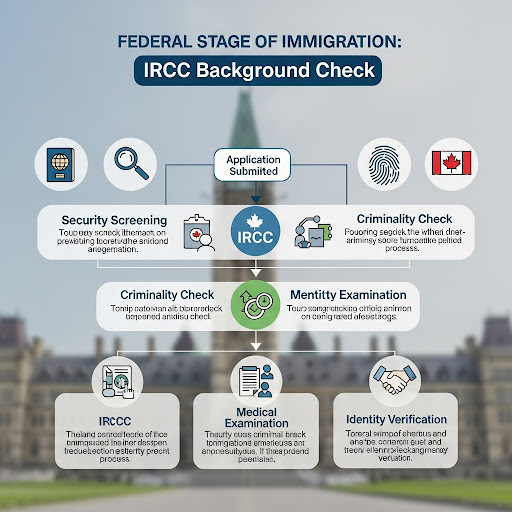
The background check typically involves three main components:

  • Criminality Check – Confirms whether the applicant has any history of criminal offences, from minor charges to more serious involvement in criminal organizations.

  • Security Screening – Conducted by IRCC in coordination with CBSA and CSIS to evaluate whether the applicant may pose a threat to the safety or security of Canada.

  • Information Sharing – Involves cooperation between Canadian agencies and international partners to cross-verify data, ensuring consistency and reliability before IRCC makes a final decision on the application.

In the Canadian immigration system, background checks are a collaborative effort involving several federal, provincial, and local authorities, all working together to ensure the safety and integrity of the country’s immigration process.

Immigration, Refugees and Citizenship Canada (IRCC)
  • Oversees the entire immigration application process.

  • Relies on background reports from CBSA, RCMP, CSIS, and local police.

  • Makes final decisions on admissibility, eligibility, and permanent residence status.

Canada Border Services Agency (CBSA)
  • Acts as the frontline authority for immigration screening at ports of entry.

  • Conducts initial interviews and assesses admissibility during entry to Canada.

  • Shares security-related findings with IRCC and partner agencies.


Local Police Departments
  • Perform Criminal Record Checks (CRCs) using local and national databases.

  • Provide detailed reports on charges, convictions, and pending legal matters.

  • Support both immigration and employment-based background checks.


Royal Canadian Mounted Police (RCMP)
  • Manages the Canadian Police Information Centre (CPIC) — a national law enforcement database.

  • Confirms and supplements information from local police departments.

  • Conducts fingerprint-based checks when required by IRCC.


Canadian Security Intelligence Service (CSIS)
  • Responsible for security screening in cases involving national security risk.

  • Assesses for links to terrorism, espionage, subversion, or organized crime.

  • May conduct reference checks, interviews, and deep background investigations.


Provincial and Municipal Authorities
  • Assist with verification of employment, licensing, or residency at the local level.

  • May have additional regulatory requirements (e.g., for healthcare or education workers).

  • Provide regional support to police and immigration officials during the background verification process.

The background check process is a critical component of Canada’s immigration system, particularly for individuals seeking to live and work in the country. Understanding how this process unfolds can help applicants prepare effectively and avoid delays.

1. Submission of Application

The background check process begins once an individual submits their immigration or work permit application, either directly to Immigration, Refugees and Citizenship Canada (IRCC) or through an employer-supported program. This marks the official start of the applicant’s review for admissibility.

2. Initiation of Background Screening

Upon receiving the application, IRCC or an employer may initiate one or more types of background checks, depending on the nature of the applicant’s intended role. Sectors such as healthcare, transportation, and public administration typically require enhanced scrutiny due to the sensitive responsibilities involved.

3. Execution of Checks by Authorities

Background checks are conducted by local police departments, often in coordination with federal agencies such as the Royal Canadian Mounted Police (RCMP). These checks may involve accessing local and national databases to gather information related to criminal records, legal proceedings, and prior enforcement actions.

4. Verification of Supporting Information

In addition to security-related checks, authorities may verify the applicant’s employment history, academic credentials, and other personal information to confirm accuracy. Discrepancies or inconsistencies can trigger further inquiries or delays in processing.

5. Admissibility Assessment

IRCC then evaluates the applicant’s overall admissibility based on the background screening results. Key factors include criminality, security risks, and program-specific eligibility requirements. The aim is to ensure that the applicant meets the legal and policy standards for entry or permanent residency.

6. Final Decision

Based on the findings, IRCC issues a decision on the application. If the applicant passes all required checks and satisfies program criteria, they may receive a work permit or permanent resident status. If concerns arise—such as unresolved security issues or unverified records—the application may be refused or subjected to further review.

The background check process is initiated as soon as an individual submits their immigration application to Immigration, Refugees and Citizenship Canada (IRCC). From that point, Canadian authorities begin a multi-layered review to verify the applicant’s personal history, identity, and admissibility. This process involves accessing a range of official data sources, including federal and provincial government databases, police records (both domestic and international), immigration history, and various civil documents such as passports, travel records, and educational or employment credentials.

The primary goal is to confirm that the applicant has no criminal history, poses no threat to Canadian security, and has been truthful and consistent in the information provided. Because authorities rely heavily on the accuracy of the submitted documents and declarations, it is critically important that all information is complete, correct, and transparent from the outset. Incomplete or misleading details may lead to significant delays, requests for clarification, or in serious cases, refusal of the application due to misrepresentation.

Background checks are a fundamental component of Canada’s immigration system, serving multiple critical purposes. First and foremost, they help safeguard national security by identifying individuals who may pose a threat due to links to criminal activity, organized crime, or security-related concerns such as terrorism or espionage. In addition, background checks ensure the accuracy and integrity of the information provided by applicants, allowing immigration officers to detect inconsistencies, false claims, or fraudulent documentation. This verification process protects the integrity of Canadian immigration programs and ensures that only individuals who meet the legal and program-specific criteria are granted entry or permanent status. By filtering out inadmissible applicants, background checks uphold the fairness, transparency, and safety of Canada’s immigration system.

A negative outcome in a background check—such as the discovery of a criminal record, unresolved legal issues, or discrepancies in the applicant’s history—can lead to a finding of inadmissibility under Canadian immigration law. This means the individual may be denied entry to Canada or refused permanent residency or a work permit. In such cases, applicants are usually informed of the specific grounds for inadmissibility and may be given an opportunity to respond through procedural fairness. In certain circumstances, remedies such as criminal rehabilitation, Temporary Resident Permits (TRPs), or judicial review may be available to challenge or overcome the decision.

Ultimately, background checks are a vital safeguard in Canada’s immigration process, helping to ensure national security, public safety, and program integrity. For applicants, it is essential to understand how this process works and to provide accurate, complete, and honest information throughout their application to avoid serious consequences or delays.

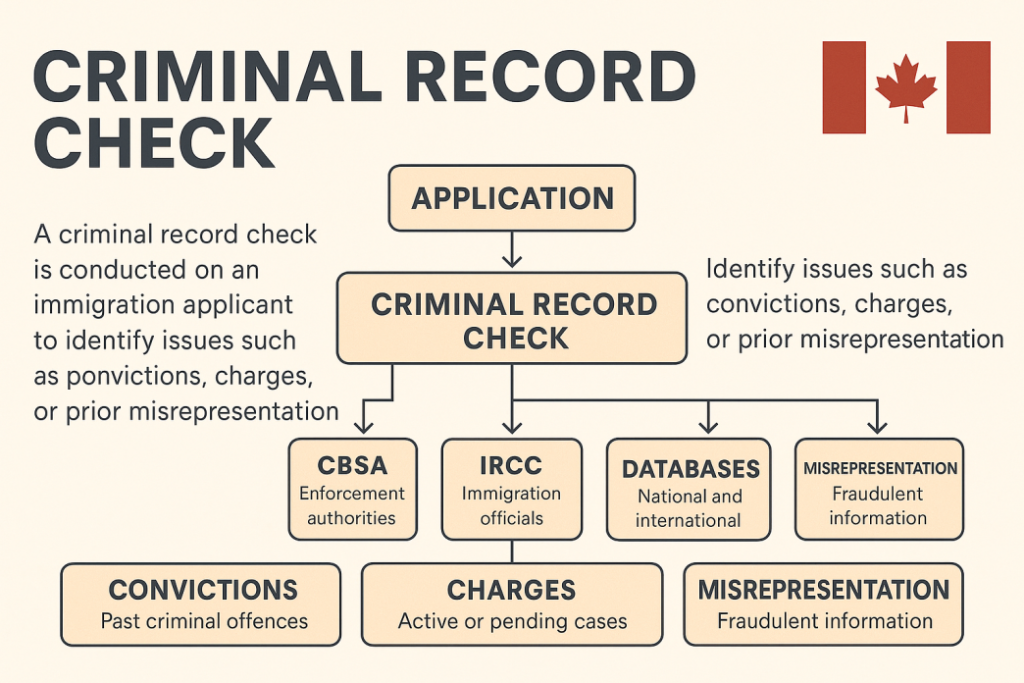
Criminal Record Check

When applying for a Canadian Permanent Resident (PR) visa, both the principal applicant and all accompanying family members must obtain a police certificate from their country of current and former residence. This document is required to demonstrate that the applicant does not have a criminal history and is therefore admissible to Canada. While commonly referred to as a police clearance certificate, it may also be called a certificate of good conduct, judicial record extract, or similar terms depending on the country. The specific requirements, procedures, and associated fees vary by country and jurisdiction. It is essential to follow IRCC’s instructions for your country to ensure the certificate meets Canadian immigration standards.

A criminal record check is one of the most critical components of the background screening process for immigration to Canada. Its primary purpose is to determine whether the applicant has a history of criminal activity that may pose a risk to Canadian society. This step plays a vital role in assessing an applicant’s admissibility and overall eligibility for entry or permanent residency.

The criminal record check is a mandatory and consequential part of the Canadian immigration process. Applicants must be fully aware of the potential implications of any past legal issues and should provide complete and truthful information in their application. Where necessary, seeking legal advice or exploring rehabilitation measures early in the process can significantly improve the chances of a positive outcome.

As part of the Canadian immigration background screening process, authorities conduct a thorough examination of the applicant’s criminal history. This begins with the data submitted in the immigration application, such as full legal names, aliases, date of birth, citizenship(s), past residences, and travel history. Canadian officials use this information to conduct checks through national and international law enforcement databases.

Domestically, the Royal Canadian Mounted Police (RCMP) plays a central role by accessing the Canadian Police Information Centre (CPIC) system, which contains records of criminal charges, convictions, and outstanding warrants. Internationally, Canada relies on partnerships with foreign governments, INTERPOL, and data-sharing agreements with trusted countries (e.g., the United States, the United Kingdom, the European Union) to gather intelligence and verify criminal history. These checks can uncover offences committed outside of Canada, including charges that may not have resulted in convictions but still raise concerns under Canadian immigration law.

This process is not limited to major crimes; even relatively minor offences may be flagged if considered serious under Canadian legal standards. Therefore, transparency and consistency in all submitted forms and supporting documents is critical. Failing to disclose past offences, even if pardoned or expunged in the applicant’s home country, can result in misrepresentation, a serious ground for inadmissibility.

If a criminal offence is confirmed, the applicant may be deemed criminally inadmissible to Canada under the Immigration and Refugee Protection Act (IRPA). This means they cannot be granted temporary or permanent status unless they qualify for an exemption or legal remedy. The severity of the consequences depends on several factors:

  • The type of offence (e.g., summary vs. indictable under Canadian law);

  • The equivalency of the offence in Canada, regardless of how it was treated in the applicant’s country;

  • The number of convictions or charges, including whether there is a pattern of criminal behaviour;

  • The time elapsed since the offence, including whether the sentence has been completed.

Even offences that might be considered minor in other jurisdictions—such as a single impaired driving conviction (DUI), petty theft, or disorderly conduct—may carry serious weight in Canadian immigration decisions. The presence of multiple minor offences may also result in inadmissibility. In contrast, certain historical or non-violent offences may not lead to refusal if sufficient time has passed or if corrective measures have been taken.

Fortunately, Canadian immigration law provides several avenues to overcome criminal inadmissibility, depending on the applicant’s individual circumstances:

  1. Deemed Rehabilitation – This may apply automatically if the offence was minor and enough time has passed (usually at least 10 years since the completion of the sentence).

  2. Individual Rehabilitation – If the applicant is not eligible for deemed rehabilitation, they may apply formally for rehabilitation after a prescribed waiting period (typically 5 years post-sentence completion). This requires evidence of remorse, good conduct, and reintegration into society.

  3. Temporary Resident Permit (TRP) – If urgent or compelling reasons exist (e.g., family unification, humanitarian need, work or study), the applicant may request a TRP to enter Canada for a limited time despite their inadmissibility. TRPs are issued at the discretion of immigration officers and require strong justification.

  4. Record Suspension / Foreign Pardon – In some cases, a pardon or expungement granted by the country where the offence occurred may be considered, though Canada does not automatically recognize foreign pardons unless the offence is no longer considered criminal under Canadian law.

Due to the complexity and legal implications of criminal inadmissibility, seeking legal representation or professional immigration advice is strongly recommended. A carefully prepared application with full disclosure and supporting documentation significantly increases the chances of a favourable outcome.

Background checks in the Canadian immigration process are thorough and multifaceted, aimed at safeguarding the security, health, and stability of Canadian society. Each verification—whether related to criminality, security, medical, financial, or personal history—serves a specific purpose in determining an applicant’s admissibility. It is therefore essential that applicants fully understand these procedures and submit clear, truthful, and complete information to support their application and avoid delays or refusals.

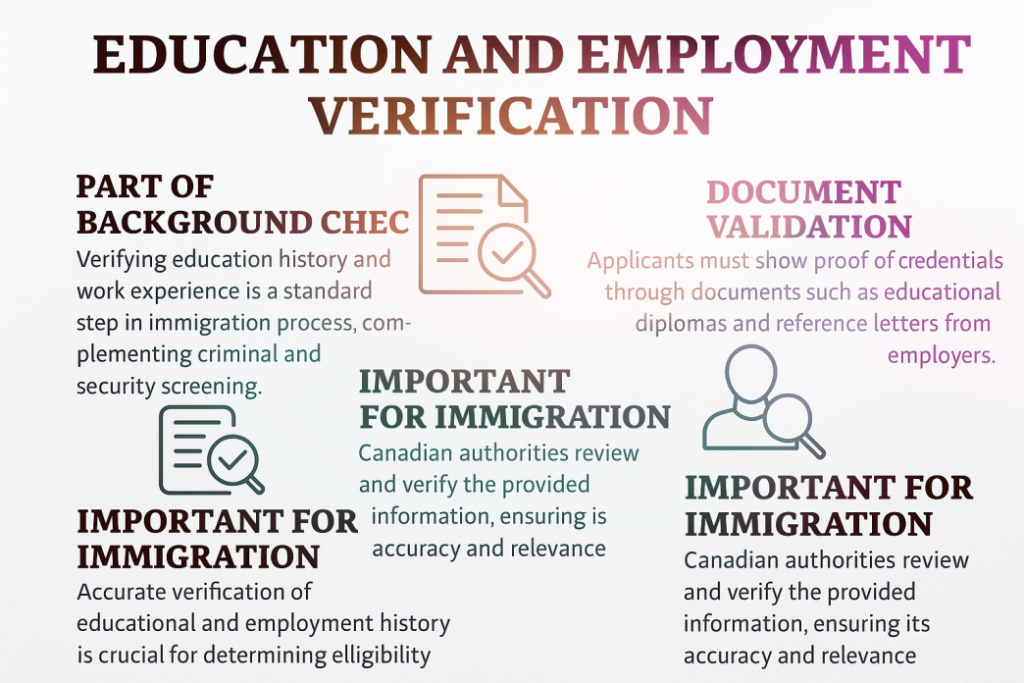
Education and Employment Verification

In addition to criminal and security screening, employment and education verification is a key component of the background check process—especially for applicants applying under economic immigration programs such as Express Entry, the Provincial Nominee Program (PNP), or other skilled worker categories. These verifications are essential to confirm that the applicant possesses the professional qualifications and work experience they have claimed in their application.


Employment and education verification is a mandatory and consequential part of the Canadian immigration process, particularly for those applying under skilled worker or economic streams. Applicants must ensure that all information related to their work history and academic background is accurate, complete, and supported by proper documentation. Inconsistencies, omissions, or unverifiable claims can lead to delays, refusal, or findings of misrepresentation. Where uncertainty exists—such as difficulties obtaining reference letters or verifying foreign credentials—it is strongly recommended to seek professional guidance early in the process to strengthen the application and reduce the risk of negative outcomes.


Employment verification is a critical component of the Canadian immigration background check process, especially for applicants applying under economic immigration streams such as the Federal Skilled Worker Program (FSWP), Canadian Experience Class (CEC), or Provincial Nominee Programs (PNPs). This step is designed to confirm the authenticity, accuracy, and relevance of an applicant’s declared work experience, which often forms the basis for eligibility and selection under these programs.

Verification Procedure and IRCC Requirements

To validate past and current employment, Immigration, Refugees and Citizenship Canada (IRCC) requires applicants to submit detailed and properly formatted reference letters from each employer. These letters must include the following key elements:

  • Job title(s) held during the period of employment;

  • Start and end dates (with exact day/month/year);

  • Detailed description of main duties and responsibilities;

  • Number of hours worked per week (full-time/part-time status);

  • Salary or wage received;

  • Name, title, and contact details of the person signing the letter.

In addition to reference letters, IRCC may request or consider additional supporting documents such as:

  • Pay stubs or salary slips;

  • Employment contracts;

  • Tax documents (e.g., T4 slips or Notice of Assessment in Canada);

  • Bank statements showing payroll deposits;

  • Business registration (for self-employed applicants);

  • Records of professional licenses or registrations (if applicable).

Government Verification Methods

Once the applicant submits these documents, IRCC may initiate independent verification as part of the background screening process. This may involve:

  • Contacting former employers or HR departments to confirm the authenticity of reference letters or verify specific employment details.

  • Reaching out to co-workers or listed references, particularly in cases where the employer cannot be reached.

  • Checking publicly available information, such as the applicant’s social media (FB, LinkedIn etc), the company’s registration status, website, business directories, or social media presence.

  • Cross-referencing employment dates with other parts of the application, including travel history, study history, and tax or immigration records, to ensure consistency and credibility.

Because employers may be contacted directly, it is advisable—when appropriate and feasible—to inform your current or former employer of your immigration application in advance. This can help ensure timely and accurate responses during verification and avoid confusion that might delay your file or trigger additional review.

Impact on Immigration Eligibility

Employment verification directly impacts an applicant’s eligibility and ranking under points-based programs like Express Entry. Verified work experience in a recognized National Occupational Classification (NOC) at TEER levels 0, 1, 2, or 3 can contribute significantly to CRS (Comprehensive Ranking System) scores or fulfill mandatory program criteria. For example:

  • Under the Federal Skilled Worker Program, a minimum of one year of continuous full-time (or equivalent) skilled work experience is required.

  • Under most PNP streams, the province may require two or more years of experience in a specific occupation or industry.

A strong and verifiable employment history not only fulfills eligibility conditions but may also increase competitiveness in candidate pools and expedite the issuance of Invitations to Apply (ITAs).

Consequences of Inconsistencies or Misrepresentation

Any inconsistency, omission, or inaccurate detail in declared work experience can trigger procedural fairness letters, delay processing, or result in refusal due to misrepresentation, which may carry serious consequences including a five-year ban from reapplying. Therefore, it is essential that all employment-related information be truthful, well-documented, and consistent across all forms and supporting documents.

Educational credential verification is a crucial part of the Canadian immigration process, especially for applicants under economic immigration programs such as the Federal Skilled Worker Program (FSWP), Canadian Experience Class (CEC), and Provincial Nominee Programs (PNPs). Academic qualifications often form the foundation of an applicant’s eligibility and contribute significantly to their Comprehensive Ranking System (CRS) score. As such, verifying the authenticity and equivalency of foreign educational credentials is essential.

Verification Requirements and Documentation

When an applicant claims education completed outside of Canada, Immigration, Refugees and Citizenship Canada (IRCC) requires them to obtain an Educational Credential Assessment (ECA) from a designated organization. The ECA is a formal evaluation that determines whether the foreign credential is valid and how it compares to Canadian academic standards.

Key points about the ECA process include:

  • The credential must be assessed by an IRCC-designated organization, such as World Education Services (WES), ICES, IQAS, ICAS, or CES.

  • The ECA must confirm that the foreign degree, diploma, or certificate is equivalent to a Canadian credential at the secondary or post-secondary level.

  • Each applicant must request the ECA to be issued specifically for immigration purposes—not for employment or professional licensing.

  • The ECA report is valid for five years from the date of issue and must be valid at the time of application submission.

In addition to the ECA, applicants may be required to submit:

  • Degree certificates and academic transcripts;

  • Letters of graduation or confirmation of completion;

  • Translations of all documents not originally issued in English or French, accompanied by a certified translator’s affidavit.

Government Verification Methods

While the ECA is completed by a third-party agency, IRCC may conduct additional internal verification if concerns arise. This could include:

  • Cross-referencing declared education with previous immigration or visa applications;

  • Assessing consistency between education dates and other parts of the application (e.g., work experience, travel history);

  • Investigating the legitimacy of issuing institutions, especially in cases involving lesser-known or unaccredited schools;

  • Flagging potential fraud if documents appear altered, inconsistent, or unverifiable.

Applicants should ensure that the information submitted to the ECA organization and IRCC is accurate, consistent, and fully supported by authentic documentation. Submitting false or misleading education claims can result in misrepresentation findings, which may lead to refusal and a five-year ban on future applications.

Impact on Immigration Eligibility

Educational credentials play a pivotal role in immigration eligibility and ranking. For example:

  • Under the Federal Skilled Worker Program, candidates must have completed at least a Canadian secondary school diploma or an equivalent foreign credential verified by an ECA.

  • In Express Entry, higher educational equivalencies (e.g., master’s or PhD-level) significantly increase CRS scores.

  • Many Provincial Nominee Programs also award points for specific levels of education or may require field-specific qualifications (e.g., in healthcare, engineering, or IT).

A valid ECA can elevate an applicant’s profile, improve selection chances, and enable access to more immigration pathways.

Best Practices and Recommendations
  • Begin the ECA process early, as processing can take several weeks or months, depending on the organization.

  • Ensure all documents are clear, legible, and translated as needed.

  • Submit only authentic and verifiable credentials—attempting to use unrecognized or altered documents can result in permanent ineligibility.

  • Maintain consistency across all forms, including personal history, work experience, and education sections of your application.

To ensure a smooth verification process and avoid delays, procedural fairness letters, or refusals, applicants should take a proactive and organized approach when preparing documents related to employment and education. Below are best practices and a list of essential supporting documents that can significantly strengthen your immigration application.


General Best Practices
  • Start early: Gathering official documents—especially from former employers or overseas institutions—can take time. Begin assembling your file as soon as possible.

  • Ensure consistency: Dates, job titles, and education details must match exactly across your application forms, personal history, reference letters, ECA reports, and resumes.

  • Use official formats: All reference letters and documents should be issued on official letterhead, signed and dated, and include full contact information of the issuer.

  • Translate and notarize: Any documents not in English or French must be accompanied by a certified translation and, if required, an affidavit of translation accuracy.

  • Explain gaps or irregularities: If you have employment gaps, part-time roles, overlapping jobs, or non-traditional education (e.g., online programs or unaccredited schools), attach a letter of explanation with context and supporting evidence.

  • Prepare for verification: Be ready for IRCC to contact past employers, academic institutions, or listed references. Inform those individuals or institutions in advance, where appropriate.


Employment-Related Documents to Prepare

For each job claimed in your application (especially those used to meet eligibility criteria or gain CRS points), prepare:

  • Reference Letter (required):

    • Official letter on company letterhead

    • Full name, position, and contact information of the signatory

    • Exact job title(s), dates of employment, salary, hours per week, and detailed job duties

  • Employment Contract (if available)

  • Pay Slips / Salary Statements (preferably for the full duration or at least recent 3–6 months)

  • Tax documents (e.g., T4s, NOAs, or employer tax filings—especially for Canadian experience)

  • Proof of company registration (especially for self-employed applicants)

  • Letters from colleagues or supervisors (to supplement where formal letters are unavailable)

  • Bank statements showing salary deposits (if pay stubs are unavailable)


Education-Related Documents to Prepare

For each degree, diploma, or certificate earned outside Canada:

  • Educational Credential Assessment (ECA) from a designated organization (e.g., WES, ICES, IQAS)

  • Diploma / Degree Certificate (official, issued by the institution)

  • Academic Transcript (listing courses and grades)

  • Letter of Graduation or confirmation of completion (if the certificate is delayed or unavailable)

  • Accreditation status of the institution (if unknown or from a lesser-known university)

  • Translations and certified copies (if not in English or French)


Avoid These Common Pitfalls
  • Submitting incomplete or generic job descriptions (e.g., copy-pasting from the NOC website without employer confirmation)

  • Using unofficial documents, unverifiable institutions, or fake job offers

  • Providing documents with conflicting or mismatched dates

  • Failing to disclose self-employment or informal work that overlaps with declared timelines


Final Tip

A strong document package speaks for you during the verification stage—especially when the IRCC officer cannot contact your employer or school directly. Take time to prepare a complete, well-organized file and consult an immigration professional if your situation involves complexities such as gaps, self-employment, or unverifiable credentials.

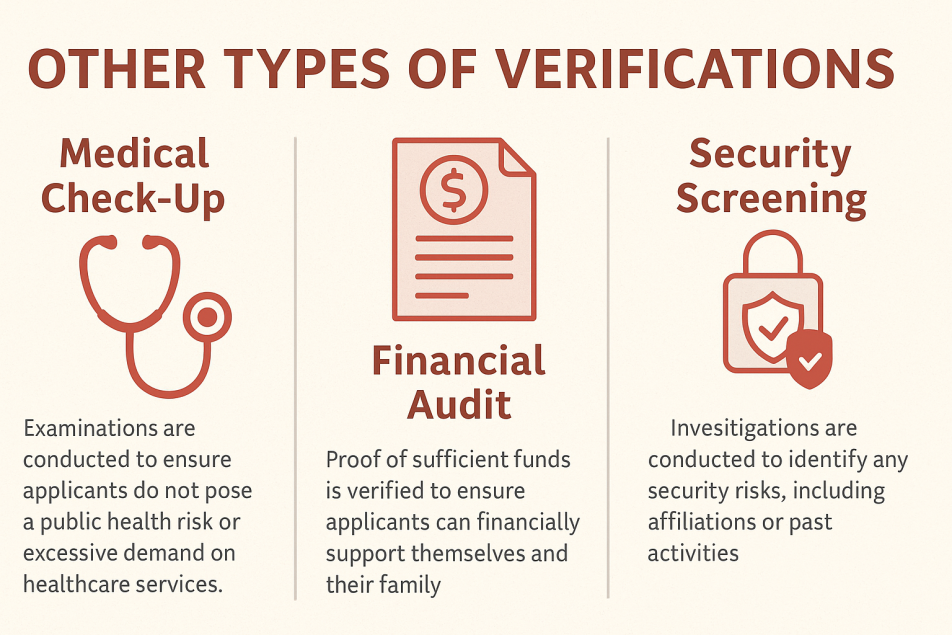
Other Types of Verifications

In addition to criminal record screening, security assessments, and verification of employment and education, the federal stage of the Canadian immigration process may involve several other types of verifications. These additional checks help ensure the authenticity, consistency, and integrity of an applicant’s profile and support IRCC’s decision-making process.

These checks are essential to upholding the integrity, fairness, and security of Canada’s immigration system. By thoroughly assessing each applicant’s background—including their health, financial capacity, criminal history, and potential security risks—Canadian authorities ensure that only individuals who meet the legal and policy standards are granted entry or permanent status. This process helps protect the safety and well-being of Canadian society, ensures that public resources are not placed under undue strain, and preserves public confidence in the immigration system as a whole.

Confirming the applicant’s identity is a foundational element of the background check process. IRCC must ensure that the person applying is indeed who they claim to be and that their identity has not been previously used fraudulently, altered, or misrepresented in prior immigration applications—either in Canada or abroad.

This process may involve:

  • Cross-referencing passport information with global databases to identify inconsistencies or alternate identities.

  • Reviewing biometric data (fingerprints and photographs) collected during the application process and comparing it with data previously collected under other visas or permits.

  • Verifying spelling variations, aliases, or name changes, particularly for individuals from regions where documentation may be less standardized or frequently changed.

  • Matching identity across all documents submitted (e.g., birth certificates, passports, PR applications, dependent documents) to ensure consistency.

If discrepancies are found—such as undeclared aliases, different dates of birth, or mismatched document numbers—IRCC may issue a procedural fairness letter or refuse the application on the basis of misrepresentation under section A40 of the Immigration and Refugee Protection Act (IRPA).

The applicant’s travel history provides critical context for assessing admissibility and verifying the applicant’s declared personal history. IRCC requires all applicants to submit a complete 10-year travel history, listing every trip taken outside of their country of residence.

Verification activities may include:

  • Reviewing passport stamps and visa stickers to ensure that all international movements are accurately reported.

  • Cross-checking travel declarations with previous visa applications or records held by Canadian and international border agencies.

  • Identifying time spent in high-risk or conflict regions, which could trigger enhanced security screening.

  • Checking for past deportations, overstays, or entry bans in other countries, particularly in the United States, European Union, or Australia.

  • Verifying residency status during declared periods of foreign residence.

Unexplained travel gaps, discrepancies in dates, or visits to flagged countries may delay processing or result in additional documentation requests to confirm the applicant’s background.

For applicants applying under family sponsorship, as accompanying dependents, or as spouses/common-law partners, IRCC must confirm that the claimed relationships are genuine and not entered into for the sole purpose of gaining immigration benefits.

Verification may involve:

  • In-depth review of documents, such as marriage certificates, photographs, joint leases, utility bills, communication records (e.g., emails, chat logs, call records), and proof of cohabitation.

  • Interviews with the sponsor and applicant (sometimes separately) to evaluate the consistency of their responses and assess the nature of their relationship.

  • Home visits or third-party checks (especially when suspicion arises or where the applicant is abroad).

  • Analysis of relationship timelines, such as when the couple met, how often they’ve seen each other, and how they maintain contact.

If IRCC determines that a relationship is not genuine or was entered into primarily for immigration purposes, the application may be refused and may trigger further consequences such as a five-year sponsorship bar for the sponsor.

An applicant’s prior immigration history—whether in Canada or another country—is an important factor in assessing admissibility and credibility.

During this check, IRCC may:

  • Review all past visa and permit applications submitted to Canada and compare the information to the current application.

  • Identify patterns of misrepresentation, such as inconsistently reported employment, education, or marital status.

  • Check compliance with past immigration conditions, including the expiration of visas or failure to depart Canada.

  • Confirm whether the applicant has been previously issued removal orders, refused visas for misrepresentation, or was declared inadmissible by any country.

Failure to disclose a past refusal, deportation, or violation of immigration conditions—even in a third country—may lead to a finding of inadmissibility for misrepresentation, a five-year ban, or refusal of the current application.

For many economic immigration programs (e.g., Federal Skilled Worker Program, Start-Up Visa, or Self-Employed Program), demonstrating sufficient and legitimate financial resources is mandatory.

Verification activities may include:

  • Reviewing submitted bank statements for consistency, duration of account holding, and overall balance trends.

  • Assessing the source of large deposits—particularly if they appear shortly before the application date. Applicants may be asked to provide evidence of sale of property, inheritance documents, or employment-related bonuses.

  • Cross-referencing declared income and assets with tax records or proof of employment and business activity.

  • Detecting fraudulent or altered financial documents, including digitally modified bank statements, unverifiable institutions, or template-based forgeries.

For many economic immigration streams—particularly the Federal Skilled Worker Program, Self-Employed Program, Start-Up Visa, and certain Provincial Nominee Programs—demonstrating financial self-sufficiency is mandatory. This ensures that immigrants can support themselves and their dependents upon arrival and will not become reliant on public assistance.

During this check, IRCC reviews:

  • Bank statements covering a 6-month period, showing a stable balance;

  • Source of funds, especially for large or recent deposits (e.g., sale of property, inheritance, savings from employment);

  • Currency conversion and availability—the funds must be readily available, liquid, and transferable to Canada;

  • Consistency with declared employment or business activity, tax filings, and past immigration history.

Applicants who fail to provide acceptable proof of funds, or who submit questionable or fraudulent documents, may face refusal based on insufficient settlement funds or misrepresentation under IRPA section A40. It is advisable to include notarized bank letters, balance certificates, and any necessary explanations regarding the source of funds to strengthen the application.


Failure to provide genuine, verifiable, and lawfully obtained proof of funds can lead to a finding of inadmissibility, a procedural fairness letter, or even criminal charges if fraud is suspected. Additionally, incomplete financial information may result in a refusal under the relevant program criteria.

A medical examination is a mandatory component for most permanent residence applications and certain types of temporary stays (e.g., long-term work or study permits). This requirement ensures that newcomers:

  • Do not pose a risk to public health or public safety (e.g., due to contagious diseases like active tuberculosis);

  • Will not create excessive demand on Canada’s publicly funded health or social services (e.g., if the applicant has high-cost or long-term medical needs).

The process includes:

  • A medical exam performed by an IRCC-approved panel physician, either in Canada or abroad;

  • Blood tests, chest X-rays, and physical examinations, depending on age and medical history;

  • A review of known medical conditions, treatments, medications, and surgical history.

Applicants may be found medically inadmissible under section 38 of the Immigration and Refugee Protection Act (IRPA) if their condition is likely to endanger public health/safety or cause excessive demand. In such cases, procedural fairness is applied, and applicants may submit a medical plan or request an exemption based on H&C (Humanitarian and Compassionate) grounds, depending on the program.

The security screening process includes an additional safety-focused review to determine whether the applicant poses a risk to Canada’s national security or public order. This goes beyond standard criminality checks and is typically conducted in coordination with:

  • The Canadian Security Intelligence Service (CSIS);

  • The Canada Border Services Agency (CBSA);

  • Foreign intelligence partners under international information-sharing agreements.

This assessment may involve:

  • A review of past or current involvement in political, military, intelligence, or paramilitary organizations;

  • Affiliations with extremist, criminal, or terrorist groups, whether formal or informal;

  • Public record analysis, including travel patterns, activities in conflict zones, or connections to individuals flagged for national security concerns.

An individual may be found inadmissible on security grounds under IRPA section A34 if they are believed to have engaged in or supported:

  • Espionage, subversion, or terrorism;

  • Acts of violence against a democratic government;

  • Membership in an organization that is known to be involved in such activities.

If such concerns arise, applicants are typically issued a procedural fairness letter and may be given an opportunity to respond. However, these cases are handled with high sensitivity and may lead to lengthy delays, in-depth investigations, or even permanent inadmissibility.

The federal background check process is far more comprehensive than a simple criminal record check. IRCC, in coordination with CBSA, RCMP, CSIS, and foreign partners, conducts multi-layered verifications to confirm identity, personal history, family ties, immigration record, and financial capacity. Each element plays a key role in determining admissibility and credibility. To avoid delays, refusals, or misrepresentation findings, applicants should ensure that all submitted information is consistent, truthful, and fully documented. Where complexity arises, professional legal or immigration advice is strongly recommended to navigate the process effectively and maximize the chances of approval.

Latest Posts on Standard Background Check

Email Us

For any inquiries or assistance, feel free to reach out to us via email at [email protected]. We aim to respond within 24 hours.

Call Us

You can contact us directly at +1 (647) 464-4526. Our team is available to assist you from Monday to Friday, 9 AM to 6 PM EST.

Visit Us

We welcome you to visit our office located at 295-297 Cosburn Ave., Toronto, Canada, M4J 2M5. Please call ahead to schedule an appointment.