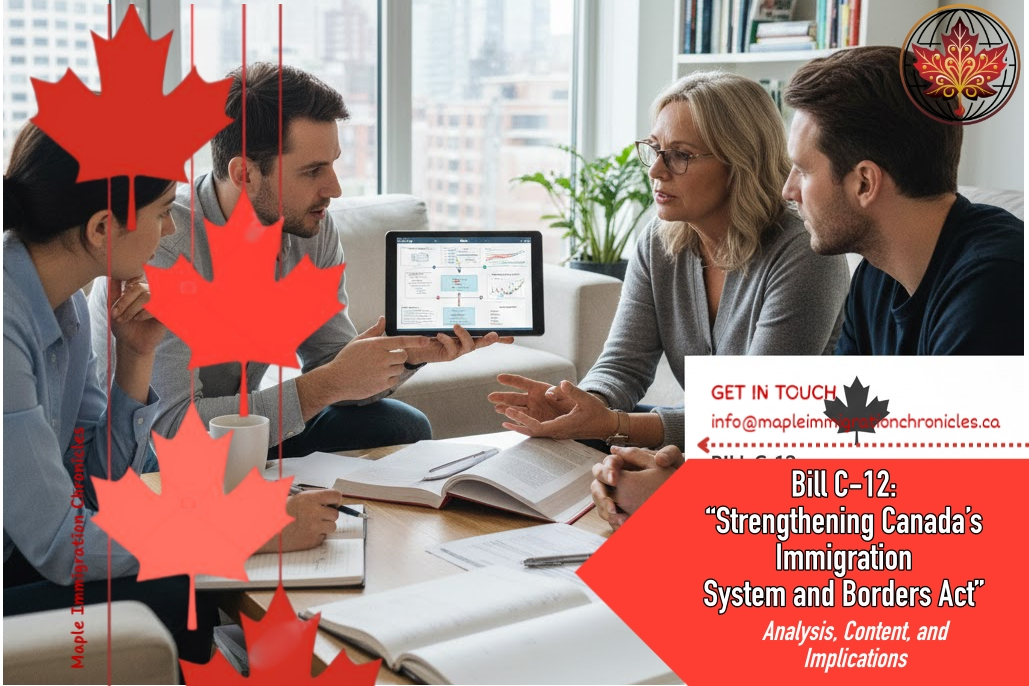
On October 8, 2025, the Government of Canada introduced Bill C-12 (Strengthening Canada’s Immigration System and Borders Act) in Parliament. Its purpose is to strengthen national border security, modernize the immigration system, improve information-sharing between government agencies, ensure the integrity of asylum and immigration procedures, and enhance the country’s capacity to combat transnational crime.
The bill covers a wide range of reforms — from customs control and border enforcement to asylum procedures, financial monitoring, anti-money-laundering measures, and public-safety protection. It represents one of the most extensive overhauls of Canada’s immigration and border legislation in the past decade.
General Structure of the Bill
Bill C-12 consists of eleven parts, each introducing amendments to various federal statutes, including:
• Customs Act;
• Controlled Drugs and Substances Act;
• Oceans Act;
• Department of Citizenship and Immigration Act;
• Immigration and Refugee Protection Act (IRPA);
• Proceeds of Crime (Money Laundering) and Terrorist Financing Act;
• Sex Offender Information Registration Act.
The bill’s objective is to equip the government with the tools needed for faster responses to emerging security and irregular-migration challenges while modernizing inter-agency cooperation mechanisms.
Amendments to the Customs Act
The bill provides for:
• an obligation for owners or operators of international bridges, tunnels, airports, docks, and railways to provide free facilities, equipment, and infrastructure for use by the Canada Border Services Agency (CBSA);
• expanded CBSA authority to access goods intended for export, including temporary storage warehouses, to combat smuggling and the illegal export of drugs and weapons;
• streamlined export-inspection procedures and strengthened inter-agency coordination.
These measures reinforce oversight of international trade flows and aim to prevent their use in criminal schemes.
Combating the Illicit Trade of Precursors and Maritime Security
In the area of precursor-chemical control, the bill:
• allows the government to quickly add new substances to the list of controlled chemicals without waiting for lengthy procedures;
• clarifies law-enforcement powers to conduct operations, including the use of controlled deliveries;
• expands the role of the Canadian Coast Guard in maritime security, surveillance, intelligence collection, and joint operations with the CBSA.
These changes are intended to help curb fentanyl smuggling and enhance the security of Canada’s coastal regions.
Information-Sharing Among Government Bodies
The bill authorizes the Minister of Immigration, Refugees and Citizenship to disclose personal information for inter-agency verification purposes — to confirm document authenticity, prevent fraud, and improve process efficiency.
Information may be shared with:
• law-enforcement agencies;
• financial-monitoring bodies;
• provincial governments and agencies.
Although the government stresses that these mechanisms will operate within privacy-protection laws, critics warn of potential overreach and risks to personal privacy for both citizens and immigrants.
Major Amendments to the Immigration and Refugee Protection Act (IRPA)
This is the core section of Bill C-12, directly affecting the foundation of Canada’s immigration system.
Asylum Procedures
• The definitions of an “abandoned” or “withdrawn” claim have been clarified. If a claimant leaves Canada or fails to cooperate with authorities, their case may be suspended or closed.
• When a claim is withdrawn, a removal order becomes effective immediately, without further review.
• The Chairperson of the Immigration and Refugee Board (IRB) gains new powers to determine hearing formats, including virtual or remote hearings.
New Documentation Requirements
The Minister may establish a list of mandatory documents that asylum applicants must provide to substantiate their claim. Failure to submit such documents without valid justification may be grounds for refusal.
Inadmissibility Criteria
Two key categories of claims will not be referred to the Refugee Protection Division (RPD):
- When an individual files a claim for protection more than one year after entering Canada.
- When a claim is filed between official ports of entry along the U.S. border after 14 days from entry.
Such claimants will not have their cases heard by the IRB but will retain access to a Pre-Removal Risk Assessment (PRRA) procedure.
Protection of Vulnerable Claimants
The bill introduces a regulatory authority to appoint designated representatives for minors or persons with diminished capacity to ensure their right to due process.
Ministerial Power to Suspend or Revoke Immigration Documents
Bill C-12 expands the Minister’s powers to suspend, cancel, or alter the validity of immigration documents such as visas, work or study permits, and temporary-resident statuses.
Such actions may be taken in the public interest or when required to maintain the integrity of the immigration system — for instance, in cases of suspected fraud, misrepresentation, permit violations, or potential security threats.
Although the government asserts these provisions will not apply to refugee claims, they cover broader categories of immigrants — including international students, foreign workers, and temporary visa holders. However, the bill does not clearly define the criteria for such decisions nor establish independent oversight mechanisms, creating a risk of discretionary or arbitrary decisions.
While designed to increase governmental flexibility during crises, this provision requires additional safeguards to preserve the balance between national security and applicants’ rights.
Financial Monitoring and Anti-Money-Laundering Measures
The section addressing financial crimes includes:
• a significant increase in fines for violations of the anti-money-laundering legislation — up to fortyfold;
• expanded powers for FINTRAC, CBSA, and other federal entities to share financial intelligence;
• tighter compliance obligations for banks and financial institutions in detecting suspicious transactions.
The goal is to strengthen Canada’s capacity to counter the financing of criminal organizations and terrorist networks linked to human trafficking and narcotics trade.
Amendments to the Sex Offender Information Registration Act
The CBSA will gain the right to share information on the movements of registered sex offenders with police and foreign border agencies. This will enhance coordination in public-safety matters and reduce the risk of monitored individuals evading oversight.
Digital Access and Privacy
Certain provisions introduce new obligations for internet service providers, technology firms, and electronic platforms to provide law-enforcement access to user data.
Companies must ensure “all reasonable technical means” are in place to facilitate government requests while maintaining the confidentiality of the requests themselves.
This clause has drawn the strongest criticism from civil-liberties organizations, as it could effectively create “digital backdoors” in private-sector systems.
Key Risks and Criticism
- Violation of the right to asylum. The new restrictions on late or irregular claims may conflict with Canada’s international obligations under the UN Refugee Convention.
- Privacy concerns. Broader government access to personal and digital data raises questions about compliance with the Charter of Rights and Freedoms.
- Ambiguity of the term “public interest.” The phrase grants the government wide interpretive latitude, potentially leading to discretionary or politically motivated decisions.
- Lack of transparency. The bill contains no clear mechanisms for independent oversight of new CBSA and Immigration Ministry powers.
Conclusions
Bill C-12 represents a strategic initiative aimed at reinforcing Canada’s security, improving border-management efficiency, and preventing abuses within the immigration system. It reflects the government’s attempt to adapt legislation to new technological, security, and social realities.
At the same time, it raises serious debates over the balance between state authority and individual rights. If enacted, it could significantly reshape the administration of immigration, the handling of asylum claims, and the management of personal data.
Further discussion in parliamentary committees and the Senate will determine whether the government can successfully align enhanced national security with the principles of democracy, the rule of law, and international humanitarian standards.