Temporary Residency: Documents

Trends 2025:

Canada’s approach to temporary residency is tightening in 2025, with key changes affecting processing times, status maintenance, and eligibility requirements. These shifts reflect the federal government’s stated goal of reducing the number of temporary residents by 2026.

1. Longer Processing Times

Work permits, study permits, and visa renewals are taking significantly longer to process. Applicants must apply well in advance and ensure documents are accurate and complete to avoid delays or refusals.

2. Implied Status Under Pressure

With delays, many rely on implied status—but it is now more heavily scrutinized. Apply before your current permit expires and keep proof of submission, as errors can result in loss of status.

3. Government Reducing Temporary Resident Numbers

Canada is moving to cut back temporary admissions, with stricter caps, limited extensions, and fewer transition pathways to permanent residency. Documentation standards are higher, and approval rates may drop.

4. Open Work Permits for Spouses More Restricted

Spouses of students or workers now face tighter rules for Open Work Permits. Only certain occupations or study programs qualify, and more supporting documents are required.

5. Increased IRCC Scrutiny

IRCC is requesting more supporting documents—like updated proof of funds, employment, or school enrollment—and inconsistencies can lead to refusal. Strong documentation is now critical at every step.


Maintaining temporary status in 2025 requires more preparation, stronger documentation, and early action. The margin for error is shrinking—and each decision can impact your future in Canada.

Temporary Residency in Canada: Key Documents for Settlement and Future Immigration

Temporary residency in Canada offers individuals the opportunity to visit, study, or work while gaining valuable experience and integrating into Canadian society. Whether the stay is short-term or part of a longer immigration journey, holding the correct legal status is essential. A well-prepared set of documents not only ensures compliance with immigration regulations but also facilitates access to essential services such as healthcare, education, housing, and employment. These foundational elements are often the first building blocks for those who plan to remain in Canada long-term.

For many, temporary residency is the initial stage of a broader immigration pathway. The way individuals manage their legal status, responsibilities, and documentation during this period can significantly influence future opportunities—such as applying for permanent residence through economic programs, provincial nominations, or family sponsorship. Adapting successfully starts with legal clarity and readiness, and being able to demonstrate stability, compliance, and genuine intent from the start can make a lasting difference in one’s immigration journey.

Not Sure If You Need a TRV or eTA? A Mistake Here Could Get You Denied Boarding...

eTA
ChatGPT said:

An Electronic Travel Authorization (eTA) is a digital entry requirement for citizens of visa-exempt countries traveling to Canada by air. It is electronically linked to the traveller’s passport and typically valid for up to five years or until the passport expires. An eTA does not permit work or study and must be obtained before boarding a flight to Canada.

A Temporary Resident Visa (TRV) is a physical sticker placed in the passport of travellers from visa-required countries. It allows the holder to travel to a Canadian port of entry, where a border officer decides on admission. A TRV does not grant the right to work or study unless accompanied by a valid permit.

Your country of citizenship determines the type of entry authorization you need—but many travellers misunderstand this critical detail.

Contact us to confirm your requirements and avoid costly delays or refusals at the airport.

Entry & Visa Documents

To enter Canada as a temporary resident, whether as a visitor, student, or worker, individuals must be prepared to present a specific set of official documents at the border or port of entry. These documents not only authorize travel to Canada but also serve as proof of the individual’s purpose of visit, financial capacity, and intent to comply with Canadian immigration laws. Depending on one’s country of citizenship and immigration status, the list of required documents may vary, and it is essential to ensure that all paperwork is valid, complete, and consistent with the information submitted during the visa or permit application process.

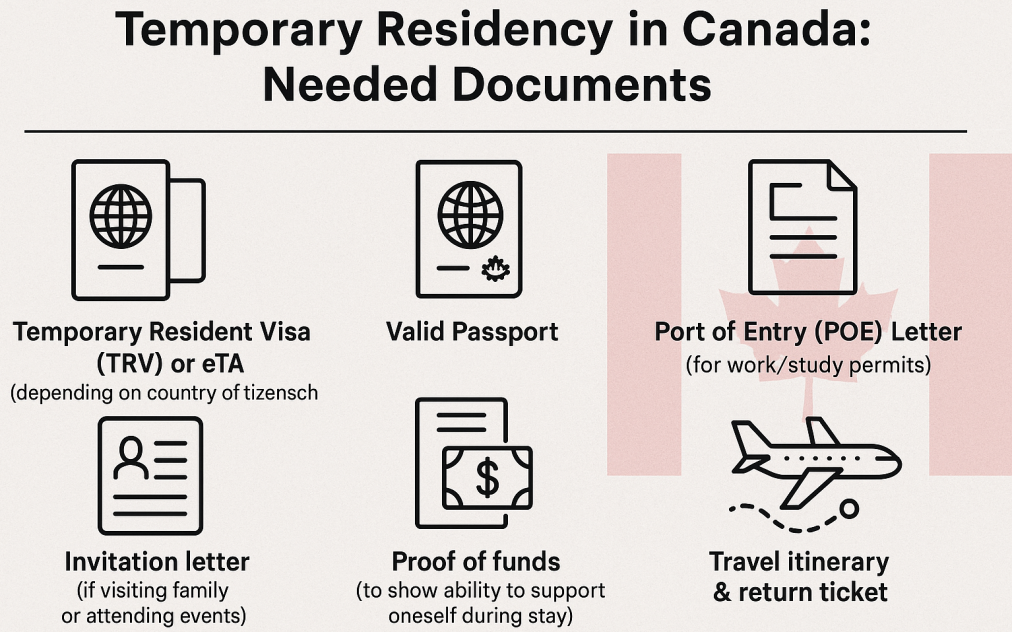
The cornerstone of entry into Canada is a valid travel document—typically a passport—accompanied by either a Temporary Resident Visa (TRV) or an Electronic Travel Authorization (eTA), depending on the applicant’s nationality. In addition, travellers may be asked to present supporting documentation such as a port of entry letter of introduction (if applicable), proof of sufficient funds, a return or onward ticket, and documents confirming the purpose of stay (such as a letter of acceptance from a school or a job offer). Failure to provide adequate documentation may result in delays, further questioning, or denial of entry. Therefore, understanding and preparing the required entry and visa documents is a critical first step for any temporary resident coming to Canada.

Depending on the individual’s country of citizenship, either a Temporary Resident Visa (TRV) or an Electronic Travel Authorization (eTA) is required to enter Canada.

  • A TRV is a physical visa label affixed inside the passport, issued to citizens of visa-required countries. It must be obtained before traveling to Canada and presented to the airline and border officers.

  • An eTA is a digital authorization linked electronically to the traveller’s passport and is mandatory for citizens of visa-exempt countries traveling by air.
    Both authorizations confirm that the traveller has met basic eligibility requirements for entry but do not guarantee admission to Canada—final entry is granted by a border services officer upon arrival.

A valid passport is the primary identification document for any foreign national entering Canada.

  • It must be valid for the entire duration of the planned stay, as permits and visas cannot extend beyond the passport’s expiry date.

  • In cases where a TRV or eTA has been issued, it must match the passport presented at the port of entry.
    Travellers should ensure their passport is not damaged, includes sufficient blank pages, and, ideally, remains valid for at least six months beyond the intended departure from Canada.

Individuals approved for a study permit or work permit will receive a Port of Entry Letter of Introduction (sometimes referred to as an “approval letter” or “correspondence letter”) from Immigration, Refugees and Citizenship Canada (IRCC).

  • This letter is not a permit itself, but must be presented to a border services officer upon arrival in Canada.

  • Upon inspection and verification, the officer will issue the actual study or work permit at the border.
    It is essential that travellers bring a printed copy of this letter and ensure it matches their passport and visa details.

A letter of invitation may be required if the traveller is coming to Canada to visit family members, attend private events, or participate in non-commercial activities.

  • This letter should come from the host (a Canadian citizen or permanent resident) and include details about the relationship, the purpose and duration of the visit, and contact information of the host.

  • Although not mandatory in all cases, it strengthens the credibility of the travel purpose and is often requested by visa officers when assessing TRV applications.
    It should be consistent with the traveller’s stated purpose and itinerary.

Why it matters:
If you’re immigrating with children, having the proper documents ensures they can enroll in school without delay, access healthcare services, and receive any necessary accommodations for learning or medical needs. Canadian schools and health authorities often request original documents, so preparing ahead avoids unnecessary interruptions in your child’s adaptation process.

Key documents to bring:

  • Birth certificates – required for school registration and healthcare (translated into English or French)

  • Immunization/vaccination records – mandatory in most provinces for school enrollment
    (e.g., proof of MMR, DTP, polio, hepatitis B, etc.)

  • Medical and dental records – including:

    • Past health history and chronic conditions

    • Specialist reports (e.g., allergies, asthma, autism, ADHD)

    • Dental exams or treatment records

  • School transcripts and report cards – from the last academic year and earlier, if available

  • School attendance certificates – if transcripts are unavailable

  • Letters of reference from teachers or principals – describing the child’s academic progress and behavior

  • Psychological assessments or IEPs (Individual Education Plans) – if applicable, to support learning accommodations

  • Extracurricular certificates – music, sports, dance, coding, etc., to support integration and school placement

  • Custody or guardianship papers – if one parent is not present or if the child travels with a legal guardian

  • Passports and visas – same as for adult family members

All temporary residents must be able to demonstrate they have sufficient financial means to support themselves (and any dependents) during their stay in Canada.

  • This may include bank statements, proof of income, credit card limits, or financial support letters from sponsors.

  • The required amount varies depending on the length and type of stay (e.g., visitors for tourism vs. students covering tuition and living expenses).
    Border officers may ask for this proof even if it was previously submitted in the visa application, so it is recommended to carry recent original or printed copies of financial documents.

A clearly documented travel itinerary—including dates, destinations, accommodations, and activities—helps demonstrate the temporary nature of the visit.

  • A return or onward ticket is particularly important, as it shows the traveller’s intention to leave Canada at the end of their authorized stay.

  • While not a legal requirement in all cases, presenting a pre-booked departure ticket often reassures officers that the individual does not intend to overstay.
    For those without a fixed itinerary, having a detailed explanation or tentative plan is still advisable.

ChatGPT said:

Proper preparation of entry and visa documents is essential for anyone arriving in Canada as a temporary resident. These documents not only establish legal permission to travel but also provide clear evidence of the individual’s purpose of visit, financial stability, and intention to leave Canada at the end of the authorized stay. Border officers rely on this documentation to assess admissibility and compliance with immigration rules, making accuracy and consistency critical.

Having a valid visa or eTA, a passport with sufficient validity, and supporting materials such as a Port of Entry letter, invitation letter, proof of funds, and return ticket significantly increases the likelihood of a smooth and timely entry. Travellers should review their documents carefully, carry printed copies where applicable, and be prepared to present them upon request. This careful approach helps establish trust with immigration authorities and sets the foundation for a successful visit, study, or work experience in Canada.


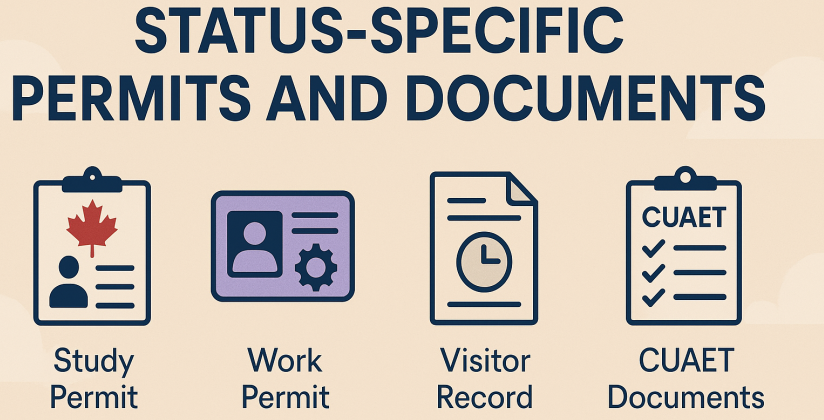
Status-Specific Permits and Documents

Once a temporary resident arrives in Canada, their legal status is defined and maintained through specific permits and documents issued by Immigration, Refugees and Citizenship Canada (IRCC). These status-specific documents confirm an individual’s right to study, work, or remain as a visitor in the country for a set period of time. Unlike entry documents such as visas or eTAs, these permits regulate what a person can do while in Canada and often contain conditions—such as duration of stay, authorized activities, or designated institutions/employers—that must be followed.

The most common status-specific documents include study permits, work permits, and visitor records, each tailored to the purpose of the stay. While they are typically issued at the port of entry for those approved beforehand, they can also be extended or changed from within Canada in some circumstances. It is essential for temporary residents to ensure that these documents remain valid throughout their stay and to apply for extensions or changes well before expiry. Maintaining valid status is not only a legal requirement but also a critical step for those who may later seek permanent residency or other long-term immigration options.

A Study Permit is an official immigration document that allows foreign nationals to pursue education at Designated Learning Institutions (DLIs) in Canada.

  • It is not a visa, but rather a permit issued either at the port of entry (for those who have received a Letter of Introduction) or through an inland application if changing status within Canada.

  • The permit specifies conditions such as the DLI attended, the level of study, and any authorized work eligibility (e.g., on-campus or off-campus employment).

  • Students must remain enrolled and actively pursue studies to maintain status and must leave Canada upon expiry unless they apply to extend their stay.

  • In most cases, minor children accompanying a parent with status in Canada may also require their own study permits to attend school.

A Work Permit authorizes a foreign national to work in Canada legally and is issued under various streams, including employer-specific and open permits.

  • An Employer-Specific Work Permit includes the employer’s name, job title, location, and validity period. It restricts the worker to the terms listed and is usually linked to a Labour Market Impact Assessment (LMIA) or an LMIA-exempt offer.

  • An Open Work Permit is more flexible, allowing the holder to work for almost any employer in Canada without a pre-arranged job. This includes spousal open work permits, post-graduation work permits (PGWP), and certain humanitarian cases.

  • Work permits are tied to immigration status and must be renewed or transitioned into a different status if the individual plans to stay longer or change roles.
    Failure to comply with permit conditions (e.g., unauthorized work) may result in loss of status or future inadmissibility.

A Visitor Record is an immigration document issued to individuals who are already in Canada and who need to extend or modify their visitor status beyond the initial authorized stay granted upon entry.

  • It is not the same as a Temporary Resident Visa (TRV); it does not allow re-entry if the individual leaves Canada.

  • It is typically issued when a person applies to extend their stay, change the conditions of their visit (e.g., from student to visitor), or is ineligible to receive a TRV while in Canada.

  • A visitor record includes a new expiry date and may contain conditions (e.g., no work or study).
    Travellers must apply for this document at least 30 days before their current status expires to remain in Canada legally.

Under the now-expired Canada-Ukraine Authorization for Emergency Travel (CUAET) pathway, eligible Ukrainian nationals were issued unique immigration documents to facilitate temporary residence in Canada.

  • These included a CUAET-coded TRV, an open work or study permit, and in some cases, a visitor record for dependents or those not immediately working or studying.

  • Although the CUAET pathway is closed to new applications, those who hold such documents must be aware of their expiry dates and conditions, especially as they transition to standard immigration streams.

  • Many CUAET holders are now applying to extend their stay or change their status to permanent residence or other temporary programs (e.g., work or study permits outside of the CUAET regime).
    It is critical for CUAET participants to keep copies of all original documents and stay informed about IRCC updates and transition options.

Status-specific permits and documents are essential for defining and maintaining legal stay in Canada after entry. Whether studying, working, or remaining as a visitor, each temporary resident must hold the correct permit that corresponds to their purpose and activities in the country. These documents outline the rights, obligations, and limitations attached to one’s status and must be carefully followed to avoid loss of legal status or future immigration complications.

Keeping permits valid, respecting their conditions, and applying for extensions or changes before expiry are fundamental responsibilities. For individuals under specialized programs such as CUAET, understanding how those documents differ from standard permits is equally important, especially when transitioning to long-term status or permanent residency. Being informed and proactive about status-specific requirements ensures continuity of legal stay and opens the door to future immigration opportunities in Canada.

Are You Entering Canada with the Right Permit Letter? Don’t Get Turned Back at the Border....

📝 Port of Entry (POE) Letter:

Having the correct permit letter, such as a Port of Entry (POE) Letter of Introduction, is essential for individuals approved to study or work in Canada. This letter confirms that IRCC has approved your application and instructs the border officer to issue your actual study or work permit upon arrival. It is not the permit itself and must be presented at the port of entry along with your passport and visa (if required). Arriving in Canada without this letter, or with incorrect or expired details, can result in delays, refusal of entry, or being issued the wrong status—so it must be carefully reviewed and kept with your travel documents.

💬 Even with a visa, if you forget or misunderstand your Port of Entry Letter or Work/Study Permit terms, you could be denied entry.
Book a consultation to review your documentation before you fly.

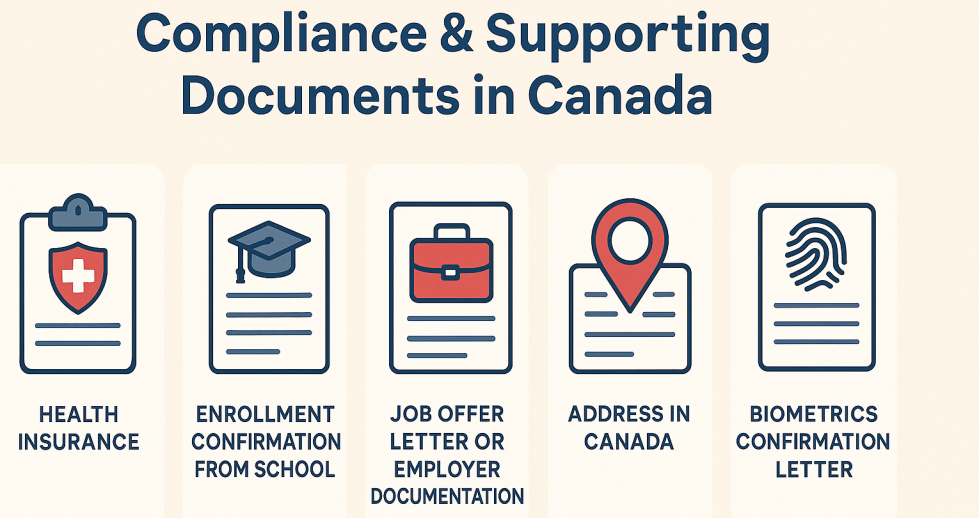
Compliance & Supporting Documents in Canada

Once inside Canada, temporary residents must be prepared to demonstrate ongoing compliance with the conditions of their stay. In addition to official permits such as a study permit, work permit, or visitor record, individuals are often required to present supplementary documents that confirm they are lawfully residing, studying, or working in Canada. These supporting documents may be requested by immigration officers, employers, educational institutions, healthcare providers, or service agencies, and serve as practical proof of status, identity, and residence.

Such documents are not issued directly by IRCC but are essential to daily life and legal functioning within Canada. They include evidence of local address, health insurance coverage, employment or enrollment confirmation, and biometrics correspondence, among others. Keeping these documents up to date and readily available helps individuals meet legal requirements, access services, and maintain good standing with Canadian authorities throughout their temporary stay.

In order to receive free or subsidized medical services such as doctor visits, hospital care, and diagnostic tests, newcomers must apply for a provincial or territorial health card. This card confirms your eligibility and must be presented at every medical appointment.

ProvinceWaiting PeriodHealth PlanNotes
Ontario (ON)✅ No wait (since March 2020)OHIPApply with ID and proof of address
British Columbia (BC)⏳ 3 monthsMSP (Medical Services Plan)Coverage starts after wait; private insurance needed in the meantime
Alberta (AB)✅ Immediate (if eligible)AHCIPApply with work permit or PR + proof of address
Quebec (QC)⏳ 3 monthsRAMQMust apply separately and may need private insurance during wait
Manitoba (MB)⏳ 3 monthsManitoba HealthWaiting period applies unless exempt
Saskatchewan (SK)✅ Immediate (if eligible)Saskatchewan Health CardBring immigration documents and proof of address
Nova Scotia (NS)⏳ 3 monthsMSIMust reside in NS and plan to stay for 12+ months
New Brunswick (NB)✅ ImmediateNB MedicareNo waiting for PRs or valid work permit holders
Prince Edward Island (PEI)✅ Immediate (in most cases)PEI Health CardMust reside in PEI and intend to stay for 6+ months
Newfoundland & Labrador (NL)✅ ImmediateMCPPRs and most work permit holders eligible
Yukon / NWT / Nunavut⏳ 3 months (varies)Territorial Health PlansApply after arrival; details vary

All temporary residents in Canada must ensure they have adequate health insurance coverage for the duration of their stay.

  • Eligibility for provincial or territorial health insurance (e.g., OHIP in Ontario, MSP in British Columbia) depends on the type of permit held and the province of residence. For example, full-time international students and open work permit holders are generally eligible, while visitors are not.

  • Those who do not qualify for public health insurance must obtain private coverage—either independently or through institutional/employer plans.

  • Proof of valid health insurance may be required when registering for school, accessing healthcare services, or extending status with IRCC.
    Maintaining continuous coverage is essential not only for personal health security but also for compliance with immigration and institutional requirements.

International students holding a valid study permit must remain actively enrolled at a Designated Learning Institution (DLI) and make reasonable progress toward completing their program.

  • Institutions issue letters of enrollment or registration confirmation, which serve as proof of compliance with study permit conditions.

  • These documents may be required by IRCC when applying for extensions, work permits, or permanent residence (e.g., post-graduation work permit applications).

  • Failure to remain enrolled or failure to provide timely proof of enrollment may result in the loss of legal status.
    Students should keep updated copies of enrollment letters, transcripts, and attendance records as part of their compliance documentation.

Temporary foreign workers must be able to provide proof of employment that corresponds with the conditions stated in their work permit.

  • This includes a job offer letter, employment contract, recent pay stubs, or a confirmation letter from the employer.

  • For those on employer-specific work permits, the documents must match the employer, job title, and location stated on the permit.

  • Open work permit holders may need such documentation to apply for provincial services or to demonstrate active employment when seeking to transition to permanent residence.
    Providing false or misleading employment information can lead to immigration consequences, so all employer-related documents must be accurate and verifiable.

Having and proving a Canadian residential address is often necessary for accessing local services and confirming one’s ongoing presence in the country.

  • Acceptable proof includes rental agreements, utility bills, bank statements, or letters from landlords.

  • Some immigration applications, including extensions or family sponsorships, require proof that the applicant resides in Canada.

  • Schools, healthcare providers, and service agencies also typically request a Canadian address to verify eligibility for services or programs.
    It is important to update addresses with IRCC and provincial agencies promptly to ensure continuous access to services and compliance with regulations.

Most temporary residents are required to provide biometrics (fingerprints and photo) as part of their initial application for a visa, study or work permit.

  • Once submitted, IRCC issues a Biometrics Confirmation Letter, which confirms that the data has been collected and is valid for 10 years.

  • This letter should be kept for future reference, especially if the individual is applying for a new status, renewing a permit, or applying for permanent residence.

  • Border officers or IRCC may request this letter to verify that biometrics have already been completed.
    Although it is not a permit or identity document, it is a critical piece of supporting evidence that proves compliance with IRCC requirements.

Compliance and supporting documents play a vital role in confirming that temporary residents are lawfully maintaining their status while in Canada. These documents—ranging from health insurance coverage and proof of enrollment or employment to residential address verification and biometrics confirmation—may not be issued directly by IRCC, but they are essential for day-to-day legal compliance and access to services.

Keeping these documents current, accurate, and readily available helps individuals fulfill the conditions of their permits, access healthcare and education, and demonstrate their legal presence when required. Failure to maintain or present appropriate documentation can lead to difficulties with service providers or immigration authorities. Staying organized and proactive ensures a smooth, compliant stay in Canada.

Temporary Residency Essentials: Arrive Informed, Stay Compliant

When individuals arrive in Canada under temporary residency without the correct documents, they may face immediate and serious challenges:

  • Entry may be denied at the border if your visa, eTA, or Port of Entry (POE) Letter is missing, expired, or inconsistent with your purpose of travel.

  • You may be unable to begin work or studies on schedule due to missing job offer letters, school enrollment confirmations, or biometrics documentation.

  • Essential services such as housing, healthcare, or banking may be inaccessible without proof of legal status, Canadian address, or insurance coverage.

  • IRCC may delay or refuse applications—such as extensions or future immigration filings—if your documentation is incomplete, inconsistent, or not properly translated.

  • Failure to prove financial means, family ties, or personal history can result in status loss, refused permits, or even enforcement action in Canada.


Arriving with a suitcase gets you to Canada.
Arriving with the right documents sets you up to stay.

FAQ about Temporary Residency Documents

A TRV is a physical visa required for citizens of visa-required countries, while an eTA is a digital authorization for visa-exempt travellers flying to Canada. Both allow entry but do not grant the right to work or study.

Yes. A TRV or eTA only allows you to enter Canada. If your purpose is to study or work, you must also have a valid study permit or work permit issued by IRCC.

The POE Letter is issued when IRCC approves your study or work permit application. You must present it at the Canadian border to receive the actual permit. Without it, your entry could be refused or your status misassigned.

In some cases, yes—but not always. Certain permit applications require applying from outside Canada. It’s important to verify eligibility before entering as a visitor if your long-term goal is to work or study.

You should bring your passport, permit or POE letter, proof of funds, return or onward travel ticket, and, if applicable, an invitation letter, insurance documents, or school/job confirmation.

Overstaying can lead to loss of legal status, refused future applications, and possible enforcement actions. You should always apply to extend your stay before your current status expires.

Yes. Depending on your province and permit type, you may qualify for public health coverage. If not, you must obtain private insurance to cover medical expenses during your stay.

A Visitor Record is issued when you apply to extend your stay in Canada as a visitor. It sets a new expiry date for your stay but does not allow re-entry if you leave the country.

Biometrics are valid for 10 years. If you’ve already provided biometrics for a previous application, you may not need to submit them again for a new temporary residence application.

Yes. Missing or inconsistent documents can delay work or study, limit access to services, and jeopardize future applications for permanent residency. Proper documentation from the beginning is crucial for your long-term goals.

Latest Posts on Documemts

Email Us

For any inquiries or assistance, feel free to reach out to us via email at [email protected]. We aim to respond within 24 hours.

Call Us

You can contact us directly at +1 (647) 464-4526. Our team is available to assist you from Monday to Friday, 9 AM to 6 PM EST.

Visit Us

We welcome you to visit our office located at 295-297 Cosburn Ave., Toronto, Canada, M4J 2M5. Please call ahead to schedule an appointment.