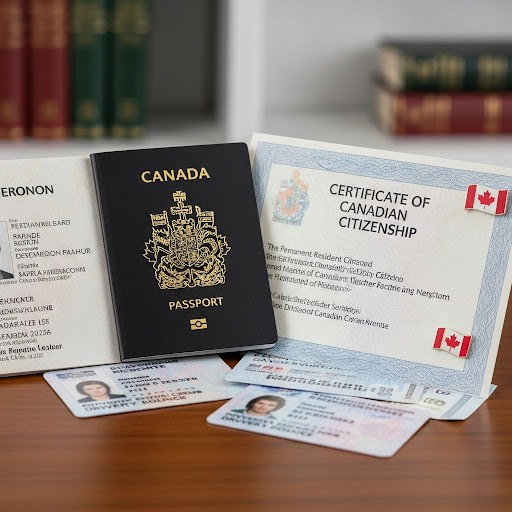
Canadian Citizenship: Documents and Supporting Evidence

Trends 2025:

In 2025, IRCC continues to raise the bar for accuracy, consistency, and supporting proof in citizenship applications. These are the top 5 trends to watch:


1. Physical Presence Under the Microscope

Even minor gaps or inconsistencies between passport stamps, CBSA records, and declared presence days can trigger procedural fairness letters. Supporting documents like leases, pay stubs, and school records are more important than ever.


2. CRA-Tax Alignment Now Expected

Officers increasingly compare presence claims with CRA tax filings. Years with low or no income require additional explanation—even if physical presence is technically met.


3. Language Proof Is Being Rejected More Often

Older test results, certificates from non-approved institutions, or vague exemption letters are facing higher refusal rates. Officers now expect current, verifiable, and clearly worded language evidence.


4. Name Inconsistencies Delay Processing

Any mismatch between passports, PR cards, and forms—no matter how small—now leads to clarification requests. Legal proof of name changes is essential before applying.


5. Citizenship Photos Still Cause Rejections

Photos that don’t meet exact IRCC specs remain one of the top reasons for application returns. Ink stamp, date, photographer info, and proper size must all be present—no exceptions.


The bottom line: Citizenship applications are no longer just about eligibility—they’re about precision. Every document must match, prove, and support your case without room for doubt.
Your Path to Citizenship Begins Here: Accurate Document Preparation

Becoming a Canadian citizen marks a significant legal and personal milestone. It not only affirms your long-term commitment to Canada but also grants access to full civic rights, including the ability to vote, apply for a Canadian passport, and fully participate in Canadian society. However, before reaching this important step, applicants must demonstrate that they meet all statutory requirements under the Citizenship Act. Central to this process is the preparation and submission of complete, truthful, and verifiable documentation. Citizenship applications are reviewed with close attention to detail, and any discrepancies, omissions, or inconsistencies may result in delays, requests for clarification, or refusal of the application altogether.

This page provides a comprehensive overview of the documents typically required when applying for Canadian citizenship, as well as those issued or updated once citizenship is granted. While each applicant’s circumstances may vary, it is critical that all submitted documents accurately reflect the facts of your case, including identity, immigration history, residency, and language proficiency. Canadian authorities apply strict standards when verifying citizenship eligibility, and falsified or misleading information can carry serious legal consequences. Ensuring accuracy and transparency at every stage of the process is therefore not only a procedural necessity—it is a legal obligation.

Are You Citizenship-Ready or Just Application-Ready?

Application-ready means you’ve done the basics:

✔ Filled out the forms
✔ Paid the fee
✔ Uploaded a few documents
✔ Maybe ran the presence calculator once

✔ Accurate travel and tax history
✔ Proof of language and PR status that actually meets the criteria
✔ Supporting docs tailored to your personal situation
✔ Consistency across every record, every date, every name

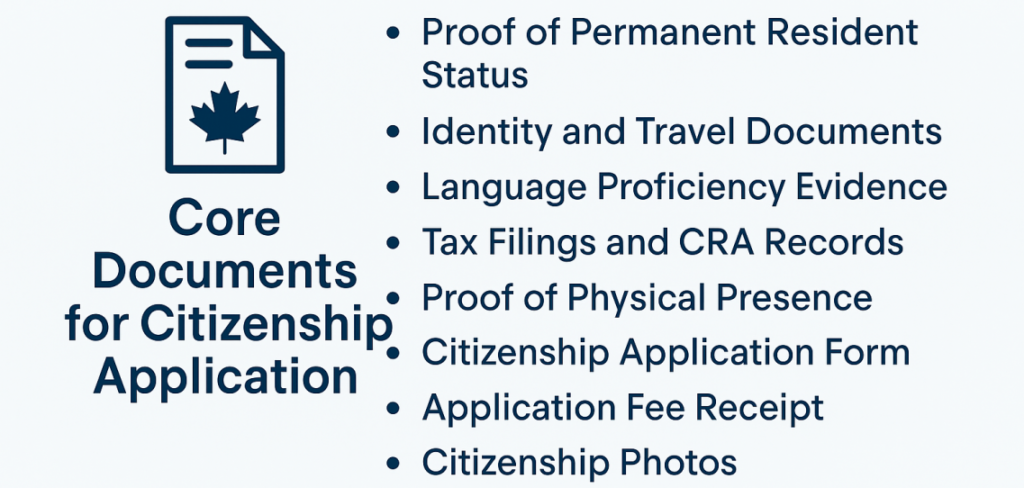
Core Documents for Citizenship Application

The core documents required for a Canadian citizenship application serve as the foundation of your file. They provide essential proof of your identity, immigration status, and fulfillment of all legal requirements under the Citizenship Act. Whether you are applying as an individual or on behalf of a minor child, these documents are used to assess your eligibility, confirm your time in Canada, and verify that you meet the language, residency, and tax obligations. Submitting a complete and properly organized application package helps reduce the likelihood of delays or procedural requests and ensures that your case is assessed based on accurate and sufficient evidence.

To successfully apply for Canadian citizenship, applicants must submit a standardized set of core documents. These are reviewed by Immigration, Refugees and Citizenship Canada (IRCC) to confirm eligibility under the Citizenship Act. Each document plays a specific evidentiary role, and all must align consistently with the information provided in the application form. Below are the key categories and their purpose within the process:

Applicants must establish that they are permanent residents of Canada and have not lost this status at any time before applying. Commonly submitted documents include a PR card (both sides), Confirmation of Permanent Residence (IMM 5292 or IMM 5688), or a Record of Landing (IMM 1000). Even if the PR card is expired, it remains valid for citizenship purposes so long as the status itself remains intact. In certain cases, expired visas, old passports, or immigration stamps may be included to help confirm entry dates or clarify historical gaps in documentation.

Documents:

  • PR Card (both sides)

  • Record of Landing (IMM 1000)

  • Confirmation of Permanent Residence (IMM 5292 or IMM 5688)

  • Valid or expired visas/stamps if needed for history

Applicants must provide clear copies of government-issued photo identification and valid or expired passports. These documents are used to confirm the applicant’s identity and to validate their travel history, residence periods, and biographical details. All pages of current and expired passports covering the eligibility period should be included, particularly if the applicant has left and re-entered Canada multiple times. Inconsistencies or missing entry/exit records may trigger further review or requests for additional information.

Documents:

  • Passport (all pages, especially for travel history)

  • Driver’s license, provincial ID, or health card

To meet the language requirement under section 5(1)(d) of the Citizenship Act, applicants aged 18 to 54 must demonstrate adequate knowledge of English or French at a Canadian Language Benchmark (CLB) level of 4 or higher. Acceptable forms of proof include approved language test results (e.g., IELTS, CELPIP), a diploma or transcript from a Canadian secondary or post-secondary institution, or documented proof of equivalent foreign credentials with an accepted language of instruction. IRCC will assess whether the document adequately confirms speaking and listening skills. Applicants who are unable to meet this requirement due to a medical condition may request a waiver with supporting documentation.

Documents:

  • CELPIP or IELTS test results (CLB 4+)

  • Canadian high school or post-secondary diploma/certificate

  • Equivalency assessments for foreign education (e.g., ECA)

Applicants are generally required to demonstrate that they have filed personal income taxes in Canada for at least three of the five years preceding their application, in accordance with the Income Tax Act. CRA Notices of Assessment (NOAs) are commonly submitted for this purpose. These records not only confirm compliance with tax obligations but also help IRCC verify physical presence claims. In addition to submitting copies, applicants may authorize IRCC to verify tax records directly with the Canada Revenue Agency through the tax consent form included in the application package.

Documents: 

  • CRA Notices of Assessment (NOA) for 3 of the past 5 years

  • Consent form to allow IRCC to check tax status (optional)

One of the core eligibility criteria for citizenship is having been physically present in Canada for at least 1,095 days within the five years before applying. The applicant must use IRCC’s Physical Presence Calculator to calculate this time and submit the resulting report with their application. Supporting documentation may include travel history records, passport stamps, CBSA travel reports, work and school records, and any other documentation that establishes Canadian residence. Gaps in residence or frequent travel abroad should be clearly explained and supported with relevant documentation.

Documents:

  • Travel history

  • Entry/exit records from CBSA or IRCC

  • Work/school records during the relevant period

This form is the central component of the citizenship application. It collects personal information, travel history, PR status details, education, and work experience. It must be completed fully and accurately, with the barcode page included. The form must be signed and dated by the applicant and submitted either online (through the secure IRCC portal) or by paper, depending on the applicant’s situation. Incomplete or outdated versions of the form may result in rejection of the application.

Application form (CIT 0002):

  • Fully completed, signed, and dated

  • Include barcode page

All adult applicants must submit proof of payment for the processing and citizenship fee. As of 2025, the total fee for adult applicants is $630, and $100 for minors applying with or without a parent. The payment must be made online through IRCC’s official website, and the receipt must be included in the application package. Failure to provide valid payment proof will result in the application being returned without processing.

Applicants must include two identical printed citizenship photos taken within the last six months. These must meet IRCC’s strict photo specifications, including size, background, and facial expression. The photos must be signed and dated by the photographer and must include the name and address of the photography studio. Improper photo submissions are one of the most common reasons for application delays or rejections.

Two identical citizenship photos:

  • Must meet IRCC specifications

  • Signed by the photographer and dated

The core documents submitted with a Canadian citizenship application form the basis of how your eligibility is evaluated under the law. They must clearly demonstrate your permanent resident status, time spent in Canada, language ability, and fulfillment of tax obligations, among other factors. Accuracy, consistency, and completeness are critical, as even minor errors or omissions can lead to delays or a refusal. By ensuring that each document meets IRCC’s formal requirements and reflects the facts of your case, you strengthen your application and move one step closer to securing Canadian citizenship.

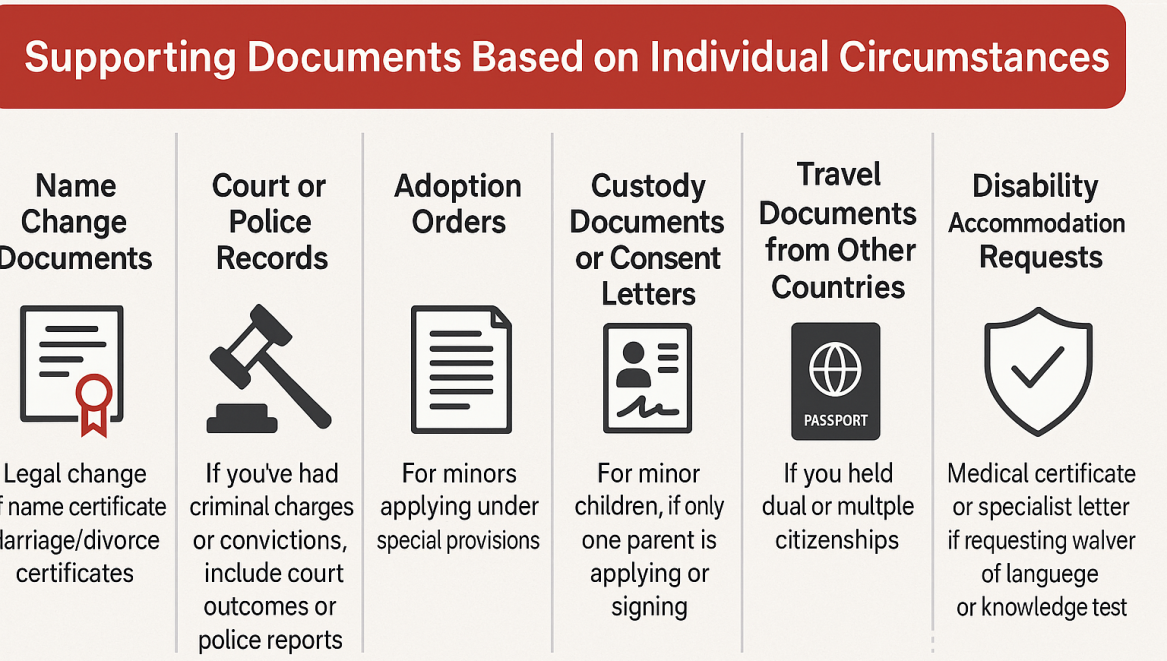
Supporting Documents Based on Individual Circumstances

In addition to the standard set of core documents, many applicants are required to submit supporting documents tailored to their individual circumstances. These documents serve to clarify or expand upon information relevant to family status, legal history, language exemptions, or exceptional personal situations. They are particularly important where an applicant’s path to citizenship involves elements not fully addressed in the core forms—such as adoption, name changes, criminal history, or custody arrangements. These documents help IRCC make an informed and fair decision by providing the full context behind the application.

Because every applicant’s situation is different, the need for supporting documents will vary. It is essential to include any relevant materials that explain or support your specific case. Submitting clear, truthful, and well-organized documents strengthens your application and helps prevent unnecessary delays or refusals.

If your legal name differs from the one listed on your immigration or identity records, you must provide documentation to explain the change. This may include a legal change of name certificate, marriage certificate, divorce decree, or any court-issued order authorizing a name change. These documents help IRCC verify your identity across all stages of your immigration history and ensure consistency in your citizenship records, especially for the Citizenship Certificate and future passport application.

Applicants who have ever been charged with or convicted of a criminal offence—whether in Canada or abroad—must provide full documentation regarding the incident. This includes police certificates, court decisions, sentencing summaries, or evidence of pardon or rehabilitation, where applicable. Citizenship cannot be granted while certain criminal prohibitions are in effect, and full disclosure is essential. Failure to submit accurate and complete legal documentation can lead to application refusal or potential misrepresentation findings.

Minors applying for citizenship through adoption must submit certified adoption orders or related legal documentation issued by a recognized authority. These orders must show that the adoption is valid under the laws of the place where it occurred and that it meets the requirements of Canada’s immigration legislation. Additional documents may be required if the child was adopted abroad or through an intercountry process. These help IRCC determine whether the child qualifies under the provisions of the Citizenship Act specific to adopted children.

Where only one parent or legal guardian is applying on behalf of a minor child, IRCC requires proof of custody or a notarized consent letter from the non-accompanying parent. These documents help prevent legal disputes and confirm that the application has been made in the child’s best interest with appropriate legal authority. In the absence of joint consent, a court order or sole custody ruling must be submitted to proceed with the child’s application.

If you hold, or have previously held, citizenship in another country, or if you have travelled extensively using foreign documents, you must disclose and include relevant travel documents, such as passports or identity booklets. These are especially important where there may be questions about your physical presence in Canada, time spent abroad, or your legal status in another jurisdiction. Submitting these documents ensures transparency and allows IRCC to accurately verify your eligibility under the physical presence and residency rules.

If you are unable to meet the standard language or knowledge requirements due to a medical or cognitive condition, you may request a waiver by submitting appropriate medical documentation. This includes a letter from a licensed physician or specialist that clearly describes the condition, how it limits your ability to complete the language or citizenship test, and whether it is temporary or permanent. IRCC reviews these requests on a case-by-case basis under section 5(3)(b) of the Citizenship Act. Submitting thorough and credible evidence is essential to support such an exemption.

Supporting documents based on individual circumstances are a critical component of many citizenship applications, particularly when the applicant’s situation involves legal, familial, or medical complexities. These records provide essential clarification, ensure compliance with legal requirements, and help IRCC assess eligibility in a fair and informed manner. Whether you are requesting an exemption, documenting a name change, or applying on behalf of a minor, it is vital that all supporting documents are accurate, clearly presented, and aligned with your application narrative. Proper documentation in these areas can significantly reduce delays and strengthen the credibility of your submission.

Avoid Delays—or Worse, a Refusal !

Unsure whether your documents meet IRCC’s strict requirements?

Even one missing page, outdated form, or unclear record can derail your entire application.

Before you submit, make sure every detail is accurate, complete, and ready for scrutiny.
📅 Let’s check your package — because citizenship is too important to leave to chance.

Post-Citizenship Documentation

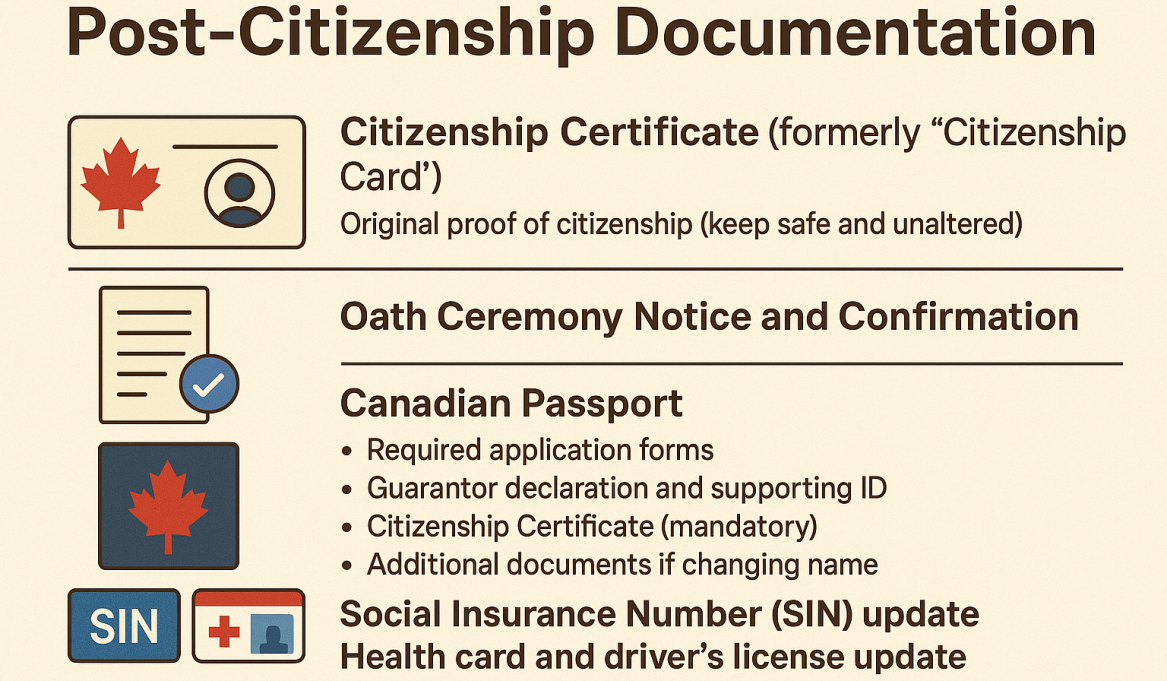
Once Canadian citizenship is granted and the Oath of Citizenship is taken, several important documents are issued or become accessible. These post-citizenship documents serve as formal proof of your new legal status and are essential for exercising your rights and responsibilities as a Canadian citizen. They are also required when updating your identity with government agencies, employers, schools, and financial institutions. Knowing what to expect—and how to use each document appropriately—ensures a smooth transition into your new civic role.

The Citizenship Certificate, in particular, becomes your primary evidence of Canadian citizenship and is required when applying for a Canadian passport. In addition, you may need to update your Social Insurance Number (SIN), driver’s license, health card, and other records that were previously issued under your permanent resident status. Each of these steps plays a role in aligning your personal information across federal and provincial systems, and ensuring that you receive the full benefits and protections of citizenship.

The Citizenship Certificate is the official and only accepted document that proves you are a Canadian citizen. It replaces the older version known as the “Citizenship Card” and is issued automatically after you take the Oath of Citizenship. This certificate includes your full name, date of birth, gender, and a unique client identifier (UCI), and should be stored safely and never altered or laminated. It will be required for important future processes, including applying for a Canadian passport, accessing certain government services, and re-establishing citizenship rights if lost abroad.

This includes both the invitation to attend your citizenship ceremony and the written confirmation that you have taken the Oath of Citizenship. While not a standalone proof of citizenship, the confirmation serves as evidence of having completed the final legal step in the process. It may also be requested for administrative updates with employers, educational institutions, or provincial authorities before your Citizenship Certificate or passport is issued.

Once you become a citizen, the Canadian passport becomes your primary travel document and a key form of identification worldwide. To apply, you must submit the correct application form (for adults or children), a valid Citizenship Certificate, and a signed declaration from a qualified guarantor who can confirm your identity. Supporting ID, such as a driver’s license or health card, is also required. If your name has changed since obtaining citizenship, you must also provide legal name change documents. The passport is not issued automatically—you must apply separately through Passport Canada or a Service Canada office.

After becoming a citizen, you should update your SIN record with Service Canada to reflect your new citizenship status. This is especially important for those who held a temporary or permanent resident SIN (starting with “9”), as it may carry expiry conditions. Updating your SIN ensures continued access to employment, tax benefits, and social programs without interruption or restriction.

Citizenship may affect the identification category associated with your provincial or territorial health card and driver’s license. Updating your status with the relevant provincial authority ensures that your records reflect your citizenship and that there are no discrepancies in eligibility or renewal processes. While your rights to these services remain the same, updating them ensures administrative consistency and avoids confusion.

Although not legally required, updating your citizenship status in school or workplace systems is advisable. Educational institutions may request a copy of your Citizenship Certificate for tuition or residency classification, while employers may need updated status for payroll, benefits, or pension plans. Ensuring your new status is recorded in these systems helps align your personal profile and may simplify future applications, background checks, or credential verifications.

Although not legally required, updating your citizenship status in school or workplace systems is advisable. Educational institutions may request a copy of your Citizenship Certificate for tuition or residency classification, while employers may need updated status for payroll, benefits, or pension plans. Ensuring your new status is recorded in these systems helps align your personal profile and may simplify future applications, background checks, or credential verifications.

Your Citizenship Story Starts with Proof—Make It Count

When you apply for Canadian citizenship without the right documents, you may face serious and avoidable consequences:

  • Returned or rejected applications:
    Incomplete forms, missing signatures, or unsubmitted documents may result in your application being returned without processing—costing you months of delay and a full re-submission.

  • Extended processing times:
    If your documents are unclear, outdated, or inconsistent, IRCC may issue procedural fairness letters, request additional information, or initiate further verification, significantly slowing down your case.

  • Increased scrutiny or refusal:
    Missing tax records, language evidence, or proof of presence can raise concerns about your eligibility. Discrepancies between documents and declarations may trigger suspicion of misrepresentation.

  • Loss of exemption opportunities:
    If you fail to provide proper medical or legal documentation to support a waiver (e.g., language or knowledge test), your application may be assessed under standard criteria and refused.

  • Delays in post-approval steps:
    Without accurate identity or name-change records, you may face complications in receiving your Citizenship Certificate, applying for a passport, or updating your SIN, health card, and other legal documents.


Applying without proper documentation means risking your status.
Applying with care and accuracy means you’re ready to be recognized as a Canadian.

FAQ about Canadian Citizenship: Documents and Supporting Evidence

Most documents should be clear photocopies, except the photos and application form. Originals may be requested later.

You do not need a valid PR card to apply. You only need proof that you were a PR and met residence requirements.

Use IRCC’s Physical Presence Calculator and include supporting travel documents and entry/exit records.

Only if you qualify for a language test exemption (e.g., due to age or medical condition) or hold Canadian education credentials.

You must apply for a Verification of Status (VOS) from IRCC. This can take several months.

If you didn’t file, you must provide written explanation and evidence to justify the exemption.

No. All documents must be translated into English or French, with certified translation and affidavit if not official.

No. You must submit printed physical photos that meet IRCC’s citizenship photo specifications.

No. You must apply separately using your Citizenship Certificate.

It depends on the document. Some can be obtained later (like bank letters), while others (like foreign police certificates or diplomas) may be hard or slow to retrieve. Delays or refusals are possible. Seek help from a settlement agency or lawyer if this applies to you.

Latest Posts on Documemts and Citizenship

Email Us

For any inquiries or assistance, feel free to reach out to us via email at [email protected]. We aim to respond within 24 hours.

Call Us

You can contact us directly at +1 (647) 464-4526. Our team is available to assist you from Monday to Friday, 9 AM to 6 PM EST.

Visit Us

We welcome you to visit our office located at 295-297 Cosburn Ave., Toronto, Canada, M4J 2M5. Please call ahead to schedule an appointment.