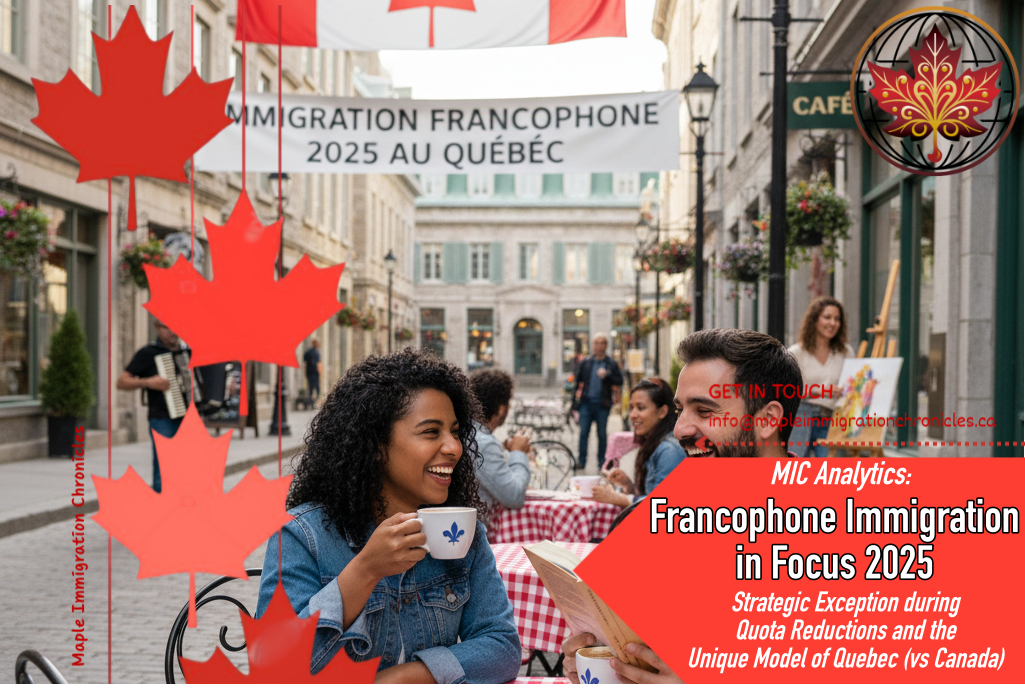
In 2025, Canada’s federal immigration policy moves to a moderate reduction of overall inflows of both permanent and temporary residents. Against this backdrop, an opposite approach is formally fixed for one category — francophone immigrants who settle outside Quebec. The government raises the benchmarks of their share and makes francophone immigration a permanent priority, entrenched in IRCC policy, levels plans, and separate selection programs, including category-based Express Entry draws for knowledge of the French language. By the results of 2023, the target of 4.4% was exceeded (≈4.7%), and for 2024–2026 increasing annual benchmarks were introduced; the government is also consulting on gradually reaching 12% by 2029 outside Quebec.
Historical Context and Goals
As early as 2003, the federal government of Canada declared an ambitious goal — to ensure that at least 4.4% of all new permanent residents who settle outside the province of Quebec would be francophone. This goal aimed to support linguistic balance, strengthen the role of the French language in Canadian society, and promote the development of francophone communities in various regions of the country. At the same time, practical implementation turned out to be extremely difficult: for a long time the share of francophones remained significantly lower than the established benchmark. Only after 19 years, in 2022, did the indicator for the first time reach the set threshold of 4.4%, which became a symbolic confirmation of the gradual but long-term process of integrating language policy into Canada’s immigration strategies.
Gradual Growth of Targets
Evolution of Targets and Results (outside Quebec)
| Year | Target (%) francophone PR outside Quebec | Real Result / Forecast |
| 1971 | — | Actual share 6.1% |
| 2003 | 4.4% | Achieved only in 2022 |
| 2021 | — | Actual share 3.5% |
| 2024 | 6% | Overachieved: 7.2% (30,550 persons) |
| 2025 | 8.5% | Current plan |
| 2026 | 9.5% | Next target |
| 2029 | 12% | Strategic goal of the Carney government |
Note: in 2024–2025 the federal “categories” of Express Entry preserve a separate category for knowledge of French. This supports the growth of the share of francophones in selections.
These figures demonstrate a sharp strengthening of the state’s commitments. The new goal of 12% is even higher than what the previous government planned (10% under Justin Trudeau).
Symbolic Significance
The return to the 1971 level (6.1%) is considered a kind of “starting point” for francophone minorities. Now the government not only plans to restore this share but also to raise it twofold, which will have significant cultural and demographic importance.
Main Mechanisms of Implementation
1. Category-Based Express Entry Selections
Since 2023, IRCC has actively applied category-based candidate selection, among which one of the key criteria has become knowledge of the French language. This allows francophone candidates to increase their chances of receiving an Invitation to Apply (ITA). Such a mechanism is especially important, since in general draws the passing scores often exceed 525–530 CRS, which makes the competition very high.
2. Financial Support for Communities
The Welcoming Francophone Communities (WFC) program provides funding for initiatives aimed at the integration of newcomers. This covers support in job search, language courses, cultural events, and the creation of social networks in communities where francophones are a minority.
3. Legislative Guarantees
The modernized Official Languages Act directly recognizes the role of immigration in preserving the francophone population. It establishes the obligation of the government to work on restoring the share of francophones outside Quebec to the historical level and to ensure further growth.
4. Pilot Programs in Regions
A number of regions are joining pilot projects:
- Acadian Peninsula zone, New Brunswick — the program gives local enterprises the possibility to hire francophone specialists;
- Timmins, Ontario — a city with 41,000 population, almost half of which speaks French, relies on attracting new francophones to support healthcare, education, and public services.
These examples demonstrate that francophone immigration has not only symbolic but also practical significance for the development of regions.
Priority Regions and Programs for Francophone Immigrants (2025)
| Region / Province | Main Programs and Initiatives | Priority Professions and Sectors |
| New Brunswick (Acadian Peninsula) | Francophone Community Immigration Pilot; WFC | Healthcare workers, teachers, production specialists, service sector workers |
| Nova Scotia and Prince Edward Island | WFC programs; local settlement initiatives | Nurses, social workers, educators, caregivers |
| Newfoundland and Labrador | Pilot programs for integration of francophones; support through settlement agencies | Education, healthcare, social services |
| Ontario (Ottawa, Northern Ontario: Timmins, Sudbury) | WFC; special Express Entry draws for francophones; partnerships with colleges (Collège Boréal) | Doctors, teachers, social workers, engineers, public servants |
| Manitoba (Winnipeg, Saint-Boniface) | Université de Saint-Boniface; Settlement Services for Francophones | Educators, healthcare staff, IT and finance specialists |
| Alberta | Integration programs through francophone associations; Express Entry support | Care workers, IT specialists, engineers, teachers |
| British Columbia | Settlement Services for Francophones; regional initiatives | Technology specialists, educators, healthcare personnel |
| Yukon, Northwest Territories, Nunavut | WFC; francophone associations | Healthcare workers, social services, public sector |
Integration Programs for Francophones
| Program | Essence and Tools | Where It Operates |
| Welcoming Francophone Communities (WFC) | Funding of local initiatives: language courses, cultural events, employment, mentorship | Selected communities in all provinces |
| Francophone Community Immigration Pilot | Facilitated access to PR for francophone specialists; employer support | New Brunswick, Ontario (Timmins, Sudbury), other regions |
| Settlement Services for Francophones | Consultations, adaptation, legal and career support in French | In most provinces |
| Educational initiatives (Collège Boréal, Université de Saint-Boniface) | Special programs for students and newcomers, training and adaptation courses in French | Ontario, Manitoba |
| Express Entry – category-based draws for francophones | Separate draws for candidates with knowledge of French, reduced CRS | All Canada outside Quebec |
These tables show that francophone immigrants have a double bonus: on one hand, higher chances to pass through Express Entry, and on the other hand, there is an expanded support network on the ground for integration into communities.
Welcoming Francophone Communities (initial 14 communities)
| Province / Territory | Community |
| Alberta | Brooks |
| British Columbia | Prince George |
| Manitoba | St. Boniface–St. Vital (Winnipeg) |
| New Brunswick | Tracadie |
| Newfoundland and Labrador | Saint-Jean (St. John’s) |
| Nova Scotia | Halifax |
| Ontario | Hamilton–Niagara; Ottawa; Sudbury; Thunder Bay |
| Prince Edward Island | Évangéline |
| Saskatchewan | Moose Jaw–Gravelbourg; Saskatoon |
| Northwest Territories | Yellowknife |
Francophone Community Immigration Pilot (FCIP), 2025
| Province | Community | Essence |
| British Columbia | Kelowna | PR pilot for skilled workers in francophone / small remote communities; authorized employers, need by proven vacancy. |
| Manitoba | St. Pierre Jolys | The same |
| New Brunswick | Acadian Peninsula | The same |
| Ontario | Sudbury; Timmins; Superior East Region | The same |
Provincial Programs and Instruments (outside Quebec)
In certain jurisdictions there exist special or priority channels for francophone applicants.
Provincial and Territorial Instruments for Francophones (sample of official channels)
| Province / Territory | Program / Stream | Format | Status and Features |
| Ontario | OINP Express Entry French-Speaking Skilled Worker | EE-aligned nomination stream | Official OINP updates for 2025; FSSW retained, policy and employer portal clarifications active. |
| New Brunswick | NBPNP Strategic Initiative (French-speaking) | Separate NBPNP stream | Stream for francophone candidates; in 2025 new EOIs temporarily not accepted due to sufficient intake; guidelines and criteria published. |
| Nova Scotia | NSNP Labour Market Priorities (targeted draws) | EE-aligned draws | Province periodically directs draws to francophones; details in guides/announcements. |
| Northwest Territories | NTNP Francophone Stream | Separate stream | Direct channel for candidates with French/English and valid job offer; covers TEER 0–5. |
| Prince Edward Island | PEI Francophone Immigration Strategy (2023–2028) | Strategy / action plan | Official plan for strengthening attraction of francophones; applied together with PEI PNP. |
| Manitoba | MPNP with francophone focus (partnerships RIF/SFM) | Targeted recruitment / support | Systemic steps at provincial and community level (white paper, institutional networks). |
Integration Programs and Support for Francophones
Beyond nominations and selections, communities have at their disposal large-scale integration instruments.
Integration Initiatives and Networks
| Instrument | Description | Geography / Status |
| Welcoming Francophone Communities (WFC) | “Welcoming communities” model with funding and partnerships for housing, employment, social integration. In 2025 an expansion of support was announced. | 14 initial WFC + expansion to 24. |
| Francophone settlement services | Expansion of network of francophone service providers; increase in share of clients served by francophone SPOs. | Federal network, indicators growing since 2018–2019. |
| Rural & Francophone Community Immigration Pilots | Umbrella format for RCIP/FCIP: allows communities to directly address workforce shortages. | Lists of communities are published by IRCC. |
Why Exactly Francophone Immigration Is a Priority
Economic DevelopmentFrancophone communities outside Quebec, especially in rural regions, face demographic decline and shortage of workforce. The attraction of new francophone immigrants allows the restoration of the local economy, support of entrepreneurship, and ensuring of the viability of small towns.
Preservation of Linguistic and Cultural Diversity
According to the federal plan on official languages, the share of francophones outside Quebec decreased from 6.1% in 1971 to 3.5% in 2021. Without special measures this trend could lead to the loss of unique cultural heritage.
Access to Public Services
In the sphere of healthcare and education francophone staff play a critical role. For patients and students who speak only French, access to their native language means higher quality of service and equality of opportunities.
Strategic Balance in Immigration Policy
Against the background of reduction of the overall number of immigrants (in 2025 — 395,000 instead of the previously planned 500,000) it is precisely francophones who are the only group that received priority in growth. This underlines their special role in the strategic plans of the state.
Quebec: Independent Model of Selection
Quebec has its own immigration system, which operates separately from the federal one. Unlike other provinces, it independently determines quotas, criteria, and programs for the selection of immigrants. This is related to the constitutionally entrenched right of Quebec to preserve and develop its francophone character.
Therefore, the new federal targets regarding francophones (12% outside Quebec by 2029) do not extend to Quebec, since here the share of francophone immigrants has always been significantly higher.
Main Channels of Quebec
Classical programs QSWP (through Arrima), PEQ for graduates and workers, as well as targeted pilots (IT/AI, medical services, food industry). French language is not a bonus, but a basic requirement for most pathways.
- Québec Skilled Worker Program (QSWP)
- Main program for skilled workers.
- Candidates submit an application through the Arrima system, where a “pool” is formed similar to Express Entry.
- Significant preference is given to those who know French (level B2 and higher).
- Programme de l’expérience québécoise (PEQ)
- Simplified pathway for those who already studied or worked in Quebec.
- Graduates of local educational institutions and temporary workers can receive a Quebec Selection Certificate (CSQ) under a simplified procedure.
- Entrepreneur, Investor and Self-Employed Programs
- Support for business immigrants who create enterprises or invest in Quebec.
- For francophone applicants the process of integration is usually easier, since knowledge of French is a key condition.
- Immigration Pilot Programs (until 2026)
- Pilot for workers in the sphere of IT and artificial intelligence.
- Pilot for workers in the sphere of medical services.
- Pilot for workers in the food industry.
Are There Additional “Perks” for Francophones?
- In Quebec almost all programs are automatically oriented towards francophones. Knowledge of French does not give a “bonus” (as in federal Express Entry draws), but is a basic requirement.
- However, immigrants with a high level of French have accelerated application processing and often higher chances of success.
- In many cases knowledge of English is secondary or even not obligatory, unlike the rest of Canada.
Francophone immigration here is not an exception — it is the norm and standard. Unlike federal programs, where knowledge of French opens additional doors, in Quebec it is the main key. For those who wish to settle precisely in this province the main task is confirmation of language level and compliance with the requirements of the programs Arrima/QSWP or PEQ.
Comparison of Approaches: Federation vs Quebec
Federal Francophone Immigration vs Quebec (Selection Architecture)
| Criterion | Federation (outside Quebec) | Quebec |
| Selection System | Express Entry + categories (including “French language”); PNP; pilots FCIP/RCIP; IMP C16 | Arrima/CSQ; QSWP, PEQ, sectoral pilots |
| Priority of French | Separate EE category; separate provincial streams/selections | Basic condition of majority of programs |
| Integration in Communities | WFC (14→24), francophone SPO, expanded funding | Provincial integration networks; francophone service ecosystem |
| Benchmarks of Share of Francophones | 6% (2024), 8.5% (2025), 9.5% (2026), 10% (2027); consultative vector to 12% (2029) | Own targets/plans, not subordinated to federal shares |
Federation (outside Quebec): French language acts as an advantage, not an obligatory condition. Selection is carried out through Express Entry with a separate category, PNP, pilots (FCIP/RCIP), IMP C16. The state finances the network of Welcoming Francophone Communities (14→24) and francophone SPO. Gradual targets established: 6% (2024), 8.5% (2025), up to 12% (2029).
Quebec: French is a basic requirement in programs Arrima/CSQ, QSWP, PEQ and pilots. Integration is ensured through its own network of francophone services. The province determines its own targets, independent from federal indicators.
Thus, federation stimulates francophoneness as a bonus, whereas Quebec makes it the main condition of access.
Canada (Federal) vs Quebec — Permanent and Temporary Immigration: Statistics
| Category | Canada (federal) | Quebec |
| PR (target indicators) | 2025: 395,000; 2026: 380,000; 2027: 365,000 | 2022: 68,704; 2021: 50,275; plan for 2023–2024: stability within 48,500–53,100 |
| PR (actual data) | Q1 2025: 104,256 persons. For comparison, Q1 2016 was a record achievement — less: 86,246 | — |
| Temporary Residents (federal) | Target 2025: 673,650 new temporary residents (45% students); 2026: 516,600; 2027: 543,600 | PR: ≈50,000 per year; no clear limits for temporary residents; in 2023 they comprised ≈1.8% of population |
| Status of Students/Workers (temporary) | Decrease in number of non-permanent residents in Q1 2025: –61,111 (especially students: –53,669) | — |
| Changes in Immigration Policy | Fed. government carried out significant reduction of number of PR due to public pressure and crisis — target reduced from 500,000 to 395,000 in 2025 | Until June 30, 2025 there was a temporary pause (moratorium) on PR programs: skilled workers and graduates PEQ, to avoid over-subscription (possible jump to 70,000) |
Federation: in 2025 PR target reduced to 395,000 (instead of 500,000), in Q1 already 104,256 new residents. Temporary residents planned 673,650, but their number decreases, especially students (–53,669).
Quebec: stably ≈50,000 PR per year, in 2022 — 68,704. For temporary residents no limits (1.8% of population in 2023). Until mid-2025 there was a moratorium on PEQ and skilled workers.
Conclusion: federation goes by way of sharp reductions, whereas Quebec preserves stability with selective pauses.
Canada (Federal) vs Quebec — Permanent and Temporary Immigration (Reference, 2025)
| Indicator | Federation (overall) | Quebec |
| PR Admission Plan 2025 | 395,000 (levels 2025–2027) | ≈56,500 (provincial plan) |
| Selection Instruments | EE, PNP, pilots (FCIP/RCIP), AIP, IMP C16 | QSWP, PEQ, pilots; Express Entry not applied |
| TR Trends (students/workers) | General decrease of inflows in 2024–2025; strengthening of control | Significant growth in 2015–2023; big role of temporary flows |
Federation: in 2025 PR admission plan — 395,000, preserved at level 2025–2027. Selection is carried out through Express Entry, PNP, pilots (FCIP/RCIP, AIP), IMP C16. Temporary flows of students and workers in 2024–2025 decrease, government strengthens control.
Quebec: target for 2025 — ≈56,500 PR. Main instruments: QSWP, PEQ, pilots, without application of Express Entry. In 2015–2023 there was significant growth of temporary residents, who play an important role in supporting the labor market and demography.
Conclusion: federation relies on centralized control and reduction of temporary flows, whereas Quebec preserves its own mechanisms of selection and actively uses temporary immigration as a resource of development.
| Criterion | Federal System (outside Quebec) | Quebec |
| Responsible Authority | IRCC (Immigration, Refugees and Citizenship Canada) | Ministry of Immigration, Francisation and Integration of Quebec (MIFI) |
| Goal of Francophone Immigration | Increase of share of francophones to 12% of all PR outside Quebec by 2029 | Preservation and strengthening of the status of French as the only official language of Quebec |
| Main Instrument of Selection | Express Entry with category-based draws for francophone candidates | Arrima (QSWP) — provincial selection system |
| Role of French Language | Advantage and bonus (lower CRS, targeted draws) | Mandatory condition for most programs (level B2+) |
| Integration Programs | Welcoming Francophone Communities (WFC), Settlement Services for Francophones, Francophone Community Immigration Pilot | PEQ (Programme de l’expérience québécoise), business programs, pilot programs for IT, medicine and food industry |
| Status of English Language | Very important (most regions English-speaking) | Secondary; in many cases not obligatory |
| Priority Regions | Atlantic Canada, Ontario (Timmins, Sudbury, Ottawa), Manitoba, Western Canada, Northern Territories | Entire Quebec (Montreal, Quebec City, regional communities) |
| Additional “Perks” for Francophones | Special Express Entry draws, faster access to ITA, funding of integration programs | Accelerated application processing in PEQ, high priority for francophones in QSWP |
Interpretation of Data
- Canada (federal):
- Target for PR in 2025–2027 reduced to less than 400,000 per year.
- In the first quarter of 2025 actual number of immigrants — 104,256 — maximum for several years, but still lower than the annual target.
- Temporary immigration (students, workers) significantly decreases, especially student programs.
- Quebec:
- PR stably fluctuates within 50–70 thousand per year, with emphasis on economic immigration categories.
- There is a moratorium on certain PR programs (PEQ and skilled workers) until mid-2025 due to over-subscription.
- Temporary residents (for example, students and workers) do not have clearly established quotas and comprised ~1.8% of population (2023) — this is significantly more than nationwide rates.
Expanded Provincial Examples and Geography
Ontario. French-Speaking Skilled Worker stream (EE-aligned) remains, and in 2025 OINP implements technical and procedural changes (new employer portal, adjustment of rules), in particular for certain professions.
New Brunswick. Strategic Initiative Stream for francophones — one of the few fully separate francophone streams in PNP; in 2025 EOI submissions temporarily suspended due to sufficient portfolio, but official guides remain valid.
Nova Scotia. Labour Market Priorities periodically directed to francophones (requirements to CLB in French as first official language were fixed in previous draws); current requirements — in provincial guide.
Northwest Territories. Separate Francophone Stream in NTNP provides clear channel for francophones with job offer.
Prince Edward Island. Strategic plan 2023–2028 for increase of francophone migration; applied together with PEI PNP and AIP.
Manitoba. Provincial institutions and RIF/SFM lead systemic initiatives on francophone immigration, in particular through recruiting and partnerships; additionally Manitoba is represented in FCIP (St. Pierre Jolys).
Interpretation and Legal Significance
Federal documents (levels 2025–2027, policy on francophones, consultative materials) testify to normative consolidation of francophone immigration as a stable priority and separate category of selection. Implementation of FCIP, expansion of WFC to 24 communities and preservation of IMP C16 form a holistic legal-program framework in which French language is both an instrument of economic selection and an element of execution of state obligations under the Official Languages Act (viability of minorities and access to services in minority language). For applicants this means real procedural advantages in selections and better integration infrastructure; for employers — simplified access to francophone staff through IMP C16; for communities — targeted funding of reception and retention of newcomers.
Conclusion
Francophone immigration in 2025–2029 acts as a strategic exception against the background of general restrictions: the state raises targets, institutionalizes category-based selection by French language and expands the network of community support. For candidates this means increased chances in Express Entry/PNP and realistic pathways of integration; for regions — an instrument of demographic and economic renewal; for Canada — a mechanism of maintaining bilingualism and execution of legislative obligations regarding francophone minorities.