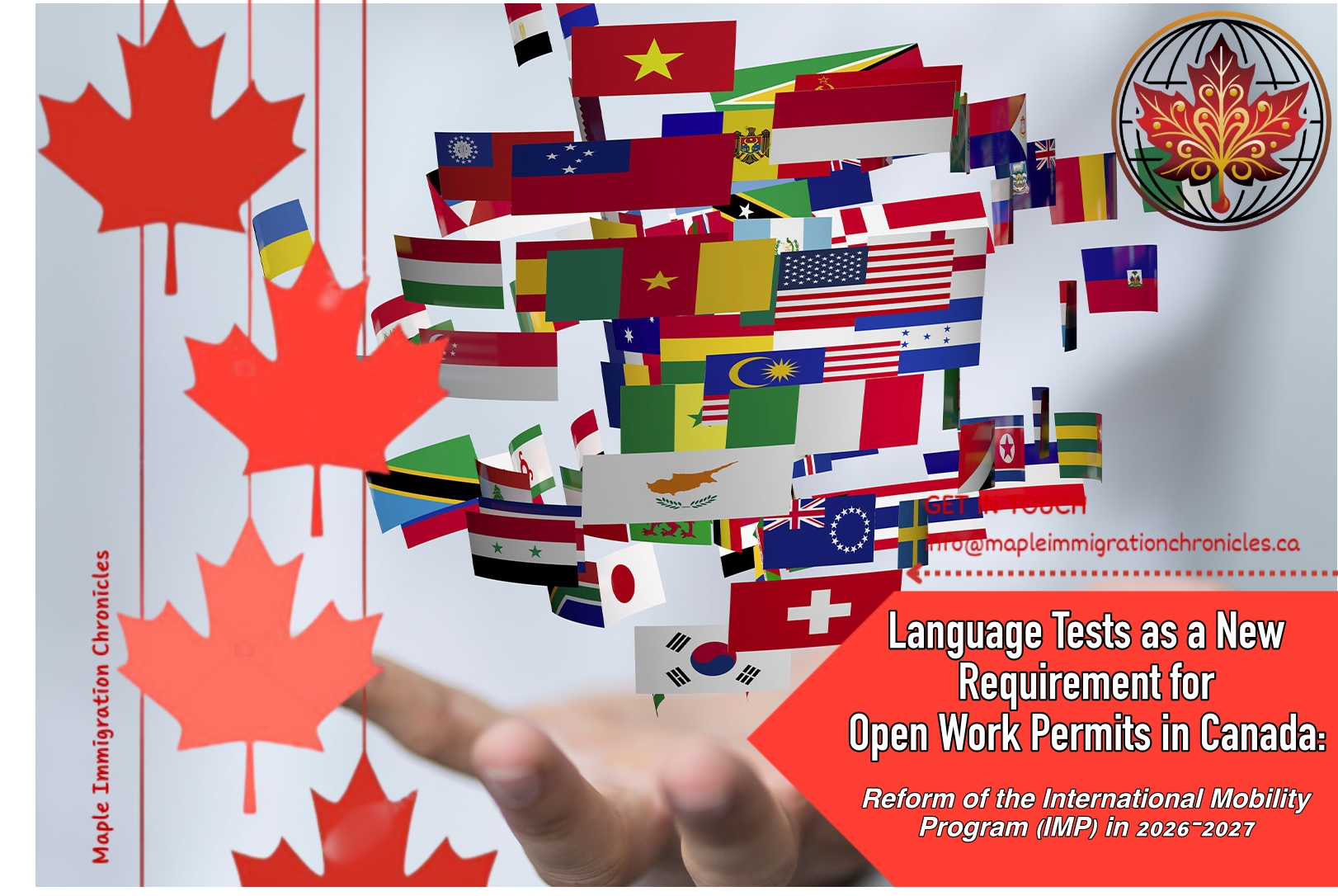
Canada is preparing for major changes in the field of temporary labor immigration. One of the most significant elements of this transformation will be the introduction of mandatory language testing for certain applicants for open work permits (OWP) issued under the International Mobility Program (IMP). For the first time in the history of the program, direct language requirements are expected to be applied to applicants, which will substantially alter access to some of the most widely used streams, particularly the Spousal Open Work Permit (SOWP).
Essence of the Reform and Its Background
Immigration, Refugees and Citizenship Canada (IRCC) has officially announced its intention to modernize the regulatory framework of the IMP. The reform aims to make proficiency in English or French a mandatory criterion for obtaining certain types of open work permits. Currently, for example, the SOWP is issued to the spouses of international students, foreign workers, or permanent residence applicants without any language requirement. The proposed change is designed to eliminate the gap between the legal right to work and the applicant’s actual ability to integrate successfully into Canadian society and the labor market.
According to the announced timeline, the first stage of implementation will involve the publication of draft amendments in the Canada Gazette, Part I in spring–summer 2025, followed by a standard 30-day consultation period. The final regulations are expected in 2026–2027, with their publication in the Canada Gazette, Part II and their subsequent entry into force.
Who Will Be Affected
The main focus of these changes is the SOWP category. This type of permit, which allows spouses of principal applicants to work in Canada, will in future require language testing. Applicants will likely be required to complete one of the recognized language tests — IELTS General, CELPIP General, TEF Canada, or TCF Canada — and submit a valid certificate with their application.
It is important to emphasize that the planned changes will not apply to holders of permits issued under humanitarian programs, such as the Canada-Ukraine Authorization for Emergency Travel (CUAET). CUAET permits have a separate legal status and are not part of the traditional IMP framework. However, if after the expiry of a humanitarian permit a holder applies for a standard SOWP, they will fall under the new regulations and be required to take a language test. This means that for many beneficiaries of CUAET and similar programs, a transition to regular work permits will involve additional obligations.
Anticipated Impact on Applicants
Currently, the SOWP is one of the most popular instruments for accompanying spouses, whether of students, temporary workers, or PR candidates. Its appeal lies in its relative simplicity and the absence of language barriers. The introduction of mandatory testing will change this dynamic. Spouses will be obliged to demonstrate language proficiency, which will entail additional financial and time commitments. Costs will include exam fees, preparation, and in some cases retesting. For many families, this could become a significant obstacle.
Furthermore, the reform creates risks for those who planned to delay their SOWP application. Whereas today proof of marital status and the main applicant’s status is sufficient, after 2026 the success of an application will also depend on achieving a minimum level of language proficiency. This threshold has not yet been published, but it is expected to range between CLB 4 and CLB 7, depending on the stream.
Objectives and Strategic Significance of the Reform
The Canadian government has outlined several key objectives for this policy change. First, it seeks to improve the integration of foreign nationals into Canadian society and the labor market, with language considered a fundamental prerequisite for employment, adaptation, and the exercise of labor rights. Second, the reform is intended to combat misuse of the system, particularly fraudulent marriages used to obtain open work permits. Third, it is designed to protect vulnerable workers who, without sufficient language skills, are at risk of exploitation. Finally, the reform has an economic dimension: it will align the qualifications and skills of incoming workers with the current needs of the Canadian labor market.
Conclusion
The planned changes to the International Mobility Program (IMP) for 2026–2027 will have far-reaching consequences for applicants who have traditionally viewed open work permits as a straightforward path to labor market access. The Spousal Open Work Permit in particular will no longer be automatically available; it will require proof of language skills.
Practical steps for candidates include monitoring publications in the Canada Gazette, taking practice language tests, and, where possible, applying for a SOWP before the new requirements come into force. Early preparation will help avoid delays, reduce the risk of refusals, and ensure readiness for the new regulatory environment governing temporary labor immigration to Canada.