In 2025, Canada’s immigration system underwent substantial and complex reforms that significantly impacted both federal and regional programs. These changes affected all major groups of migrants: prospective permanent residents, temporary foreign workers, international students, refugees, and those already residing in Canada. The key drivers behind these policy shifts included the need to curb excessive population growth driven by temporary migration, a severe housing shortage, political pressure in the pre-election period, and the government’s intent to better align immigration mechanisms with labour market realities.
Government Strategy and Immigration Targets for 2025–2027
In October 2024, the Canadian government presented its new three-year Immigration Levels Plan. This document formalized a significant reduction in the number of new permanent residents, particularly within humanitarian categories. For the first time in Canadian history, official targets were introduced for temporary residents, alongside specific quotas for French-speaking immigrants outside the province of Quebec. More than 40% of new permanent residents in 2025 will be selected from individuals already in Canada with work or study status. At the same time, the intake of refugees and protected persons has been scaled back, with priority given to candidates with proven Canadian work or study experience.
Provincial Programs: New Rules and Restrictions
The federal government reduced Provincial Nominee Program (PNP) allocations by 50%. Despite this, provinces such as Newfoundland and New Brunswick successfully negotiated partial quota increases. At the same time, selection requirements became stricter, with preference given to candidates in construction, healthcare, and French-speaking professionals.
New electronic Expression of Interest (EOI) systems, introduced in Yukon and Newfoundland and Labrador, made application procedures more competitive and complex for candidates.
New Immigration Pilot Programs
On January 30, 2025, two key pilot programs were launched:
- Rural Community Immigration Pilot (RCIP) — aimed at attracting skilled workers to rural regions facing acute labour shortages.
- Francophone Community Immigration Pilot (FCIP) — designed to increase the share of French-speaking immigrants outside Quebec.
In March, caregiver pilot programs were introduced and quickly reached their application caps. The Agri-Food Pilot closed in February after exhausting its available quota.
Express Entry: Structural Changes
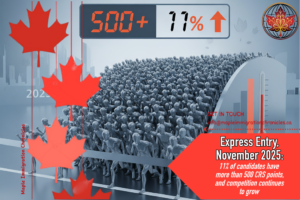
On March 25, 2025, additional points for arranged employment offers were eliminated, significantly altering the competitive balance within the Express Entry system.
On February 27, category-based selection was updated: the “Transportation” category was removed, “Education” was added with five eligible occupations, and lists within other categories were revised.
Priority now goes to candidates who:
- Possess French language proficiency;
- Work in healthcare occupations;
- Hold qualifications in skilled trades.
Political Landscape and New Leadership
On March 14, 2025, Mark Carney became Canada’s Prime Minister. His government announced plans to reduce overall migration to pre-pandemic levels, prioritize temporary residents already living and working in Canada, and lower the number of temporary foreign workers.
In the immigration sector, leadership changes included Rachel Bendayan briefly serving as Minister of Immigration, followed by Lina Diab’s appointment in May 2025.
Temporary Policies and Special Measures
- Open work permits for PNP candidates have been extended through the end of 2025.
- Special measures for Ukrainian nationals under CUAET remain in effect until March 2026.
- Iranian nationals continue to benefit from streamlined permit processes until February 2026.
As of May 2025, closed work permit holders can change employers without leaving Canada. From May 6, participants in the International Experience Canada (IEC) program can obtain work permits without exiting the country.
Systemic Regulatory Changes
Key updates include:
- An extended 75-day deadline for judicial review of immigration decisions;
- Caps on new study permit applications (550,000 applications, 437,000 permits);
- A revised Post-Graduation Work Permit (PGWP) occupation list, with 119 occupations added and 178 removed;
- Restricted open work permits for spouses of international students and foreign workers;
- Mandatory new study permits for school transfers;
- Relaxed health insurance requirements for Super Visa applicants;
- A notable decline in temporary resident population growth, with the federal government targeting a reduction to 5% of the national population by 2026.
Legislative Initiatives and Quebec’s Position
Bill C-3 proposes restoring citizenship by descent for children of Canadian citizens born abroad. Bill C-2 significantly limits access to asylum claims for individuals violating immigration procedures.
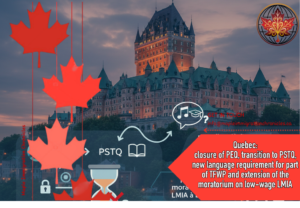
Quebec has announced reductions in migration quotas, suspended several programs, and is demanding that the federal government reduce the number of International Mobility Program (IMP) permit holders in the province.
Conclusion
In 2025, Canada’s immigration system has become more selective, restrictive, and focused on domestic priorities. The government’s overarching strategy includes reducing total migration flows, tightening controls on temporary residents, and encouraging the integration of those already residing in the country. Prospective applicants must carefully monitor ongoing policy updates, as even minor changes can significantly affect their prospects for successful immigration.