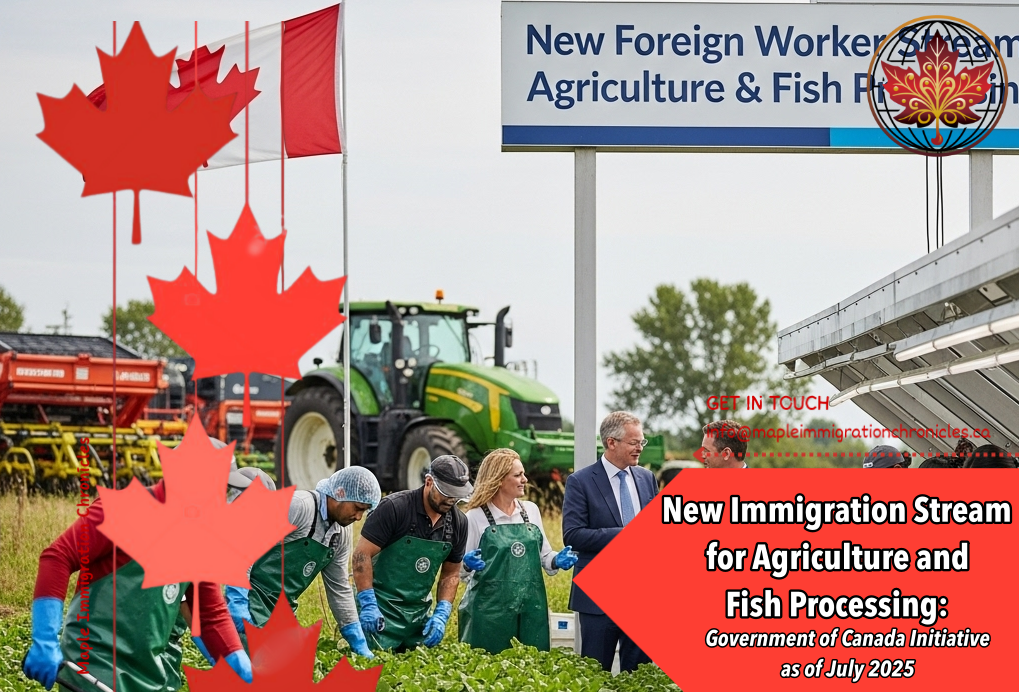
In July 2025, Immigration, Refugees and Citizenship Canada (IRCC) officially confirmed the development of a new targeted immigration stream designed to attract foreign workers to Canada’s agriculture and fish processing sectors. This initiative directly responds to the chronic labour shortages in these vital industries and is expected to serve as a partial replacement for the Agri-Food Pilot, which was closed in May 2025.
Below is a comprehensive overview of the confirmed components of the initiative and the anticipated next steps leading up to its launch.
1. Core Elements of the New Stream
The program is being developed in collaboration with Employment and Social Development Canada (ESDC) and will include:
- Specialized work permits tied specifically to one of two sectors: agriculture or fish processing;
- Eligibility criteria that reflect labour market needs and the particular characteristics of each industry;
- Expansion of bilateral agreements with selected countries to facilitate the recruitment and mobility of foreign workers in the relevant sectors.
2. Public Consultations and Interdepartmental Coordination
To ensure broad stakeholder engagement and policy coherence, the following measures are being undertaken:
- Extensive public consultations will take place during 2025–2026 to include input from industry associations, employers, unions, and the general public;
- Final program parameters will be determined based on the outcomes of these consultations;
- Close interdepartmental coordination with ESDC will guide the program’s development to align immigration measures with labour market realities.
3. Rationale Behind the New Stream
This initiative arises from a combination of urgent structural needs and recent policy transitions:
- Persistent workforce shortages have severely affected the agriculture and fish processing sectors, particularly among semi-skilled and skilled labour;
- Closure of the Agri-Food Pilot, which since 2020 allowed workers in meat processing, greenhouse production, and livestock operations to apply for permanent residency. The program officially ended on May 14, 2025, after reaching its intake cap;
- Policy necessity to recalibrate Canada’s immigration tools in response to domestic labour market deficiencies and international economic shifts.
4. Key Features of the Proposed Program
- Work permits will be sector-specific, limiting eligibility to either agriculture or fish processing roles;
- Priority may be given to candidates from countries with which Canada has established bilateral recruitment agreements;
- The stream is expected to become part of a broader national immigration strategy, aiming to balance temporary labour supply with long-term settlement options;
- Although permanent residency (PR) eligibility is not yet confirmed, the structure of previous programs suggests that a PR pathway could be introduced in the future.
5. Anticipated Timeline
- 2025–2026: Policy development and public consultations;
- Second half of 2026 (tentative): Potential program launch, subject to completion of regulatory approvals and interdepartmental review;
- Details regarding eligibility, quotas, and application procedures will be announced closer to the official launch, likely in Q2 or Q3 of 2026.
Conclusion
This planned immigration stream reflects Canada’s strategic response to ongoing labour shortages in critical economic sectors. It has the potential to:
- Provide a legal and controlled pathway for temporary foreign workers to enter and contribute to Canada’s agri-food and fisheries industries;
- Replace or supplement the functions of the Agri-Food Pilot, offering regulated access to employment and possibly future PR pathways;
- Reinforce Canada’s international cooperation efforts in the area of labour mobility and fair recruitment practices.
For foreign nationals with relevant work experience and an interest in legally working in Canada’s primary industries, this stream presents a promising future opportunity.
We strongly recommend monitoring IRCC announcements over the course of 2025–2026 to stay informed about the official terms and application procedures.
Stay connected for updates — we will share all new information as soon as it becomes available.