Levels of approval IRCC by programs (January–April 2025): what this means and how to act applicants
On the basis of summarized statistics for January–April 2025 we see essential difference between programs
Family reunification remains a priority, with 94,500 spots allocated under the Family Class in 2025.
Processing times for inland spousal sponsorships outside Quebec have increased sharply—up to 29 months in some cases.
Outland applications remain more stable, averaging 10–14 months.
Quebec applicants face longer delays, with timelines reaching 34–36 months due to additional provincial processing.
The Parents and Grandparents Program (PGP) reopened in July 2025, with 10,000 invitations issued to those who submitted interest forms in previous years.
Between January and June 2025, Canada welcomed 207,600 new permanent residents. As the Family Class accounts for roughly 22% of admissions, an estimated 63,000 individuals received PRs through sponsorship streams in the first half of the year.
Canada’s Family Sponsorship Program enables Canadian citizens and permanent residents to sponsor close family members for permanent residence, helping keep families together. As part of Canada’s broader family reunification policy, this program recognizes the importance of maintaining strong family ties as a foundation for successful settlement and integration.

Through the sponsorship process, eligible Canadians may sponsor their spouse, common-law or conjugal partner, dependent children, parents, or grandparents to immigrate to Canada. In some cases, they may also sponsor orphaned relatives or other family members under specific conditions. The sponsor must meet age, residency, and financial requirements, and commit to providing financial support for the sponsored person during their initial years in Canada.
There are two main types of spousal sponsorship: the Inland Class, for spouses or partners living in Canada, and the Outland Family Class, for those residing abroad. While both streams follow a similar process, they differ in eligibility criteria, work permit options, and appeal rights.
In most cases, applicants must submit their sponsorship and permanent residence application together through the online IRCC portal. The process begins with a review of the sponsor’s eligibility, followed by an assessment of the applicant’s admissibility. IRCC also carefully examines the genuineness of the relationship in cases of spousal or partner sponsorship. Processing times for most family sponsorship applications average around 12 months, though complex cases may take longer.
The Sponsorship Program remains a vital component of Canada’s immigration system, balancing legal responsibility with humanitarian values and enabling thousands of families to reunite and build their futures in Canada.
Who can be sponsored (spousal) for PR in Canada?
Spouse
A spouse is an individual, of any gender, who is legally married to their partner. The marriage must be legally valid both in the country where it occurred and under Canadian law. Religious ceremonies alone do not meet the requirement unless they result in a legally recognized marriage.
Common-Law Partner
A common-law partner refers to someone—of the same or opposite sex—who has been living in a marriage-like relationship with another person for a continuous period of at least one year. This includes sharing a home and presenting themselves as a couple in a committed, long-term relationship.
Conjugal Partner
A conjugal partner is someone residing outside Canada who has been in a committed, marriage-like relationship with the sponsor for at least one year but is unable to live with them due to circumstances beyond their control (such as legal, cultural, or immigration barriers).
A conjugal relationship is characterized by a high level of commitment, mutual support, and shared life similar to that of a married couple, including a physical and emotional bond.
Choosing the Right Sponsorship Stream Is Crucial
Selecting the appropriate sponsorship category—either the Spouse or Common-Law Partner in Canada Class (SCLP) or the Family Class (outland)—is a critical step. If you submit your application under the wrong category and do not meet its eligibility requirements, IRCC may take months to return it without processing. Importantly, once submitted, IRCC does not permit switching between categories, meaning you would need to start the process over entirely with a new application. Making the right choice from the outset helps avoid unnecessary delays and complications.
Outland Sponsorship (Family Class Application)
Sponsor can live in Canada or abroad (if a Canadian citizen)
Can be used to sponsor a conjugal partner
Right to appeal a refusal (if the applicant opts in)
Principal Applicant cannot apply for an open work permit
Principal Applicant may apply for a visitor visa or study permit while the application is in process
Inland Sponsorship (Spouse or Common-Law Partner in Canada Class)
Sponsor must reside in Canada at the time of application
Cannot be used to sponsor a conjugal partner
No right of appeal if the application is refused
Principal Applicant may apply for a Spousal Open Work Permit
Application may be jeopardized if the Principal Applicant leaves Canada during processing
A spouse or common-law partner of a Canadian citizen or permanent resident may qualify for immigration to Canada through spousal sponsorship. This pathway is open to both opposite-sex and same-sex couples, as Canada legally recognizes same-sex marriages and partnerships. To apply, both the sponsor and the sponsored partner must provide all required documentation to Immigration, Refugees and Citizenship Canada (IRCC) as part of the family reunification process.
A Canadian citizen or Canadian permanent resident is eligible to act as a sponsor if he/she:
The application for spousal sponsorship must include marriage certificates, standard birth certificates or child adoption records, joint photos, receipts, and other documents that demonstrate a genuine relationship of the couple.
Not all Canadian citizens or permanent residents aged 18 or older are eligible to sponsor a spouse or common-law partner. You may be ineligible for spousal sponsorship if:
You are receiving social assistance, unless it is for a disability;
You were yourself sponsored as a spouse or partner and became a permanent resident less than five years ago;
You are still within the three-year period of having previously sponsored a spouse or partner;
You have failed to comply with a court order for spousal or child support payments;
You are legally married to someone else while submitting a sponsorship application;
You have a criminal history involving violent or sexual offences;
You are subject to an exclusion order or removal order from Canada;
You are currently undischarged from bankruptcy.
Each of these factors may prevent IRCC from approving a spousal sponsorship application.
It depends on the nature of the relationship. Couples who are neither legally married nor meet the definition of a common-law partnership under Canadian immigration law are not eligible for spousal sponsorship. However, if a couple has lived together in a marriage-like relationship for at least 12 consecutive months and shares a household—such as joint finances, rent, or utility bills—they may qualify as common-law partners and be eligible for family reunification through sponsorship.
There is also a distinct category within the family class known as conjugal partners. These are individuals in a committed relationship who rely on each other for emotional, financial, and personal support but are unable to live together due to factors beyond their control—such as legal, cultural, or immigration barriers in their home countries. Although they do not meet the definition of common-law partners, conjugal partners are eligible for family sponsorship under Canadian immigration law.
Processing times for spousal sponsorship applications can vary depending on the complexity of the case. In most standard situations, IRCC aims to process applications within 12 months. However, if immigration officers require additional documentation or further verification of the relationship between the sponsor and the applicant, the process may take longer. Delays are more common in cases where the evidence of the relationship is limited or unclear.
Spouses or common-law partners being sponsored under the Spouse or Common-Law Partner in Canada Class may be eligible to apply for an open work permit (OWP). The key requirement is receiving the Acknowledgement of Receipt (AOR) from IRCC, confirming that the sponsorship and permanent residence application has been officially received.
Once issued, the open work permit is typically valid until a final decision is made on the PR application. It allows the sponsored spouse to work full-time for any employer in any occupation across Canada during the processing period.
The spousal sponsorship process is largely the same for both Outland (Family Class – FC1) and Inland (Spouse or Common-Law Partner in Canada – SCLP) applications. Regardless of the stream, each application involves two parties: the Canadian sponsor and the Principal Applicant, who is being sponsored for permanent residence. Immigration, Refugees and Citizenship Canada (IRCC) reviews and assesses both individuals separately before issuing a final decision.
Step 1: Gather Required Documents
Begin by reviewing the country-specific document checklist available on the official IRCC website. The Principal Applicant must also create a PR Portal account to manage and submit the application. It is important to use the correct checklist based on the applicant’s country of residence to ensure all required documents are collected.
Step 2: Complete Forms and Collect Supporting Evidence
Both applicants must fill out the relevant immigration forms and prepare supporting documentation. These typically include proof of the relationship (marriage certificates, photos, communication records), identity documents (passports, birth certificates), financial information (employment letters, income proof), and any additional documents listed in the checklist. All forms must be completed accurately and signed.
Step 3: Submit the Application
Once the application is complete, it must be submitted online through the PR Portal, as electronic submission is now mandatory. Ensure that all forms are correctly filled and all required documents are included to prevent processing delays.
Step 4: Screening and Eligibility Review by IRCC
IRCC will first check the application for completeness and then assess the sponsor’s eligibility. If the sponsor is found eligible, IRCC will issue an Acknowledgment of Receipt (AOR) and begin evaluating the Principal Applicant’s admissibility, including background and medical checks.
Step 5: Relationship Assessment and Final Decision
IRCC reviews the relationship to determine whether it is genuine and meets the requirements. Officers may approve the application, request further documentation, or invite the applicants to an interview. A positive determination leads to permanent residence approval; otherwise, the application may be refused based on insufficient evidence.
Spousal sponsorship applications may be refused if a visa officer has concerns about the genuineness or legal validity of the relationship. It is essential to submit thorough and convincing documentation that demonstrates a real, committed partnership, regardless of whether the couple follows a traditional format or not.
Working with qualified immigration consultants can significantly improve your chances of success.
Canada offers a family reunification pathway that allows Canadian citizens and permanent residents to sponsor their children for immigration. While this program facilitates family unity, the process can be complex and must be approached with care, as sponsorship carries a legal obligation of financial and emotional support. A child may be granted immigration status under this stream if they meet specific eligibility criteria set by the federal government.
Sponsorship can apply to a range of relationships, including biological children, adopted children, foster grandchildren, or the children of a sponsored spouse or partner, provided all legal and immigration requirements are met.
To qualify for sponsorship, a child must meet the definition of a dependent child under Canadian immigration law. This applies whether the child is biological or adopted by a Canadian citizen or permanent resident. A child is considered dependent if they are under 22 years of age and not married or in a common-law relationship. Children aged 22 or older may still be considered dependents if they have a physical or mental condition that prevents them from supporting themselves financially.
As with all family sponsorship programs, both the sponsor and the sponsored child must meet specific eligibility requirements for the child to obtain permanent residence. To sponsor a child, the parent must:
Be a Canadian citizen or permanent resident living in Canada;
Be at least 18 years old;
Not be incarcerated, facing serious criminal charges, or declared bankrupt.
The parent must also provide proof of the parent–child relationship, such as a birth certificate or adoption documents. If an adoption process is nearing completion, it is possible to begin the sponsorship before it is finalized. In addition to meeting the definition of a dependent child, the sponsored person must be either the biological child of the sponsor or the sponsor’s spouse, or the adopted child of the sponsor or the sponsor’s spouse.
If the Canadian sponsor resides in Quebec, they must agree to a financial undertaking to support the sponsored family member. The length of this commitment depends on the child’s age at the time of sponsorship. For a dependent child under 16 years old, the sponsor must provide financial support for 10 years or until the child turns 18, whichever period is longer. For a dependent child aged 16 or older, the obligation lasts for three years or until the child reaches 25 years of age, whichever is longer.
Canadian citizens and permanent residents sponsoring dependent children are generally not required to meet the Minimum Necessary Income (MNI), as long as the child being sponsored does not have dependent children of their own. However, if the sponsored dependent child has children of their own, the sponsor must meet the applicable MNI threshold based on the total size of their family unit.
The Parents and Grandparents Program (PGP) is a key component of Canada’s family reunification strategy, designed to help bring families back together. Through this program, eligible sponsors may submit an Interest to Sponsor form during designated intake periods. From these submissions, IRCC conducts a randomized selection process, inviting chosen sponsors to file a full sponsorship application. Sponsors must meet specific eligibility requirements, including income thresholds, and commit to providing financial support to their parents or grandparents for a set period after they obtain permanent resident status.
Sponsored parents or grandparents must also satisfy certain admissibility criteria, which include medical examinations and security clearances. Once the application is approved, they are granted permanent residence in Canada, giving them the opportunity to live, work, and study in the country, and later, if eligible, apply for Canadian citizenship.
An eligible sponsor for the Parents and Grandparents Program (PGP) is a Canadian citizen or permanent resident who meets specific requirements set by the Canadian government.
Age and Residency
The sponsor must be at least 18 years old. If the sponsor is a permanent resident, they must be physically residing in Canada at the time of application.
Financial Eligibility
Sponsors must meet the Minimum Necessary Income (MNI) requirement to prove they can financially support their parents or grandparents. These income thresholds are established by the Canadian government and are updated annually.
Agreement to Support
Sponsors are required to sign a sponsorship agreement with the Government of Canada, committing to provide financial support for their parents or grandparents for a set undertaking period. This agreement also includes the obligation to repay any social assistance benefits the sponsored family members may receive during that time.
Those applying to sponsor their parents or grandparents under the Parents and Grandparents Program (PGP) must sign an undertaking with Immigration, Refugees and Citizenship Canada (IRCC). For sponsors living outside Quebec, this undertaking requires providing financial support to the sponsored family members for 20 years from the date they become permanent residents of Canada, as well as repaying any provincial social assistance they may receive during that period.
The undertaking also obligates the sponsor to cover the basic needs of the sponsored relatives, such as food, clothing, utilities, and other essential living expenses.
For sponsors residing in Quebec, the undertaking period is 10 years from the date the sponsored parents or grandparents obtain permanent resident status.
The Parents and Grandparents Program (PGP) application process in Canada involves several key stages:
Expressing Interest
The process begins by submitting an Interest to Sponsor form online during a period announced by IRCC. This form allows you to indicate your intention to sponsor your parents or grandparents.
Random Selection
Once the submission period closes, IRCC conducts a random draw to select potential sponsors from the pool of entries. Only those chosen will move forward to the next stage.
Invitation to Apply
Selected sponsors receive an invitation to apply, which includes detailed instructions for submitting a complete sponsorship application.
Submitting the Application
The sponsor must complete the necessary forms, provide all required supporting documents—such as proof of income and proof of relationship—and pay the applicable fees.
Approval Process
IRCC reviews the application to ensure that both the sponsor and the applicants meet all eligibility requirements. If approved, the parents or grandparents are granted permanent resident status.
Medical Examinations and Security Checks
The sponsored family members must undergo medical exams and security clearances before approval is finalized.
Arrival in Canada
Once the process is complete, the sponsored parents or grandparents can travel to Canada and enter as permanent residents.
Sponsors residing anywhere in Canada except Quebec must meet or exceed the Minimum Necessary Income (MNI) based on the total size of their family unit. The MNI is updated annually and applies to all applicable sponsorship programs for those living outside Quebec.
In a sponsorship application, both the sponsor and any co-signer (if applicable) must demonstrate sufficient financial capacity to support all individuals for whom they will be responsible, including themselves. This requires proof of meeting the MNI for each of the three tax years preceding the date of the Invitation to Apply (ITA)—not the date of the Interest to Sponsor submission.
For the 2024 PGP intake (for sponsors who submitted their Interest to Sponsor form in 2020), applicants must meet the income requirements for 2023, 2022, and 2021, as outlined below:
| Size of Family Unit | Minimum Income 2023 | Minimum Income 2022 | Minimum Income 2021 |
|---|---|---|---|
| 2 persons | $44,530 | $43,082 | $32,898 |
| 3 persons | $54,743 | $52,965 | $40,444 |
| 4 persons | $66,466 | $64,306 | $49,106 |
| 5 persons | $75,384 | $72,935 | $55,694 |
| 6 persons | $85,020 | $82,259 | $62,814 |
| 7 persons | $94,658 | $91,582 | $69,934 |
| Each additional person | +$9,636 | +$9,324 | +$7,120 |
.
In Quebec, the minimum income requirement for family sponsorship differs from the federal standard. Sponsors must calculate the basic income needed to support their own family, plus the needs of the sponsored person(s) and their family members—even if those family members are not accompanying them to Canada.
Part 1 – Basic Annual Income for the Sponsor’s Own Family Unit
| Total Family Members | Basic Annual Income Required |
|---|---|
| 1 | $28,242 |
| 2 | $38,124 |
| 3 | $47,068 |
| 4 | $54,135 |
| 5 | $60,250 |
| Each additional person | +$6,115 |
Part 2 – Additional Income Required for Sponsored Persons Under 18 Years of Age
| Adults in Sponsored Family | Children Under 18 | Additional Income Required |
|---|---|---|
| 0 | 1 | $9,776 |
| 0 | 2 | $15,493 |
| Each additional child | — | +$5,166 |
Part 3 – Additional Income Required for Sponsored Persons 18 Years or Older
| Adults in Sponsored Family | Children Under 18 | Additional Income Required |
|---|---|---|
| 1 | 0 | $20,657 |
| 1 | 1 | $27,755 |
| 1 | 2 | $31,341 |
| Each additional child | — | +$3,582 |
Part 4 – Additional Income for Two or More Adults in Sponsored Family
| Adults in Sponsored Family | Children Under 18 | Additional Income Required |
|---|---|---|
| 2 | 0 | $30,294 |
| 2 | 1 | $33,935 |
| 2 | 2 | $36,634 |
| Each additional adult | — | +$9,630 |
| Each additional child | — | +$2,689 |
Navigating the Parents and Grandparents Program (PGP) application process in Canada involves multiple steps and requires careful attention to detail. Since immigration rules and requirements can change, it is essential to stay informed by regularly checking the official Immigration, Refugees and Citizenship Canada (IRCC) website or consulting a qualified immigration professional.
While the general process follows the standard steps outlined earlier, each applicant’s situation can differ, which may affect how the application is handled. To ensure a smoother experience and avoid common mistakes, many applicants choose to seek guidance from an immigration lawyer or regulated consultant with expertise in the PGP process.
A Super Visa is a special type of multiple-entry visitor visa designed exclusively for the parents and grandparents of Canadian citizens and permanent residents. It allows the holder to remain in Canada for up to five years at a time without the need to renew or extend their status during that period.
The primary difference between a Super Visa and a regular visitor visa is the length of the authorized stay. While a standard visitor visa generally permits a stay of up to six months (with the option to apply for an extension), a Super Visa grants much longer stays, enabling parents and grandparents to spend extended periods with their family in Canada without frequent renewal applications.
You can apply for a Super Visa either online or through a paper-based application. In both cases, you must prove that you are the parent or grandparent of a Canadian citizen or permanent resident. Your application must include a letter of invitation from your child or grandchild in Canada, outlining plans for your care and providing details about the number of people living in their household.
You will also need to show proof of private medical insurance from a Canadian insurance provider, valid for at least one year. In addition, your child or grandchild must demonstrate that they have sufficient financial resources to support you during your stay by meeting or exceeding the Low Income Cut-Off (LICO) for their family size.
To qualify for a Super Visa in Canada, applicants must meet specific eligibility criteria. This visa is intended exclusively for parents and grandparents of Canadian citizens or permanent residents, allowing visits of up to five years per entry.
Relationship Proof – Applicants must provide documentation proving their relationship to the Canadian citizen or permanent resident, such as a birth certificate or baptismal record.
Medical Admissibility – A valid medical examination must be completed, and the applicant must be admissible to Canada on health grounds.
Health Insurance – Applicants must hold private medical insurance from a Canadian insurance provider that covers healthcare, hospitalization, and repatriation, with a minimum coverage of $100,000, valid for at least one year from the date of entry.
Letter of Invitation – A letter from the host child or grandchild in Canada is required, promising financial support for the duration of the stay and listing all household members.
Financial Support Proof – The host must show that their household meets the Low Income Cut-Off (LICO), providing documents such as recent tax assessments, pay stubs, or Employment Insurance benefit statements.
The application must be submitted from outside Canada, include the $100 processing fee per person, and meet all general temporary resident requirements for visitors.
Depending on their country of citizenship, some foreign nationals are visa-exempt and do not require a visitor visa to enter Canada. These visa-exempt visitors can generally stay in Canada for up to six months without extending their status. However, parents and grandparents of Canadian citizens or permanent residents who are visa-exempt may still choose to apply for a Super Visa, which allows them to remain in Canada for up to five years per visit, enabling longer stays with family.
Visa-exempt parents and grandparents follow the same Super Visa application process as other applicants. If approved, they receive a letter of authorization to present to the border services officer upon entry, instead of a visa. In addition, visa-exempt travelers arriving in Canada by air must obtain an electronic travel authorization (eTA), even if they hold an approved Super Visa.
A Super Visa allows the holder to stay in Canada for up to five years per entry. If you wish to remain in Canada beyond this period, you must apply for an extension of your stay. The extension application should be submitted at least 30 days before your current status expires. If your visa expires while your extension request is still under review, you may legally remain in Canada until a decision is made. This temporary right to stay is known as implied status.
To act as a sponsor under Canada’s family reunification program, you must be a Canadian citizen, a permanent resident living in Canada, or a person registered as an Indian under the Canadian Indian Act.
In addition, you must meet the following eligibility criteria:
Be at least 18 years of age;
Not be receiving social assistance, unless it is due to a disability;
Be financially capable of meeting the basic needs of the person(s) you intend to sponsor;
Have the legal capacity to marry, and if previously married, the divorce must be legally finalized;
If you are a Canadian citizen living abroad, you must demonstrate your intention to reside in Canada once your sponsored family members become permanent residents (IRPR, s. 130(2));
If you are a permanent resident, you must be physically present in Canada at the time of application;
If you reside outside Quebec, you must agree to financially support the sponsored persons for the required undertaking period;
If you live in Quebec, you must meet that province’s specific sponsorship requirements and sign a formal undertaking agreement with the provincial authorities following federal approval.
You will be required to submit a range of supporting documents to demonstrate your eligibility and the genuineness of your relationship. These include proof of relationship (such as a marriage certificate, photographs, and records of communication), identification documents (like passports and birth certificates), and financial information (such as proof of income). Additional documentation may also be requested by IRCC to further establish the authenticity of your relationship or meet specific program requirements.
Yes, spouses or partners being sponsored under the Inland sponsorship stream (Spouse or Common-Law Partner in Canada Class) are eligible to apply for a Spousal Open Work Permit, which allows them to work in Canada while their permanent residence application is being processed. This option is generally not available for Outland sponsorship applications submitted under the Family Class.
Yes, you may sponsor your spouse if they are currently in Canada on a temporary status—such as a visitor, student, or worker. In this case, the application would be submitted under the Inland sponsorship stream, and your spouse may also be eligible to apply for an Open Work Permit while the sponsorship is being processed.
To demonstrate that your relationship is genuine, you should submit evidence such as your marriage certificate, photos of time spent together, records of communication (including emails or messages), joint financial documents (like shared bank accounts or leases), and written declarations from friends or family who can attest to your relationship. Since IRCC closely examines whether the relationship is authentic and not entered into for immigration purposes, it is strongly recommended that you seek legal guidance to help ensure your application meets the necessary evidentiary standards and minimizes the risk of refusal.
Spousal sponsorship applications are commonly refused due to insufficient evidence of a genuine relationship, errors or omissions in the application forms—such as missing signatures or incorrect details—and failure to meet financial eligibility requirements. Even minor mistakes can lead to delays or refusal, so it is crucial to submit complete, accurate, and well-documented applications to reduce the risk of rejection.
Yes, Canada fully recognizes same-sex marriages and common-law partnerships for the purposes of spousal sponsorship, and applicants are assessed under the same criteria as opposite-sex couples.
Yes, Canadian citizens living outside Canada may sponsor their spouse, provided they can demonstrate a clear intention to return and reside in Canada once the application is approved. However, permanent residents are only eligible to sponsor a spouse if they are physically residing in Canada at the time of application.
Inland sponsorship applies when the sponsored spouse or partner is already living in Canada, typically on a temporary status. It allows the applicant to apply for a Spousal Open Work Permit. Outland sponsorship is used when the spouse or partner lives outside Canada or prefers their application to be processed through a visa office abroad. Only Outland applicants have the right to appeal a refusal.
Yes. If your spouse is currently in Canada on a valid temporary visa (such as a visitor, student, or worker), you can sponsor them under the Inland stream. They may also be eligible for an open work permit while their application is being processed.
No. Once your application is submitted, IRCC does not allow switching between Inland and Outland streams. If you apply under the wrong category, your application may be returned or refused, and you would need to start over with a new application under the correct stream. Choosing the right category from the outset is essential.
On the basis of summarized statistics for January–April 2025 we see essential difference between programs
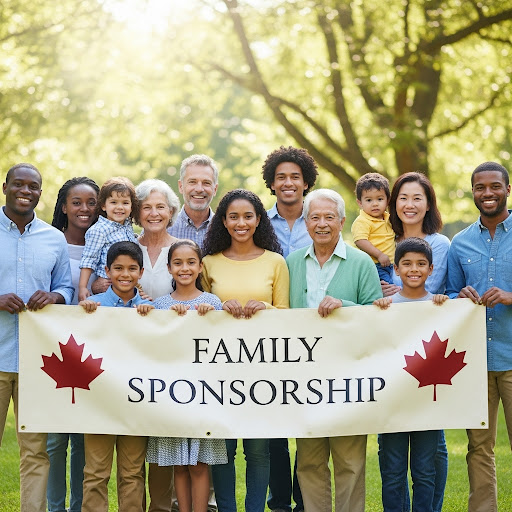
Canada in 2025 year set ambitious goal: to grant 395,000 permits for permanent residence (PR).This
The Express Entry system is one of the main mechanisms for obtaining permanent resident status
Canada, as one of the most developed immigration jurisdictions in the world, traditionally recognizes family
..as of August 2025 Canada traditionally positions itself as a country that values family
As of July 29, 2025 On July 29, 2025, Immigration, Refugees and Citizenship Canada (IRCC)
Recent trends in the processing of permanent residence applications through the Express Entry system raise
The Government of Canada has announced the launch of a new stage in the Parents
One of the key conditions for participating in the Family Reunification Program for Ukrainian
Complete Guide: Eligibility, Requirements, Documents, Timelines, and Step-by-Step Application Instructions General Information About the
For any inquiries or assistance, feel free to reach out to us via email at [email protected]. We aim to respond within 24 hours.
You can contact us directly at +1 (647) 464-4526. Our team is available to assist you from Monday to Friday, 9 AM to 6 PM EST.
We welcome you to visit our office located at 295-297 Cosburn Ave., Toronto, Canada, M4J 2M5. Please call ahead to schedule an appointment.
© 2023 – 2025 Maple Immigration Chronicles. All rights reserved.