
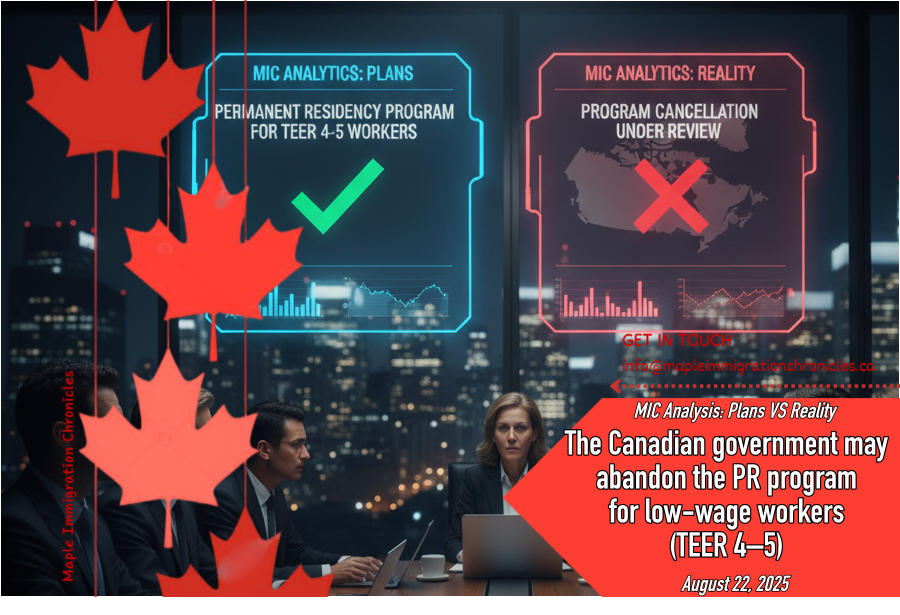
In 2024, the federal government of Canada publicly announced the creation of a new immigration stream aimed at providing permanent residence to workers in low-wage sectors of the economy (categories TEER 4 and TEER 5). It concerned representatives of key professions — from caregivers and retail workers to food production employees and delivery drivers. It was expected that the program would become a unified mechanism for those who had lived and worked in Canada for years but had no direct pathway to permanent status.
A year has passed, but the official launch has not taken place. Moreover, the strategic plans published by the government in July 2025 contain no mention of this stream, which indicates a high probability of abandoning its implementation.
What was planned
In April 2024, in the Canada Gazette, a notice appeared regarding the government’s intention to hold consultations on amendments to immigration legislation. The proposed changes aimed to create a new economic category for candidates with work experience in professions TEER 4 and TEER 5.
It was planned to include in this group:
- delivery drivers, who ensure logistics and product availability;
- caregivers, who support families by caring for children or elderly persons;
- food production workers, responsible for the country’s food security;
- retail workers, who interact daily with millions of consumers.
A characteristic feature of these professions is that higher education is not required, and sufficient condition is often only secondary school or confirmed work experience. That is why most current economic programs, oriented toward highly skilled specialists, leave this category outside their scope.
The double function of the new program
- Unification of existing pilot initiatives (for caregivers and seasonal agricultural workers).
- Creation of a predictable mechanism for obtaining permanent residence for tens of thousands of persons integrated into Canada’s labor market.
Current situation
In July 2025, IRCC published its three-year plan of regulatory changes, which did not include the launch of a program for TEER 4–5. Experts interpret this as a signal of the actual winding down of the initiative.
The department’s representative, Sofika Lukianenko, in comments for the media emphasized that the government “continues to study the role of immigration in filling labor market needs for TEER 4 and 5.” However, this statement was more general in nature and did not contain any concrete steps or deadlines for implementation.
In fact, low-wage workers remain outside the main economic streams. The Express Entry program is inaccessible due to high requirements for education, experience, and language competence. The only real options remain limited mechanisms:
Alternative option | Main characteristics |
Pilot programs for caregivers | 5,000 places annually; strict quotas and limited occupational requirements |
Agricultural pilots | Seasonal and restricted access, dependent on regional needs |
Provincial programs (OINP, SINP, AAIP, AIP, etc.) | In isolated cases allow TEER 4–5, but with numerous conditions and restrictions |
Arguments “for” and “against”
Position of supporters of the program:
- Granting stable legal status to persons already integrated into society and the economy.
- Recognition of the contribution of low-wage workers in ensuring basic needs of the population.
- Elimination of fragmentation caused by temporary pilots and creation of a permanent mechanism.
Position of critics:
- Risk of pressure on wage levels and encouragement of dependence on cheap labor (the position of Professor Mikal Skuterud).
- Potential decrease in public support for immigration against the backdrop of the housing affordability crisis.
- Political context: pre-election shift of the government towards limiting student and temporary flows to demonstrate “control” over the labor market.
Comparison: Government promises (2024) VS reality for TEER 4–5 (2025)
Aspect | What the government promised in April 2024 | Current options for TEER 4–5 | Consequences of absence of the program |
Type of program | New federal category for low-wage workers (TEER 4–5) | Temporary pilots (caregivers, agricultural workers), limited provincial streams (AIP, certain OINP, SINP, AAIP) | Absence of a single, transparent, and stable pathway to PR |
Coverage of professions | Delivery, caregiving, food production, retail trade (and other TEER 4–5) | Narrow groups of professions: caregivers (~5,000 places annually), seasonal agricultural workers, certain positions in provinces | Majority of those employed in retail and food industry remain without access |
Mechanism | Single stable mechanism instead of multiple pilots | Quota-based programs with strictly limited requirements | Constant uncertainty for workers already integrated into the economy |
Scale | Planned to cover tens of thousands of persons already working in Canada | In total several thousand places annually in different pilots | Tens of thousands of people remain in a “suspended” status |
Social effect | Legalization of a vulnerable category, recognition of their contribution | Localized effect only for a limited circle of participants | Growth of social inequality and dependence on temporary permits |
Conclusion
The federal program for TEER 4–5, announced in 2024, was supposed to become a stable and transparent pathway to permanent residence for tens of thousands of low-wage workers, but in 2025 it is effectively not realized. Instead, only narrow pilot and provincial mechanisms with strict quotas exist, covering only a small share of needs. This leaves most workers in caregiving, retail, and food industry in legal uncertainty, causing social inequality and strengthening dependence on temporary permits.
As of August 2025, there are no signs that the new program for TEER 4–5 will be launched. Its absence in IRCC’s strategic documents, vague official statements, and political risks confirm the high probability of abandonment of the initiative.
The consequences of this decision are already evident: thousands of workers engaged in caregiving, retail, food production, and delivery remain in an uncertain position. They are critically important for Canada’s economy but do not have stable legal guarantees regarding their future.
Thus, the question of creating a real and permanent pathway to PR for low-wage workers remains open. It will directly depend on the government’s ability to balance political interests with economic needs and obligations before society.