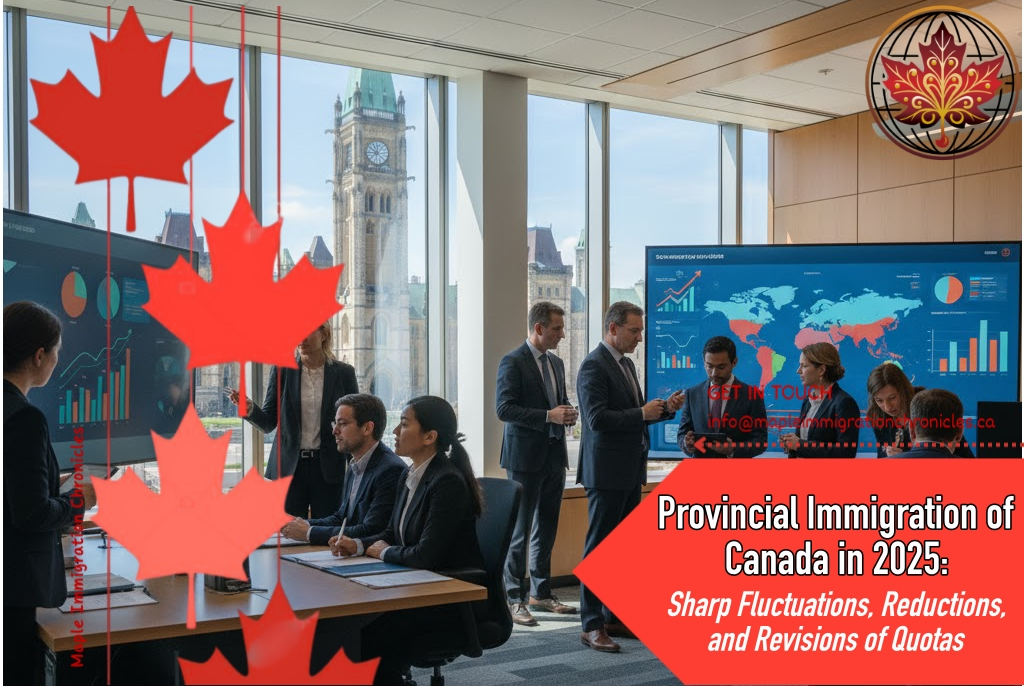
Throughout 2025, Canada’s provincial immigration experienced significant fluctuations. Most provinces and territories received an increase in their annual nomination limits for permanent residence under the Provincial Nominee Program (PNP). As of the time of writing, only Ontario and Prince Edward Island had not received additional spots.
The PNP allows provinces and territories to nominate foreign nationals for permanent residence; after receiving a nomination, the candidate becomes a permanent resident of Canada once approved by federal authorities. A “nomination allocation” is the annual number of nomination certificates that the federal government allows a specific province or territory to issue within a year.
Below is a detailed overview of the 2025 allocations before and after increases, key findings, reasons for changes, official immigration targets (“landings”), reactions of individual jurisdictions, and structural features of the PNP. Assess your eligibility for enhanced PNP streams if you are planning to immigrate through Express Entry.
(Source: Janice Rodrigues.)
1) PNP Allocations in 2025: Before and After Increases
The table shows: current (after increases) allocations for 2025; last year’s limits (2024); starting limits for the beginning of 2025 (before increases); number of additional spots granted during 2025; share of 2024 allocation actually received for 2025.
For the Atlantic Provinces (New Brunswick, Newfoundland and Labrador, Nova Scotia, Prince Edward Island), the allocation includes nominations under PNP plus endorsements under the Atlantic Immigration Program (AIP).
| Province/Territory | Current Allocation (after increases) | 2024 Allocation | Allocation at Start of 2025 (before increases) | Additional Spots in 2025 | Final Share of 2024 Allocation Received in 2025 (%) |
| Alberta | 6,403 | 9,750 | 4,875 | 1,528 | 65.67% |
| British Columbia | 5,254 | 8,000 | 4,000 | 1,254 | 65.68% |
| Manitoba | 6,239 | 9,500 | 4,750 | 1,489 | 65.67% |
| New Brunswick | 4,250 | 5,500 | 2,750 | 1,500 | 77.27% |
| Newfoundland and Labrador | 2,525 | 2,100 | 1,525 | 1,000 | 97.62% |
| Nova Scotia | 3,709 | 6,300 | 3,150 | 559 | 58% |
| Ontario | 10,750 | 21,500 | 10,750 | 0 | 50% |
| Prince Edward Island | 1,025 | 2,050 | 1,025 | 0 | 51% |
| Saskatchewan | 4,761 | 8,000 | 3,625 | 1,136 | 59.51% |
| Yukon | 282 | 300 | 215 | 67 | 94% |
| Northwest Territories | 300 | 300 | 150 | 150 | 100% |
| Total | 45,048 | 73,300 | 36,340 | 8,683 | — |
Key findings for 2025 allocations.
A significant portion of jurisdictions achieved full or near-full recovery of their 2024 levels: Northwest Territories – 100%, Yukon – 94%, Newfoundland and Labrador – 98%. The largest increase was received by Alberta: in September, the Alberta Advantage Immigration Program (AAIP) was granted an additional 1,528 spots; next came New Brunswick (+1,500) and Manitoba (+1,489). Meanwhile, Ontario and Prince Edward Island did not receive any additional quota.
2) How Allocations Are Calculated, Why They Changed, and What “Landings” Mean
The official PNP targets in the Immigration Levels Plan for 2025 were significantly reduced: in fall 2024, the government effectively halved the PNP “landing” targets compared to 2024. In January 2025, this translated into a proportional reduction of provincial allocations “across the board.” Some provinces also reported a new requirement: at least 75% of nominees must be in Canada at the time of nomination.
| Year | Immigration Levels Plan 2025–2027 | Immigration Levels Plan 2024–2026 |
| 2025 | 55,000 | 120,000 |
| 2026 | 55,000 | 120,000 |
| 2027 | 55,000 | — |
The annual Immigration Levels Plan sets goals for permanent residents (“landings”)—the moment when a successful applicant officially becomes a permanent resident of Canada. Because of processing timelines, the year of receiving a PNP nomination or AIP endorsement does not necessarily match the year of “landing.”
Typical processing times: about 6 months for enhanced PNP streams, over 1 year for base PNP streams, and up to 37 months for AIP. Accordingly, a large portion of 2025 nominations/endorsements will be counted toward the next year’s immigration targets, not the current one.
3) How Provinces and Territories Adjusted Their Selections in 2025
To align with reduced allocations and new selection parameters, jurisdictions adjusted the structure of their streams: suspending certain pathways, narrowing priorities, or prioritizing specific sectors and candidate categories.
- British Columbia suspended the launch of three new graduate streams and placed International Post-Graduate applications submitted after September 1, 2024, on a “waitlist.”
- Nova Scotia began prioritizing applicants from the health care, social assistance, and construction sectors, especially those with work permits expiring in 2025.
- Prince Edward Island announced priority for skilled workers in medicine, trades, childcare, and other shortage occupations.
- New Brunswick focused on workers in healthcare, education, and construction and additionally stopped accepting new EOIs under the New Brunswick Strategic Initiative.
- Saskatchewan (SINP) limited overseas intake except for the healthcare, agriculture, and skilled trades sectors; introduced a 25% cap on nominations for candidates in transportation, retail, accommodation, and food services.
Importantly, during the year, most provinces and territories managed to negotiate increases in their allocations. In several cases (notably in New Brunswick and Newfoundland and Labrador), the increased economic immigration quota was granted in exchange for accepting asylum seekers or humanitarian immigrants.
The combined 2025 increases, along with information from the latest Minister Transition Binder, indicate that in the next Immigration Levels Plan, the PNP landing target for 2026 will likely be adjusted upward compared to previous benchmarks.
4) PNP Overview: Structure, Application Options, and the Role of Express Entry
The Provincial Nominee Program (PNP) was launched in 1998 to distribute the benefits of immigration among provinces and territories. Today, it is the second most important pathway for skilled workers after Express Entry. The process has two stages:
- Obtaining a provincial/territorial nomination.
- Submitting a federal application to Immigration, Refugees and Citizenship Canada (IRCC).
There are two ways to obtain permanent residence through PNP:
Base streams. The candidate applies directly to a provincial stream; after receiving the nomination, they submit a separate permanent residence application to IRCC.
Enhanced streams (linked to Express Entry). Certain Express Entry candidates intending to reside in a specific jurisdiction may receive +600 CRS points, which virtually guarantees an invitation to apply for permanent residence in the next Express Entry draw.
Each province and territory of Canada has its own nomination program, except Nunavut and Quebec. Quebec manages its own immigration system.
Conclusions
- 2025 brought a dual effect: first, the reduction of targets and allocations (October 2024 / January 2025), and then gradual increases for most jurisdictions. Ontario and Prince Edward Island remained without additional spots.
- Healthcare, social assistance, construction, and trades became priority sectors in many provinces; Saskatchewan introduced sectoral caps, while certain streams in other jurisdictions were suspended or narrowed.
- Due to the processing time lag, it is crucial to understand the difference between the year of nomination/endorsement and the year of “landing”: about 6 months for enhanced PNP streams, over a year for base PNP, and up to 37 months for AIP.
- Signals from the Minister Transition Binder and the 2025 increases point to a probable rise in PNP landing targets for 2026 compared to previous plan values.
- Evaluate your eligibility for enhanced PNP streams considering the current priorities and allocation adjustments in 2025, and remember that Nunavut has no PNP, while Quebec operates its own immigration system.