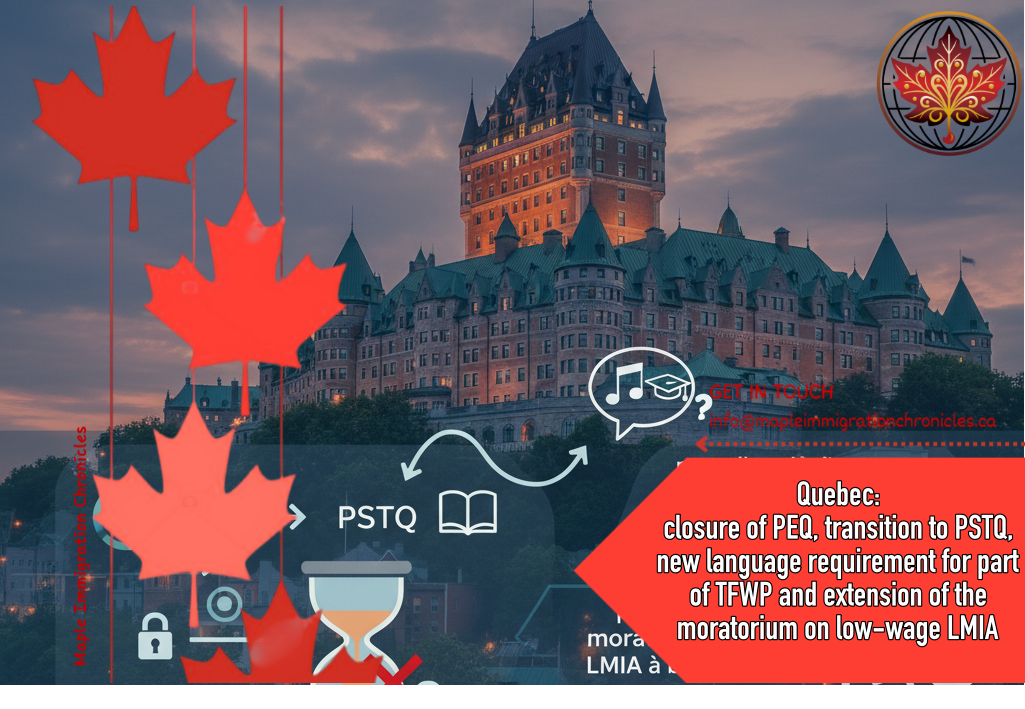
Quebec is simultaneously changing several key elements of its immigration architecture. First, the province is definitively closing the Quebec Experience Program (PEQ) for graduates and temporary foreign workers. Second, a mandatory requirement for oral French at level NCLC 4 appears for a separate category of TFWP permit applicants, with a transition period and clear exemptions. Third, the moratorium on the processing of low-wage LMIAs in Montreal and Laval has been extended, with detailed geographic and sectoral exemptions. In parallel, the Immigration Levels Plan has been updated, which sets targets for permanent and temporary streams. Below is an expanded explanation of each block with practical consequences and recommended actions.
Closure of PEQ and completion of pilot programs
1.1. What exactly is being closed and when
On November 6, the Government of Quebec announced the closure of PEQ—one of the most popular programs for transition to permanent residence. Both of its streams are ending: for graduates of Quebec educational institutions (Quebec Graduates) and for temporary foreign workers (Temporary Foreign Workers). The final date of closure of both streams is November 19, 2025. In practice, intake is already stopped: the streams have been on pause since October 31, 2024; initially reopening was planned for June 30, 2025, but the suspension was extended to November 30, 2025, after which full closure occurs.
This means that for new candidates PEQ as a submission tool is already unavailable and will not reopen. For those who managed to submit earlier, transitional provisions apply as set out below.
1.2. What happens to already submitted applications and to family members
All submitted applications for permanent selection under PEQ (both streams) and under the pilot programs continue to be processed by the Quebec Ministry of Immigration, Francisation and Integration (MIFI). This concerns full processing of the file up to a decision. Separately, MIFI will continue to accept and process applications to add family members—spouses and dependent children—for candidates who have already been selected under these programs. That is, the mechanism for “adding family” is not blocked by the closure.
1.3. Pilot programs: scheduled “finish” and remaining quotas
Three pilot programs end on January 1, 2026, as originally planned: for workers in food processing; for orderlies/caregivers; and for workers in artificial intelligence, information technology, and the visual effects industry. Within these pilots only the francophone profile of the artificial intelligence stream is still accepting new applications until December 31; for the rest of the streams the quotas have already been exhausted. In practice this means that the “window of opportunity” for new pilot applicants is almost closed, and for existing applicants the system continues “processing to decision” without opening new general intakes.
PSTQ as the only pathway for skilled workers
2.1. Instead of PEQ — “expression of interest → invitation” model
After the closure of PEQ, the main and only pathway for economic applicants becomes the Quebec Skilled Worker Selection Program (Programme de sélection des travailleurs qualifiés, PSTQ). The logic is as follows: the foreign national first submits an expression of interest in the Arrima system. Expressions form a “pool” from which the government periodically selects candidates according to points and priority criteria. Selected applicants receive an invitation to submit a full application for permanent selection.
2.2. Structure of PSTQ: four target streams
Within PSTQ four streams operate: highly skilled and specialized skills; intermediate and manual skills; regulated professions; and exceptional talent. They allow the government to manage labour market needs in a targeted manner, from shortages of narrow competencies to attracting specialists from licensed professions.
2.3. General requirements and restrictions on employment intentions
A candidate must be at least 18 years old, have the intention to settle and work in Quebec, be capable of performing the job, have financial self-sufficiency for the first three months after obtaining permanent resident status (for themselves and accompanying family), obtain the Attestation of Learning about Quebec Democratic Values for themselves and family members, fulfill any conditions of returning Quebec scholarship funds (if applicable), and also meet the criteria under which they were invited to submit the application.
There are substantial restrictions regarding “employment intentions”: work cannot be in a business that the candidate controls or owns; intentions to work in excluded sectors are not allowed, in particular in payday loans, cheque cashing, pawnbroking, or the adult entertainment industry. Some streams may contain additional conditions on top of the basic ones.
2.4. Practical conclusion
PSTQ is a competitive selection through Arrima. Therefore, preparing a high-quality expression of interest, understanding government priorities, and meeting stream requirements are critical. The closure of PEQ does not block the path to PR, but shifts it to a “ranking-invitation” model with greater selectivity.
Quebec Immigration Levels Plan: benchmarks for 2025–2026
On November 6, Quebec submitted an updated Immigration Levels Plan. For 2025 the target is 45,000 new permanent residents, with 64% of economic admissions expected to come from temporary residents who are already in the province. For the first time, separate target indicators have been set for temporary foreign workers and international students. For 2026, the government plans up to 55,700 foreign workers and up to 68,500 international students.
These benchmarks signal a priority for temporary residents integrated into the local environment when selecting for permanent residence and simultaneously — more explicit quota management of temporary streams. For candidates this means that having legal status and experience in Quebec may increase chances in economic selection, but overall selectivity and controlled intake will increase.
Mandatory oral French (NCLC 4) for part of TFWP
4.1. When and for whom the requirement applies
Starting December 17, 2025, foreign nationals who have accumulated three or more years of work experience in Quebec must meet the oral French requirement at NCLC 4 to be eligible for a work permit under the Temporary Foreign Worker Program (TFWP). This is directly linked to the ability to obtain the Quebec Acceptance Certificate (CAQ), which is a prerequisite for the subsequent TFWP work permit.
4.2. Transition period for those already in Quebec
For temporary foreign workers already in the province at the time the change is introduced, a three-year “grace period” applies — until December 17, 2028. During this period they may continue receiving CAQs for extending TFWP work permits without proof of French; however, the requirement must be met by the end of the grace period.
4.3. Who is exempt immediately
Exempt from the oral French requirement are agricultural workers; foreign nationals working in the office of a political organization of a foreign state; workers of international non-governmental organizations (INGO) recognized by the Government of Quebec.
4.4. TFWP context and distinction from IMP
TFWP is an instrument that allows employers to address labour shortages through hiring foreign workers. TFWP permits are employer-specific and require a positive or neutral Labour Market Impact Assessment (LMIA) and, for Quebec, a CAQ. In contrast, permits under the International Mobility Program (IMP) may be open or employer-specific and do not require an LMIA. Among open IMP permits are the Post-Graduation Work Permit (PGWP), Bridging Open Work Permit (BOWP), and Spousal Open Work Permit (SOWP).
4.5. Practical conclusion
If by December 17, 2025 you will reach three years of experience in Quebec and plan to continue working under TFWP, you need to plan in advance to confirm oral French at NCLC 4. If you are already in Quebec — use the transition period, but do not postpone language preparation.
Extension of the moratorium on low-wage LMIA in Montreal and Laval
5.1. Essence of the restriction and scope
Quebec has extended the moratorium on processing low-wage LMIAs in the Montreal and Laval regions until December 31, 2026. The ban covers all LMIA applications for jobs in these regions with pay below Quebec’s “low-wage” threshold — 34.62 CAD per hour (as of publication). The moratorium also covers applications under the Quebec facilitated LMIA process and applications for extending permits for temporary workers already working in Montreal and Laval.
Geographically this applies to the following municipalities: Baie-D’Urfé, Beaconsfield, Côte-Saint-Luc, Dollard-des-Ormeaux, Dorval, Hampstead, Kirkland, the city of Laval, Dorval Island, Montreal, East Montreal, Montreal West, Mount Royal, Pointe-Claire, Sainte-Anne-de-Bellevue, Senneville, Westmount.
5.2. General and sector-specific exemptions
The moratorium does not apply to jobs outside the administrative regions of Montreal and Laval; to jobs with wages not below the federal “high-wage” threshold; to TSS requests related to an already approved LMIA; or to LMIA applications submitted before September 3, 2024.
Separate exemptions are identified for selected sectors: agriculture, construction, food processing, education, health care and social services, home health workers (for medical needs and in some cases for child care). The full list of exempt occupations is provided on specialized Quebec government webpages.
5.3. National context
The Quebec moratorium aligns with federal measures to reduce the use of low-wage LMIAs in metropolitan areas with unemployment at 6% or higher. In other regions of Canada confirmed lists of metropolitan areas under the moratorium have been published until January 6, 2026; ESDC updates them quarterly depending on unemployment. Today in 32 metropolitan areas low-wage LMIAs cannot support work permits. The initial announcement of this federal initiative occurred on August 26, 2024 as part of a package of measures to reduce the number of temporary residents amid challenges with housing affordability and cost of living.
5.4. Practical conclusion
Employers in Montreal and Laval with vacancies below 34.62 CAD/hour will need alternative strategies: adjusting wages to “high-wage,” relocating the vacancy outside the mentioned regions, checking the possibility of qualifying under sector exemptions, or, where relevant, using IMP tools that do not require LMIAs.
Strategy of actions by profile
6.1. PR candidates in Quebec
Assess eligibility for PSTQ, prepare an expression of interest in Arrima, and consider the requirements for financial self-sufficiency and the Attestation of Learning about Quebec Democratic Values. The closure of PEQ does not block the path to PR, but increases competition in the invitation model.
6.2. Temporary workers under TFWP
If by December 17, 2025 you reach three years of experience in Quebec, plan to bring your oral French to NCLC 4. Those already in the province when the change takes effect have a “window” until December 17, 2028 to meet the requirement without losing the ability to extend permits.
6.3. Employers of Montreal and Laval
Check whether the position falls under exemptions; if necessary—change the compensation structure, geography, or use alternative programs that do not require an LMIA. For renewing permits of existing workers in low-wage positions within these regions, the same moratorium applies.
6.4. Applicants with submitted PEQ and pilot files
Wait for MIFI processing. The mechanism for adding family members remains open for those already selected under the mentioned programs.
Key dates and benchmarks
October 31, 2024: suspension of intake for PEQ streams.
June 30, 2025 → November 30, 2025: extended suspension of PEQ intake.
November 19, 2025: final closure of both PEQ streams.
December 17, 2025: start of the oral French NCLC 4 requirement for persons with 3+ years of work in Quebec who seek a CAQ/TFWP permit.
December 17, 2028: end of the three-year transition period for those already in Quebec at the time of the change.
December 31 (current intake): the francophone profile of the AI-stream pilot program is still accepting applications until this date; others are closed due to exhausted quotas.
January 1, 2026: scheduled end of the three pilot programs.
December 31, 2026: end of the extended moratorium on low-wage LMIAs in Montreal and Laval.
January 6, 2026: date until which other regions of Canada confirm the lists of metropolitan areas under the federal moratorium (ESDC updates quarterly).
2025: Quebec target — 45,000 PRs, 64% economic — from current temporary residents.
2026: up to 55,700 temporary foreign workers and up to 68,500 international students.
Questions and answers
Will my already submitted PEQ application be processed?
Yes. MIFI continues processing all already submitted applications under PEQ and the pilots.
Can I add a family member to a PEQ/pilot file?
Yes, MIFI accepts such applications for those who have already been selected.
Can I extend my TFWP work permit without French now?
If you are already in Quebec at the time the requirement is introduced, until December 17, 2028 a grace period applies for extending CAQs/permits without oral French. After that, NCLC 4 will be required.
What should an employer in Montreal or Laval do if the wage is below 34.62 CAD/hour?
Check exemptions, raise the wage to “high-wage,” move the position outside the moratorium regions, or explore the possibility of using IMP.
Are there still pathways to PR besides PEQ?
Yes, for skilled workers — PSTQ through Arrima with four streams and competitive selection.
Conclusion
Quebec is moving from the mass PEQ mechanism to the more selective PSTQ model with targeted selection through Arrima, simultaneously strengthening the role of French in TFWP and restricting the use of low-wage LMIAs in heavily burdened metropolitan areas. For candidates and employers this means the need for advance planning: preparing the language component, properly structuring the strategy for applying through PSTQ, and adjusting recruitment and compensation policies under the applicable moratoria and exemptions.