Can You Leave Canada While a Humanitarian Application Is Under Review?
The question of whether applicants under the Humanitarian and Compassionate (H&C) program are allowed to
Canada welcomes thousands of newcomers every year through a variety of immigration pathways, including economic programs, family sponsorship, humanitarian streams, and provincial nominee programs.
Each pathway is designed to meet the country’s economic, social, and cultural needs while offering individuals and families the opportunity to build a secure and prosperous future.
Understanding the main categories of immigration, eligibility criteria, and long-term benefits is the first step in deciding whether Canada is the right destination for you.
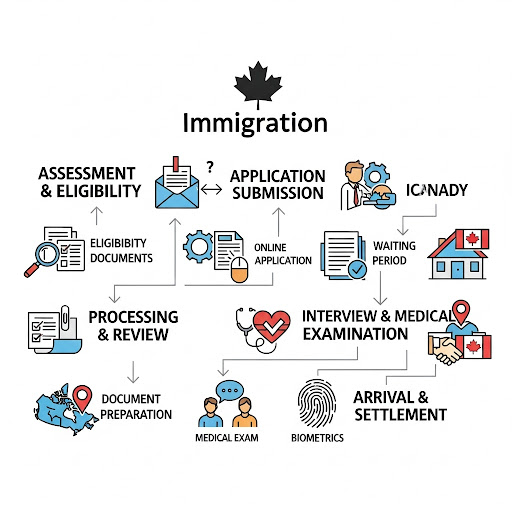
The Canadian immigration process involves several stages, from selecting the most suitable program to preparing and submitting a complete application.
Depending on your situation, this may include gathering personal documents, undergoing medical and security checks, proving language proficiency, and meeting specific program requirements.
Beginning your immigration journey to Canada starts with a clear plan. The first step is to assess your eligibility for different programs, taking into account your work experience, education, language skills, and personal goals. Once you know which pathway suits you best, you can gather required documents, prepare your application, and submit it to Immigration, Refugees and Citizenship Canada (IRCC).
With the right strategy and preparation, you can move from planning to action and start building your future in Canada.
Immigration to Canada is governed by the Immigration and Refugee Protection Act (IRPA) and the Immigration and Refugee Protection Regulations (IRPR). The government also updates the Immigration Levels Plan each year.
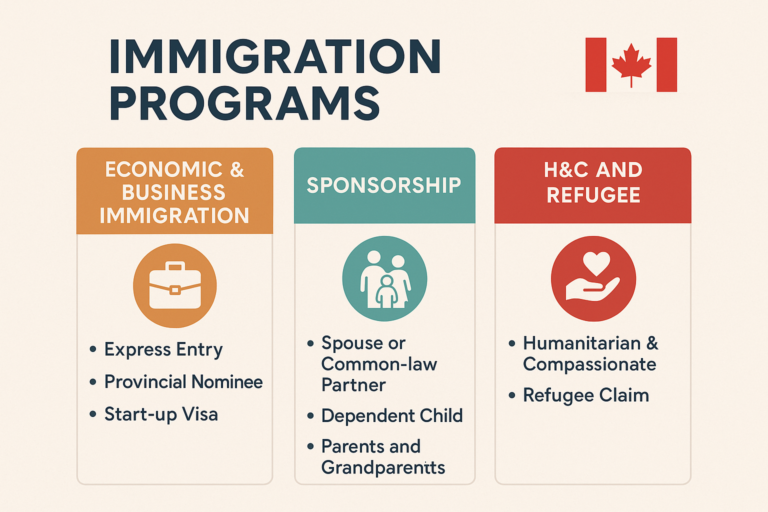
Canada admits immigrants under three main categories: Economic Class, Family Class, and Refugees and Protected Persons. The Economic Class includes all federal, provincial, regional, and business immigration programs. The Family Class allows Canadian citizens and permanent residents to sponsor spouses, common-law partners, children, adopted children, parents, and grandparents. Refugee programs provide protection to asylum seekers and persons in need of safety.
Economic immigrants make up about 60% of annual admissions, Family Class about 35%, and refugees and humanitarian cases around 5%.
Canada welcomes newcomers through three main immigration categories: the Economic Class, the Family Class, and the Refugee and Humanitarian Class.
The largest share of immigrants arrive under the economic class, primarily skilled workers who help sustain Canada’s high standard of living. With an aging population and a low birth rate, Canada relies on these individuals to strengthen its labour force and support long-term economic growth. Skilled immigrants typically bring strong language skills, valuable work experience, and recognized education, along with the determination to succeed. Their contributions are essential in bolstering Canada’s economy and sustaining vital social services such as universal healthcare and public education.
The second-largest category is family sponsorship, which enables Canadian citizens and permanent residents to reunite with close relatives. Canada recognizes that strong families are a cornerstone of a thriving society. By allowing loved ones to settle and build their lives in Canada, the country fosters emotional stability, cultural continuity, and economic resilience within communities.
Canada also upholds its global humanitarian commitments by offering refuge to those fleeing persecution, conflict, or hardship. Since the end of the Second World War, Canada has been a leader in providing safe haven to the most vulnerable. In recognition of this commitment, the United Nations awarded the people of Canada the prestigious Nansen Medal in 1986—its highest honour for exceptional service to refugees—making Canada the first and only country to receive it. This tradition of compassion continues to shape Canada’s role on the world stage.
Canada offers over 80 different immigration pathways. To keep it simple, we’ll outline the main categories of immigration.
Economic and business immigration pathways are designed for skilled professionals whose expertise contributes to Canada’s economic growth. Since each program has distinct eligibility criteria, no single description applies to all.
Categories under economic and business immigration include:
Provincial Nominee Programs (PNP)
Express Entry
Quebec Immigration
Investor Programs
Entrepreneur and Self-Employed Programs
Other federal streams, such as the Caregivers Program, Atlantic Immigration Program, Rural and Northern Immigration Pilot (RNIP), and Agri-Food Pilot.
Express Entry
Express Entry is Canada’s primary system for managing skilled worker applications under three programs:
Federal Skilled Worker Program (FSWP)
Canadian Experience Class (CEC)
Federal Skilled Trades Program (FSTP)
Eligible candidates create an online profile and receive a Comprehensive Ranking System (CRS) score based on factors like age, education, language ability, and work experience. The highest-ranked candidates are invited—about every two weeks—by Immigration, Refugees and Citizenship Canada (IRCC) to apply for permanent residence. Most applications are processed within six months, and Canada’s target is to welcome around 110,000 immigrants annually through Express Entry.
Provincial Nominee Program (PNP)
Through PNPs, provinces and territories (except Quebec and Nunavut) nominate individuals who wish to live and work in a specific province. Each PNP has its own criteria and selection process, often using Expression of Interest (EOI) systems similar to Express Entry.
Applicants can apply directly to a province through a base stream or via an enhanced stream linked to Express Entry. A provincial nomination from an enhanced stream grants an additional 600 CRS points, virtually guaranteeing an invitation to apply for permanent residence.
Quebec Immigration
Quebec operates its own immigration programs, separate from IRCC and PNPs. Selected candidates receive a Quebec Selection Certificate (CSQ) from the province’s immigration ministry.
Programs include:
Quebec Skilled Worker Program (QSWP)
Quebec Experience Program (PEQ), for graduates and workers with Quebec experience
Business immigration streams for entrepreneurs, self-employed individuals, and investors
Atlantic Immigration Program (AIP)
The AIP helps employers in the Atlantic provinces—New Brunswick, Newfoundland and Labrador, Nova Scotia, and Prince Edward Island—hire and retain foreign workers. No Labour Market Impact Assessment is required. Once a job offer is accepted, the employer connects the candidate to a settlement service provider, and a temporary work permit may be available for quick hiring.
Other Federal Skilled Worker Pathways
Targeted federal programs provide additional options for permanent residence, such as:
Rural and Northern Immigration Pilot (RNIP) – supports smaller communities in attracting workers.
Agri-Food Immigration Pilot – for experienced workers in the agriculture and agri-food sectors.
Home Child Care Provider Pilot and Home Support Worker Pilot – for caregivers with at least two years of relevant work experience.
Business Immigration
Entrepreneurs and investors can fast-track immigration through programs like the Federal Start-Up Visa or Federal Self-Employed Persons Program. Quebec also has its own business immigration options, and many PNPs offer dedicated entrepreneur streams.
Family sponsorship is one of the key pillars of Canada’s immigration system, enabling Canadian citizens and permanent residents to reunite with their loved ones and help them establish a life in Canada. This pathway recognizes the importance of strong family ties and the role they play in building stable, thriving communities.
Under this category, eligible sponsors can bring certain family members to Canada as permanent residents. The primary relationships that qualify for sponsorship include:
Spouse or common-law/conjugal partner – to support couples in building their lives together in Canada.
Dependent child – whether adopted or biological, ensuring that children can live with and be supported by their parents.
Parents and grandparents – allowing families to stay connected across generations and enabling older relatives to benefit from Canada’s healthcare and social support systems.
In special circumstances, when a sponsor has no other eligible relatives, they may also be able to sponsor extended family members outside the standard categories, such as:
An orphaned brother or sister
An orphaned nephew or niece
An orphaned grandchild
These exceptions are designed to provide a compassionate solution for situations where close family members have lost their parents and need a stable home environment.
Canada is widely recognized as a global leader in offering protection and resettlement to refugees and in granting permanent residence for humanitarian and compassionate (H&C) reasons. This commitment reflects both Canada’s international obligations and its long-standing tradition of providing safe haven to individuals fleeing persecution, violence, or other serious hardships.
Each year, a significant share of Canada’s annual immigration targets is reserved for refugees and those admitted under humanitarian programs. These pathways are designed to uphold Canada’s values of compassion, human rights, and fairness, ensuring that vulnerable individuals receive the opportunity to rebuild their lives in safety and dignity.
Refugee resettlement occurs through several channels, including:
Government-Assisted Refugees (GARs) – identified abroad and resettled in Canada with financial and settlement support from the federal government.
Privately Sponsored Refugees (PSRs) – supported by private groups or organizations who commit to providing financial and social assistance for at least the first year in Canada.
Blended Visa Office-Referred (BVOR) Refugees – supported through a cost-sharing arrangement between the government and private sponsors.
In addition to refugee resettlement, the Humanitarian and Compassionate (H&C) grounds process allows individuals already in Canada to apply for permanent residence when they do not otherwise meet standard immigration requirements, but can demonstrate compelling reasons for an exemption. This may include considerations such as the best interests of children, establishment in Canada, and the hardship they would face if required to leave.
Canada’s humanitarian and refugee programs not only fulfill legal and moral responsibilities under international law but also contribute to the country’s diversity, resilience, and social fabric by helping newcomers integrate and thrive in their new communities.
Understanding the steps involved in a Permanent Residency (PR) application and the broader Canadian immigration process is essential to ensuring a smooth, timely, and successful outcome. Each stage—from determining eligibility, selecting the most suitable program, and gathering the correct documentation, to submitting the application, responding to requests from Immigration, Refugees and Citizenship Canada (IRCC), and preparing for arrival—requires careful attention to detail and adherence to legal requirements. A clear grasp of these steps helps applicants avoid costly mistakes, delays, or refusals, while also enabling them to make informed decisions about timelines, supporting evidence, and program selection. Knowing the process in advance empowers individuals to plan strategically, manage expectations, and position themselves for success in achieving their goal of becoming a permanent resident of Canada.
Tracking your application status with Immigration, Refugees and Citizenship Canada (IRCC) is an important step for anyone planning to move to Canada. Below is a clear and simple guide to help you stay informed about the progress of your IRCC application.
1. Determine Your Eligibility
The first step in the Canadian immigration process is to assess your eligibility. Canada offers multiple immigration pathways, each with its own set of requirements. The most common include the Federal Skilled Worker Program (FSWP), the Provincial Nominee Program (PNP), and the Canadian Experience Class (CEC).
Eligibility is determined based on factors such as age, language proficiency, education, work experience, and financial capacity. You can verify your eligibility by completing an online self-assessment or consulting with a licensed immigration consultant for a professional evaluation.
2. Create an Online Profile
Once you have confirmed your eligibility, you must create an online profile through the Immigration, Refugees and Citizenship Canada (IRCC) website. Your profile will include essential personal details such as your name, address, contact information, and program selection.
3. Submit Your Application
With your profile in place, you can proceed to submit your full application. This involves providing supporting documents, which may include:
A valid passport
Educational credential assessments
Language test results (IELTS, CELPIP, or TEF)
Employment reference letters
You will also need to pay the applicable government processing fees, which vary depending on the chosen program. The IRCC website offers detailed checklists outlining the required documents and fee structure for each immigration pathway.
4. Wait for Processing
After submission, your application will be reviewed by IRCC. Processing times depend on the program type and the volume of applications received.
During this stage, IRCC may request additional documents or invite you for an interview. Respond promptly to avoid unnecessary delays.
5. Receive a Decision
Once processing is complete, IRCC will issue a decision:
If approved: You will receive a Confirmation of Permanent Residence (COPR) and, if applicable, a permanent resident visa.
If refused: You will be provided with an explanation outlining the reasons for refusal.
6. Arrive in Canada
If approved, you can make travel arrangements to Canada. Upon arrival, you must present your COPR, visa, and any additional documents requested by a border services officer.
At this stage, you will officially be granted permanent resident status. You should then apply for a Social Insurance Number (SIN), health insurance, and take the necessary steps to settle into your new community.
7. Maintain Your Permanent Residency Status
As a permanent resident, you must meet Canada’s residency obligations, comply with tax laws, and avoid criminal offenses. Maintaining your status is crucial for long-term settlement.
After fulfilling the residency requirements, you may be eligible to apply for Canadian citizenship.
Conclusion
Immigrating to Canada involves a detailed and structured process. By understanding each step—from eligibility assessment to maintaining your residency—you can improve your chances of a successful application. Preparing a complete and accurate application, staying responsive to IRCC requests, and following the outlined procedures will help you start your new life in Canada with confidence.
When you apply for immigration to Canada, there are several ways to monitor the progress of your application:
IRCC Online Account – The most direct option. By signing in to your secure IRCC account, you can view a summary of your application’s current status.
Application Status Tracker (AST) Tool – Offers more detailed updates for certain applications, including Express Entry, study permits, work permits, visitor visas, and family sponsorships. It provides a breakdown of each stage in your application process.
Global Case Management System (GCMS) Notes – For a more in-depth view, you can request GCMS notes. These reveal internal records, officer comments, and the steps taken on your file.
Client Application Status (CAS) Website – A separate portal for applications not covered by the AST tool, such as citizenship or some permanent residence applications.
What the AST Tool Provides
The AST tool allows you to track key elements of your application:
Overall Status – Indicates if your application is received, in progress, or closed.
Application Details – Monitors eligibility assessments, medical exams, background checks, and biometrics.
Document Status – Updates on important documents such as the Confirmation of Permanent Residence (COPR) or visa.
Contact Information and Next Steps – Shows if further action is required from you.
When You Can Begin Tracking
You can start using the AST tool after:
Submitting your application.
Receiving acknowledgment from IRCC that it has been accepted for processing.
Passing the completeness check.
Receiving your Acknowledgment of Receipt (AOR) with your application number.
Once you have the AOR, you can log in regularly to check updates.
Understanding Common Status Messages
Received – IRCC has your application and is reviewing it.
In Progress – Your file is actively being processed.
Closed – Your application has been approved, refused, or withdrawn.
Application Detail Statuses:
Not Started – No action yet on that stage.
Waiting on You – IRCC needs additional information or documents.
In Progress – The stage is currently being worked on.
Completed – The step is finished.
Exempted – This requirement does not apply to your case.
This streamlined approach helps you stay informed and better prepare for the next steps toward obtaining Canadian permanent residency or citizenship.
Your application status tracker account provides a centralized view of the progress of your immigration or visa application. In your account, you can see:
Overall application status
Detailed application sections and their review status
Application history
Your contact details
Status of submitted documents
Next steps (if applicable)
You will start seeing status updates only after you receive an Acknowledgement of Receipt (AOR) by letter or email.
The AOR is issued after IRCC receives your application and confirms it is complete.
Until you receive your AOR, you may only see limited information, such as the date IRCC received your application and your contact information.
Displayed at the top of your tracker, your overall status will show one of the following:
Received – IRCC has received your application and is checking if it is complete.
In progress – Your application is under review. You can also view progress for each section of the application.
Closed – Your application is finalized because it was:
Approved
Refused
Withdrawn or abandoned by you
Note: IRCC will contact you before closing your application.
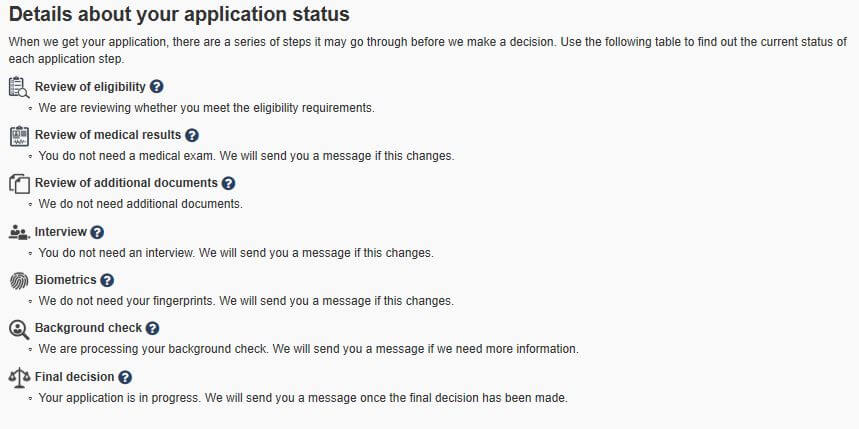
Your application will be reviewed across four key sections:
Eligibility – Verifies if you meet the program requirements.
Medical Exam – Assesses your health to ensure you are admissible to Canada.
Background Verification – Checks your admissibility, including security and criminal history.
Biometrics – Verifies your identity through fingerprints and a photo.
Each section can have one of the following statuses:
Not started – Review has not yet begun.
Waiting on you – IRCC requires additional information or documents.
In progress – Review is ongoing.
Completed – Review of this section is finished.
Exempted – This section does not apply to your application.
Here you can track the status of specific documents, which may include:
Medical exam results
Confirmation of Permanent Residence (COPR)
Visitor visa (Temporary Resident Visa)
Study permit
Work permit
The documents displayed will depend on the type of application you submitted.
This section outlines any actions IRCC requires from you. Examples include:
Submitting police certificates or passports
Paying outstanding fees
Providing biometrics
Tip: Check the “Your Next Steps” section regularly to ensure you respond promptly to any IRCC requests and avoid processing delays.
All applications are processed under the Immigration and Refugee Protection Act & ministerial instructions and go through the following stages:

An AOR is an automated confirmation from the Express Entry system that your application has been successfully submitted. Most applicants receive it instantly, though in some cases it can take up to 24 hours. Your application becomes “locked” as of the submission date. After this point, you generally only need to notify IRCC of changes in limited circumstances, such as:
A change in your country of residence (update via webform).
Loss of a job for which you claimed CRS points (important if IRCC later verifies your employment during the Eligibility Review stage).
The temporary UCI (starting with “CAN”) assigned at AOR is different from your permanent UCI and will change after your file passes the R10 Completeness Check. If you see a GCMS note like “Existing UCI eligibility showed as failed prior to promotion”, it usually means there was a UCI number conflict, later resolved by linking multiple IDs.
The completeness check is the first processing stage where the Central Intake Office (CIO) verifies that your application contains all required documents per the official checklist at the time of submission. If anything is missing without a valid explanation in your Letter of Explanation (LOE), your application may be returned with fees refunded. In some cases, officers may grant extra time to submit missing documents.
Applications can be refused even for small errors, so double-check your forms and uploads before submission. The six-month processing clock begins only once your application passes the completeness check.
This stage determines whether you meet the eligibility requirements for the program under which you applied. It is a two-step process:
A case analyst or program assistant reviews your documents and makes a recommendation.
An immigration officer makes the final decision, which can override the initial recommendation.
If further scrutiny is needed, the file may be flagged “Review Required”, transferred to another office, or trigger additional document requests, verification calls, or even an interview. Common “review required” triggers include:
Proof of funds verification
Employment reference letters
Work experience inconsistencies
Statutory questions answered “Yes”
“Pass candidate” in GCMS means your profile met the initial criteria, but eligibility is only officially passed when marked as such by an officer.
Medical results are usually assessed during the eligibility stage, about 1–1.5 months after AOR (longer for PNP cases). Medicals must be valid for at least six months at the time of final decision. IRCC may:
Extend validity (often by 6–12 months)
Request a new medical exam (“re-medical”)
Delays can occur if the results were not correctly linked to your file or if manual reassessment is needed. You can use a webform to inquire or request an extension.
IRCC may request extra documents at any time before approval, though most requests occur during the eligibility stage. If no request is made, your MyCIC account will show “We do not need additional documents.”
While rare in economic immigration, interviews may be required to clarify details or for quality assurance. MyCIC will show “You do not need an interview” unless that changes. In GCMS, “Recommend Interview” (analyst suggestion) is different from “Interview Required” (officer decision).
If you are between 14 and 79 years old, you must provide fingerprints and a photo (biometrics) for every permanent residence application, even if you have previously provided them and they are still valid. Biometrics must be completed before your application can be approved and before security checks (final stage) begin.
If you are already in Canada, biometrics are not required until IRCC specifically requests them. Once requested, you will receive a Biometrics Instruction Letter (BIL) through your MyCIC account. After you submit your biometrics, your account will be updated to reflect completion.
The background check ensures you are admissible to Canada. It includes criminality, information sharing, and security screening. Three federal bodies coordinate this process:
IRCC – makes the final decision.
CBSA – conducts screening and provides recommendations.
CSIS – assesses national security risks.
Delays at this stage are common, as IRCC must wait for all clearances before approving your application.
Criminality checks review police certificates (PCCs) from every country where you have lived for six months or more since age 18. While you generally do not need to submit additional PCCs after application, IRCC may request updated ones.
For inland applicants (CEC or others in Canada), an RCMP PCC may be required before criminality can pass. Submitting this with your initial application can shorten processing time. Criminality is often assessed early, around the R10 Completeness Check stage.
In MyCIC, a change from “In Progress” to “Not Applicable” often means criminality has passed. In GCMS notes, “Passed – Bio” indicates criminality was cleared using biometrics.
Information sharing checks for criminal history, human rights violations, and terrorism links through partner countries and agencies. This process supports:
Screening for inadmissibility
Preventing program abuse and fraud
Coordinating enforcement and security efforts
Combating international crimes and terrorism
If GCMS shows “Info Sharing: System Error”, it usually means either no records were found or there was a technical retrieval issue. Officers may proceed with processing if no concerns arise.
Security screening, handled primarily by CSIS and CBSA, ensures applicants are not involved in activities such as espionage, terrorism, war crimes, or organized crime.
CSIS provides “No Reportable Trace” reports if no concerns exist or prepares briefs if potential inadmissibility is found.
CBSA conducts its own screening for referred cases and issues recommendations to IRCC.
Security screening typically starts after eligibility is passed, except for PNP applicants where it may begin earlier. The only definitive way to confirm security screening status is through CBSA notes, as GCMS often leaves the “Security” field blank during processing.
Background check status often changes twice:
Initially after submission (for early criminality checks).
Again later, showing “We are processing your background check” until COPR is issued.
In GCMS:
“Not Started” or blank = still underway or already passed.
If blank and Section 15 of the Access to Information Act is cited, security screening has likely passed.
Once all stages (including security) are complete and clear, IRCC issues a Passport Request (PPR) for applicants outside Canada or the Confirmation of Permanent Residence (COPR) for those inside Canada.
COPR and visas cannot be issued beyond the expiry of your passport or medical results.
“RFV” (Ready for Visa) in GCMS means issuance is pending final checks; “Appears RFV” is an eligibility note, not final approval.
Applicants generally have 30 days to submit passports, with possible extensions upon request.
Typical Express Entry stages:
AOR (Acknowledgment of Receipt)
R10 Completeness Check
Medicals
Biometrics
Criminality Check
Information Sharing
Eligibility Review (A11.2)
Security Screening
Final Decision & COPR/PPR
Processing time: IRCC aims for 6 months for 80% of Express Entry cases, counted from the date your application passes the R10 Completeness Check.
1 to 1.5 months after AOR – Most applicants move through the Completeness Check (R10), Medical Examination Pass (MEP), and Biometrics Instruction Letter (BIL) stages.
+ 1 month – Eligibility Review Stage 1, conducted by a case analyst or program assistant.
+ 1.5 to 3 months – Eligibility Review Stage 2, performed by an immigration officer who makes the final determination.
By 4–5 months post-AOR – Eligibility Review (both Stage 1 and Stage 2) is usually completed for most applications.
2–3 months after Eligibility Review Passed – If no final decision has been issued, the application is likely in security screening.
Standard security checks are often completed within 1 month.
Enhanced security screening can take much longer—anywhere from several months to 1–2 years.
If it has been more than 2 months since eligibility was passed and security has not concluded, enhanced screening is a strong possibility.
In cases of excessive delays, applicants may consider a writ of mandamus application to prompt a decision.
⚠️ The IP1 → NA1 → NA2 → IP2 status progression (used in online forums) has been irrelevant since 2017 and no longer indicates specific stages of processing.
Starting your Permanent Residency (PR) application is a pivotal step toward building your future in Canada, and knowing the exact path ahead is crucial for success. Understanding eligibility criteria, required documents, timelines, and potential challenges allows you to prepare a complete and accurate submission, reducing the risk of costly mistakes or delays.
Proper preparation not only streamlines the process but also positions you to respond quickly to IRCC requests, navigate program changes, and secure your place in Canada with confidence.
IRCC main site: programs, forms, news, special measures — https://www.canada.ca/en/immigration-refugees-citizenship.html
Help Centre: FAQs on extending status, fees, biometrics — https://www.cic.gc.ca/english/helpcentre/index.asp
Check application status: https://www.canada.ca/en/immigration-refugees-citizenship/services/application/check-status.html
Processing times: https://www.canada.ca/en/immigration-refugees-citizenship/services/application/check-processing-times.html
Contact IRCC: web form, phone, offices — https://www.cic.gc.ca/english/contacts/index.asp
Program Delivery Instructions / Manuals (IRCC): https://www.canada.ca/en/immigration-refugees-citizenship/corporate/publications-manuals/operational-bulletins-manuals.html
IRPA (current consolidated): https://laws-lois.justice.gc.ca/eng/acts/I-2.5/
CanLII (free case law & statutes): https://www.canlii.org/en/
NOC 2021 (TEER) search: https://noc.esdc.gc.ca/
Job Bank (official): https://www.jobbank.gc.ca/home
PNP overview (IRCC): https://www.canada.ca/en/immigration-refugees-citizenship/services/immigrate-canada/provincial-nominees.html
Example portal — BC PNP: https://www.welcomebc.ca/Immigrate-to-B-C
Claim refugee protection in Canada (IRCC): https://www.canada.ca/en/immigration-refugees-citizenship/services/refugees/claim-protection-inside-canada.html
Immigration and Refugee Board (IRB): https://irb-cisr.gc.ca/en/Pages/index.aspx
Find free newcomer services near you: https://ircc.canada.ca/english/newcomers/services/index.asp
Settling in Canada hub (IRCC): https://www.canada.ca/en/immigration-refugees-citizenship/services/new-immigrants.html
Protect yourself from immigration fraud (IRCC): https://www.canada.ca/en/immigration-refugees-citizenship/services/protect-fraud.html
How to choose/verify a representative (IRCC): https://www.canada.ca/en/immigration-refugees-citizenship/services/representative/choose.html
CICC Public Register (consultants): https://college-ic.ca/protecting-the-public/find-an-immigration-consultant
If you are a skilled worker, several immigration pathways may be well-suited to your profile:
Federal Skilled Worker Program (FSWP) via Express Entry
Canadian Experience Class (CEC) via Express Entry
Provincial Nominee Program (PNP)
Quebec Skilled Worker Program (for those intending to settle in Quebec)
Federal Skilled Trades Program (FSTP) via Express Entry (for individuals in specialized trades)
Atlantic Immigration Program
Other targeted federal immigration programs
Canada places strong value on your education and professional experience, both of which are important eligibility factors for many immigration streams. In programs that use a points-based system, higher levels of education—such as a Master’s degree or PhD—can earn you additional points.
Similarly, having at least one year of skilled work experience increases your likelihood of successfully integrating into the Canadian labour market. Many programs award extra points for greater work experience, further strengthening your application.
Permanent residents (PRs) of Canada are required to carry and present a valid PR card or Permanent Resident Travel Document (PRTD) when boarding a flight or traveling to Canada on any other commercial carrier. Without one of these documents, you may be refused boarding on your flight, train, bus, or boat to Canada.
It is your responsibility to ensure your PR card is valid before returning to Canada from abroad. If your PR card is expired, you must apply for a new one—but note that an expired PR card does not mean you have lost your permanent resident status.
A permanent resident is someone who has been granted PR status through immigration to Canada but is not a Canadian citizen. Most PRs are citizens of another country, while some may be stateless.
Refugees resettled from overseas become PRs through the Government-Assisted Refugee Program or the Private Sponsorship of Refugees Program.
Refugee claimants inside Canada do not become PRs immediately; their claim must first be approved by the Immigration and Refugee Board, after which they can apply for PR status.
Temporary residents—such as students or foreign workers—are not permanent residents.
The PR card is official proof of your PR status in Canada. If traveling outside Canada and returning by commercial transport, you must present:
Your valid PR card, and
Your passport or refugee travel document.
If you are outside Canada and do not have a valid PR card, you must apply for a Permanent Resident Travel Document (PRTD) before returning.
If your PR card is lost, stolen, or damaged, you should apply for a replacement.
Tip: To protect your privacy, destroy an expired PR card by cutting it in half before disposal.
As a permanent resident, you:
Are entitled to most social benefits Canadian citizens receive, including a Social Insurance Number (SIN) and provincial health coverage.
Can live, work, or study anywhere in Canada.
Can apply for Canadian citizenship when eligible.
Are protected under Canadian law and the Canadian Charter of Rights and Freedoms.
Must pay taxes and comply with Canadian laws at the federal, provincial, and municipal levels.
As a PR, you cannot:
Vote or run for political office.
Hold certain jobs that require a high-level security clearance.
To retain PR status, you must be physically present in Canada for at least 730 days (two years) within the last five years. These days do not have to be consecutive. In some cases, time spent outside Canada can count toward your residency obligation—for example, if you are traveling with a Canadian citizen spouse or working for a Canadian business abroad.
You do not lose PR status when your PR card expires. Loss of PR status occurs only if:
An immigration officer determines you no longer meet the requirements, following an inquiry or an unsuccessful PRTD appeal.
You voluntarily renounce your PR status.
A removal order against you comes into effect.
You become a Canadian citizen.
If you do not meet the residency obligation, you remain a PR until an official decision is made.
You may choose to give up your PR status voluntarily, for example:
If you have been outside Canada for an extended period and no longer meet the residency requirement.
If you want to visit Canada but avoid delays caused by a formal PR status review upon entry.
In these cases, you might need to either apply for a PRTD or complete the process to renounce your PR status before traveling.
The question of whether applicants under the Humanitarian and Compassionate (H&C) program are allowed to
The recent update of IRCC’s online tool for tracking processing times has drastically changed the
Immigration, Refugees and Citizenship Canada (IRCC) has released updated plans for 2025 regarding the processing
On the basis of summarized statistics for January–April 2025 we see essential difference between programs
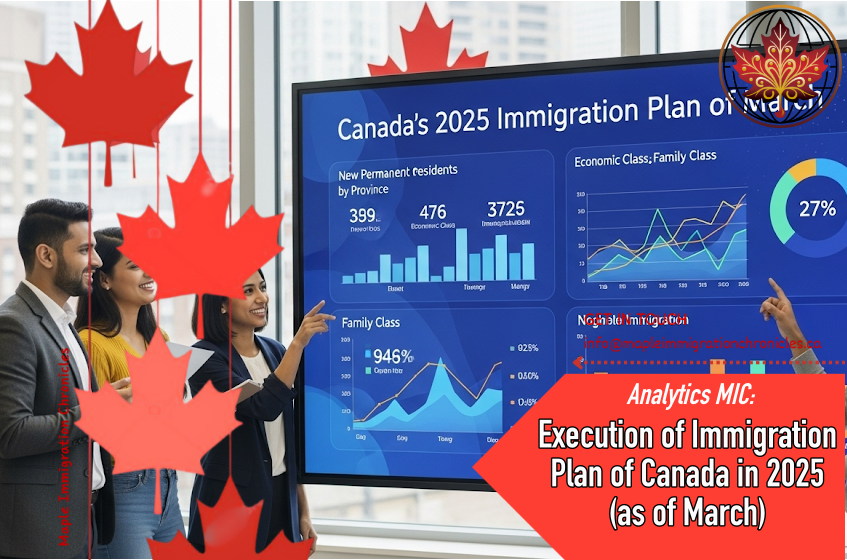
Canada in 2025 year set ambitious goal: to grant 395,000 permits for permanent residence (PR).This
The issue of application processing times is always in the center of attention of applicants,
The Express Entry system is one of the main mechanisms for obtaining permanent resident status
The Skilled Worker Stream of Manitoba is one of the most stable instruments for obtaining
There is a widespread myth that after reaching 40 years old, obtaining permanent residence in
In Humanitarian and Compassionate (H&C) cases, receiving the Acknowledgement of Receipt (AOR) means that your
On July 29, 2025, the Government of Canada, through Immigration, Refugees and Citizenship Canada (IRCC),
Importance of Language Proficiency for Immigration Proficiency in English is one of the fundamental eligibility
In the first half of 2025 Canada recorded a significant reduction of new arrivals of
Analysis developed on the basis of data from ATIP (Access to Information and Privacy request,
The Canadian Express Entry system, introduced back in 2015 as an innovative tool for selecting
For any inquiries or assistance, feel free to reach out to us via email at [email protected]. We aim to respond within 24 hours.
You can contact us directly at +1 (647) 464-4526. Our team is available to assist you from Monday to Friday, 9 AM to 6 PM EST.
We welcome you to visit our office located at 295-297 Cosburn Ave., Toronto, Canada, M4J 2M5. Please call ahead to schedule an appointment.
© 2023 – 2025 Maple Immigration Chronicles. All rights reserved.