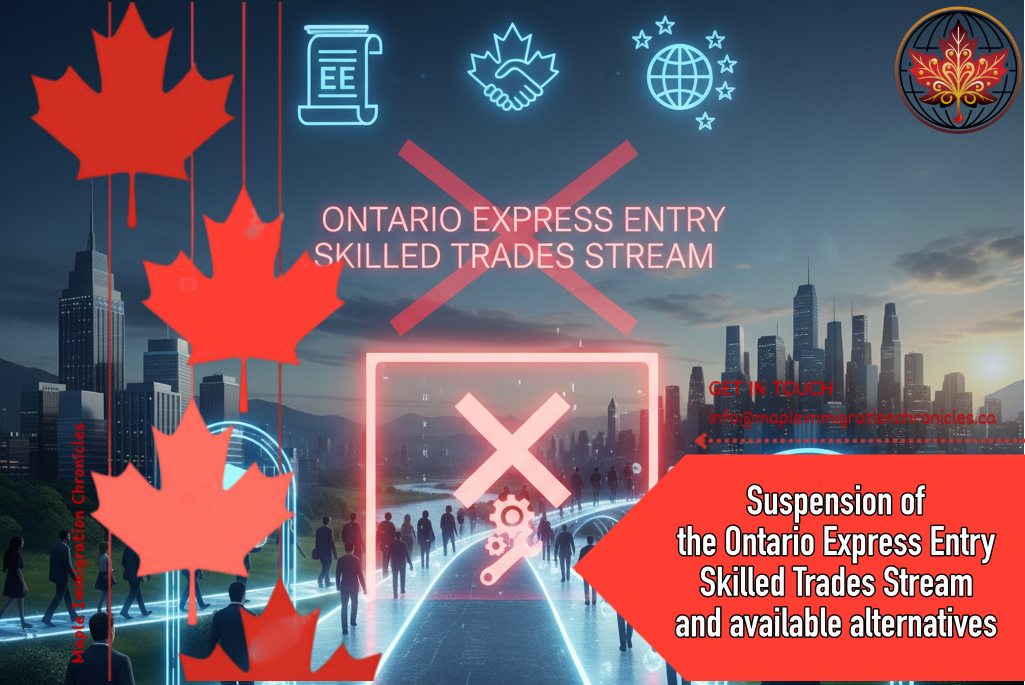
The Province of Ontario has announced the immediate and complete suspension of the Express Entry: Skilled Trades Stream, which operated within the provincial immigration program, the Ontario Immigrant Nominee Program (OINP). This decision was unexpected for applicants, as the stream traditionally was one of the most accessible pathways to obtaining a provincial nomination for representatives of construction, industrial, and technical occupations.
The suspension has a significant impact both on those who have already submitted an application and on candidates who planned to use this pathway in the near future. Considering the importance of provincial nominations for increasing CRS scores in the Express Entry system, applicants are facing the need to redirect to alternative pathways. This material sets out in detail the legally justified reasons for the suspension, the administrative consequences for all parties involved in the process, and the possible immigration pathways that remain available.
The essence of the announcement and immediate consequences
The decision of the Ministry of Labour, Immigration, Training and Skills Development of Ontario provides for a complete halt of processing applications under the Express Entry Skilled Trades Stream due to confirmed cases of submitting false, incomplete, or inaccurate information. This refers to systemic violations that could have called into question the reliability of a significant portion of applications.
After the decision was made public, all operational processes within the stream were immediately stopped. The practical consequences include several key points. New applications under this stream are no longer accepted, even if candidates already had an Express Entry profile. All applications that were at any stage of consideration are subject to return to applicants without the possibility of reinstatement or accelerated resubmission. Fees paid by applicants for the processing of applications must be refunded according to the established procedure, since the termination of processing was initiated by the provincial authority and not by the applicant.
Applicants whose applications have been returned will not be able to continue the pathway to provincial nomination specifically within this stream and must look for other immigration instruments. At the time of the announcement, OINP did not indicate any forecasts regarding the resumption of the stream’s operation, which makes its status uncertain for an indefinite period.
Reasons for the suspension of the Skilled Trades Stream
According to information from OINP, the decision to suspend the stream is the result of a comprehensive internal audit of the program. The review found that the Skilled Trades Stream had become vulnerable to systemic abuses by certain applicants and intermediaries. The most common violations were incorrect declaration of work experience, manipulation of employment status, document falsification, and inconsistency of actual job duties with those required by the stream’s criteria.
The analysis also revealed certain ambiguity in the program criteria, which complicated qualitative and consistent decision-making by officers. Due to the excessively broad wording of the requirements, the risks of incorrectly assessing candidates’ eligibility increased, which contradicted the principles of integrity and transparency of OINP.
A significant additional factor was the considerable reduction of the federal nomination quota for Ontario for 2025. Given the limited capacity to issue nominations, the province was forced to reallocate resources to those categories of candidates who can clearly demonstrate alignment with labour market needs and ensure maximum economic impact. Taken together, these factors made further functioning of the stream impossible without substantial reform.
Alternative pathways to obtaining permanent residence for candidates who planned to use the Skilled Trades Stream
Despite the suspension of the Skilled Trades Stream, candidates may still be eligible to obtain permanent residence through other available channels. The main alternatives include participation in Express Entry category-based draws, in particular the Trade Category, which is especially relevant for representatives of skilled trades. Such draws are conducted at the federal level and do not depend on provincial quotas.
A second full-fledged alternative is submitting to other available OINP streams, both those aligned with the Express Entry system (enhanced streams) and those independent of it (base streams). Different streams are designed for various categories of candidates, including those who have Canadian education, work experience, French-language proficiency, or employer support in Ontario.
Express Entry: Trade Category as the most convenient alternative
The category-based draws in the Trade Category within the Express Entry system are one of the most functional pathways for those candidates who initially focused on the Skilled Trades Stream. Since applying to this stream required having an active Express Entry profile, a significant portion of candidates already meet the basic criteria for participation in category-based rounds.
One of the key advantages of the Trade Category is the lower CRS cutoff compared to other rounds of invitations. The most recent round for trade occupations at the time of publication had a CRS cutoff of 505, whereas within the Canadian Experience Class the most recent cutoff was 533. This difference demonstrates a real opportunity to receive an ITA for applicants with a lower CRS score.
The eligibility criteria are also more predictable and focused on key professional experience. A candidate must have at least six months of verified work experience in a relevant occupation within the last three years. The experience may be either full-time or part-time, if the total number of hours meets the requirements. In addition, the candidate must meet the requirements of at least one of the following programs: Canadian Experience Class, Federal Skilled Worker Program, or Federal Skilled Trades Program.
Alternative OINP streams
After the suspension of the Skilled Trades Stream, OINP officially confirmed that applicants with returned applications may apply to other streams provided they meet the requirements. The provincial program contains several streams targeting different categories of candidates.
5.1. Enhanced streams (aligned with Express Entry)
Enhanced streams operate in direct integration with the federal Express Entry system, which means automatic searching of candidates in the pool and sending them Notifications of Interest (NOI). Such streams include the Human Capital Priorities Stream, which targets highly skilled professionals, and the French-Speaking Skilled Worker Stream, aimed at candidates with a high level of French proficiency. Both pathways are particularly valuable because they provide 600 CRS points after nomination, which practically guarantees receiving an ITA in the next round.
5.2. Base streams (not connected to Express Entry)
These streams exist outside the Express Entry system and therefore have their own selection criteria and separate submission stages. To participate, candidates must create a profile in the OINP Expression of Interest (EOI) system. Such pathways include the Employer Job Offer: Foreign Worker Stream, which requires a valid job offer from an Ontario employer; the Employer Job Offer: International Student Stream, intended for graduates of Canadian educational institutions; the Employer Job Offer: In-Demand Skills Stream, aimed at low- and medium-skilled occupations in demand on the labour market; as well as the Master’s Graduate Stream and the PhD Graduate Stream, which allow graduates of Ontario universities to obtain PR without an employer.
These alternative pathways are particularly relevant for those candidates who already have employer support or have completed studies in Ontario.
The importance of proper consultation
Given the abrupt suspension of the Skilled Trades Stream and the increased standards regarding verification of data accuracy, candidates should pay attention to a systematic analysis of their options. It is recommended to evaluate one’s profile for compliance with the requirements of alternative streams and determine the most realistic pathways for application.
Of particular importance is analyzing the possibility of transitioning to category-based Express Entry rounds, where eligibility for CEC, FSW, or FST programs plays a key role. Within OINP, candidates should thoroughly familiarize themselves with the criteria of each stream and the rules for inviting candidates through the EOI system.
Under conditions of strengthened control over document authenticity and expanded checks, any inaccuracies or gaps in the submitted data should be avoided, as this may lead to refusal not only at the nomination stage but also during IRCC verification after receiving an ITA. Professional consultation helps minimize such risks and ensures a proper level of document preparation.
Conclusion
The suspension of the Skilled Trades Stream is a justified and foreseeable response by the Province of Ontario to systemic violations, ambiguity of program criteria, and the limited nomination quota for 2025. Despite temporary difficulties, applicants have access to several alternative pathways, including category-based Express Entry draws for trade occupations and other OINP streams, both integrated with Express Entry and independent of it.
Timely analysis of one’s profile, choosing the most appropriate stream, and high-quality document preparation will allow applicants to maintain real chances of obtaining permanent residence in Canada.