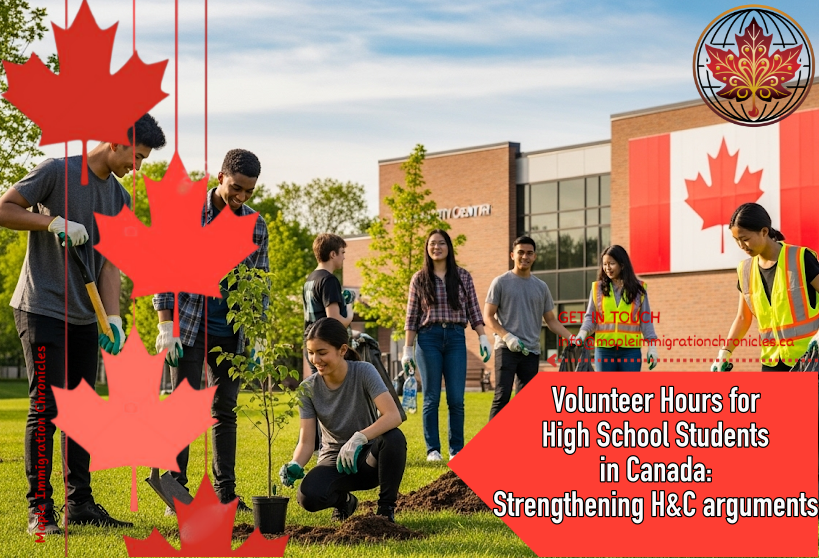
In Canada, volunteer activity is an important component of secondary education. It not only contributes to the formation of responsible and active citizens, but also opens for students opportunities for the development of practical skills, social contacts, and even future career prospects. In a number of provinces, the completion of a defined number of hours of volunteer work is a mandatory condition for obtaining a high school diploma. However, the significance of this experience goes far beyond school: volunteerism forms a positive image of the student in the eyes of universities, employers, and can become a substantial argument in immigration processes, in particular when submitting applications on Humanitarian and Compassionate grounds (H&C).
Requirements in Different Regions of Canada
Province / Territory | Requirements |
Ontario | 40 hours of mandatory volunteer activity |
British Columbia | 30 hours; it is allowed to count paid work experience |
Yukon | Uses the curriculum of British Columbia (30 hours) |
Newfoundland and Labrador | 30 hours |
Northwest Territories | 25 hours |
Nunavut | Mandatory Grade 11 course with practice in the community |
Prince Edward Island | Scholarship $5 per hour (30–100 hours of volunteering) |
Manitoba and Nova Scotia | Elective courses with credit for community work |
New Brunswick | Elective physical education course (30 hours of volunteering) |
Certain educational programs, in particular the International Baccalaureate (IB), also include mandatory elements of volunteerism.
Why This Is Important for Students
Volunteering in school has a multidimensional effect:
- Social integration. Students interact with the community and different groups of people, forming stable connections.
- Professional orientation. Teenagers can try themselves in the spheres of healthcare, education, sports, or arts, which helps in career choice.
- Development of skills. Time management, responsibility, organizational and leadership qualities are formed in the process of volunteerism.
- Academic perspectives. Many universities positively perceive applicants with volunteer experience, considering it a sign of maturity and activity.
- Formation of civic consciousness. Students realize their own role in society and learn to take part in its development.
Examples of Volunteer Activity
Volunteer hours can be credited through the most diverse forms of activity:
- School projects: art performances, sports teams, student committees, mentoring.
- Religious communities: assistance in Sunday schools, musical service, participation in parish committees.
- Social actions: charity marathons, fundraising, organization of fairs.
- Environmental initiatives: territory clean-ups, tree planting, recycling programs.
- Medical institutions: help in hospitals, hospices, Canadian Blood Services.
- Community events: festivals, parades, summer fairs.
- Social support: assistance to elderly people, support of children in learning, animal care.
Volunteering During the Pandemic
COVID-19 expanded the understanding of volunteerism: students joined online initiatives — from writing letters to elderly people and sewing masks to online tutoring. This proved that volunteering can take different forms and adapt to circumstances.
Where to Find Opportunities
Students can use resources:
- Charity Village
- Spark Ontario
- YMCA
- Volunteer Canada
As well as turn to local organizations and community centres.
How This Can Help in Immigration (H&C Applications)
Volunteerism is a significant factor in immigration processes. When considering applications on Humanitarian and Compassionate grounds (H&C), IRCC officers pay attention to the level of integration of applicants into Canadian society.
- Proof of integration. If children take part in community activity, this testifies to their successful adaptation.
- Social connections. Volunteerism creates a support network in the community, which can be confirmed by letters from organizations.
- Good faith and contribution. Families that actively engage in social life demonstrate readiness to contribute to the development of Canada.
- Impact on children. Evidence of children’s participation in volunteering underlines their development, moral values, and benefit from being in Canada.
Practical Examples
In a number of positive H&C decisions, courts and IRCC officers considered:
- participation of children in school and extracurricular volunteer programs as proof of their best interest to remain in Canada;
- support letters from community organizations confirming that the family actively helps in community projects;
- cases where children’s volunteer activity was regarded as an indicator of a high level of integration, even despite the absence of significant financial or professional achievements of the parents.
Thus, even the minimal mandatory school requirement can turn into a serious argument in an immigration case.
Conclusion
Volunteer hours in Canadian schools are a powerful instrument of personal development, the formation of civic activity, and support for the community. They give students the opportunity to gain practical experience, open new professional horizons, and lay the foundation for a successful future. For families who plan immigration or submit applications on humanitarian grounds, children’s volunteerism becomes additional confirmation of integration and positive contribution to the life of Canada.